

The day you buy a new vehicle, selling it is probably the last thing on your mind.
You're learning the touchscreen.Adjusting the seat.
Connecting your phone.
Admiring it through the window every time you walk past your house.
You're definitely not thinking:
"I wonder what this will be worth six years from now."
But maybe you should be.
Your vehicle is one of the largest purchases you'll make, and eventually there's a good chance you'll sell it or trade it toward something else.
How much value remains at that point isn't entirely outside your control.
Mileage matters.
Market conditions matter.
The vehicle itself matters.
But how you own it matters, too.
At Conley Buick GMC in Bradenton, Florida, customers can shop new and pre-owned vehicles, maintain them through our service department and eventually use our online trade-in tools or in-person appraisal process when they're ready for something different.
So what can you do between buying and selling?
Quite a bit.
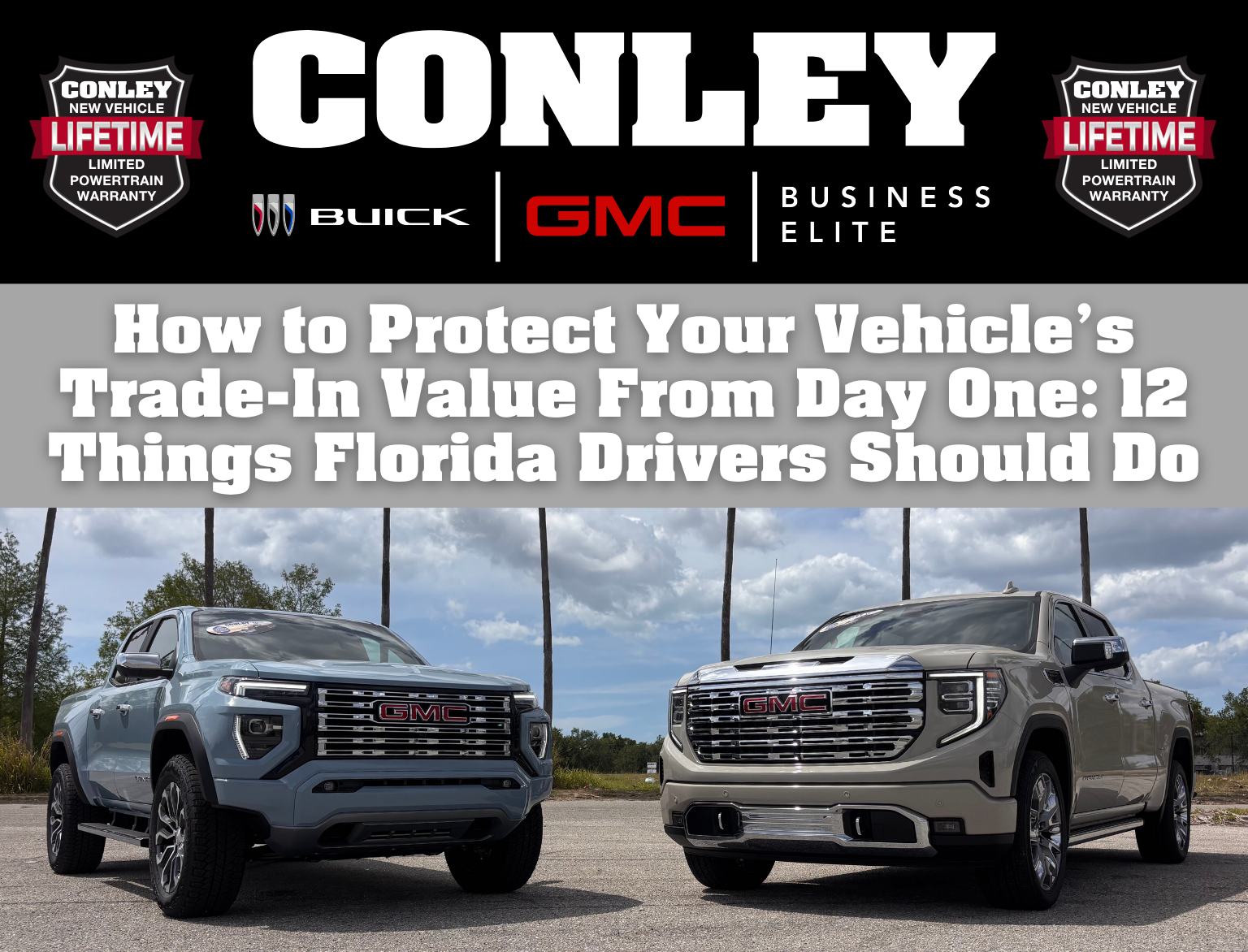
Here are 12 ways to help protect your vehicle's trade-in value from day one.
1. Keep Your Maintenance Records
Let's start with something incredibly simple.Keep records.
When your vehicle is serviced, maintain documentation showing what was done and when.
That could include:
- Oil changes
- Tire rotations
- Brake service
- Battery replacement
- Fluid services
- Alignments
- Warranty repairs
- Major mechanical repairs
- Replacement parts
- Recommended scheduled maintenance
Because there's a big difference between saying:
"I always maintained it."
and being able to show it.
A documented maintenance history can give a future buyer or appraiser a clearer picture of how the vehicle was cared for.
This becomes increasingly important as mileage accumulates.
A 70,000-mile vehicle with consistent maintenance records tells a different story than a 70,000-mile vehicle with an unknown history.
2. Don't Skip Maintenance Because "Nothing Is Wrong"
This is one of the easiest traps in vehicle ownership.The vehicle starts.
No warning lights.
No weird noises.
Air conditioning works.
Everything seems fine.
So maintenance gets delayed.
The problem is that preventive maintenance exists specifically to address things before something feels wrong.
Oil changes are an obvious example, but maintenance can also include inspections, tire care, brakes, batteries, fluids and other manufacturer-recommended services.
Conley Buick GMC currently operates a full-service center in Bradenton for routine maintenance and more involved repairs, along with a parts department supporting Buick and GMC owners.
Keeping up with those needs isn't simply about avoiding a breakdown.
You're helping preserve the condition of the vehicle you're eventually going to sell.
3. Mileage Matters, But Don't Become Obsessed With It
Yes, mileage influences vehicle value.No, that doesn't mean you should be afraid to drive your vehicle.
You bought it to use it.
Take the road trip.
Go to the beach.
Drive to Orlando.
Visit family.
Tow the boat.
Use your truck like a truck.
The goal isn't to preserve your vehicle like a museum exhibit.
Instead, understand that mileage becomes one factor in the overall value equation.
If you're deciding between taking your vehicle or unnecessarily adding thousands of miles when another transportation option makes more sense, mileage can be worth considering.
But enjoying your vehicle has value, too.
There's little point buying a beautiful new GMC Yukon and refusing to take it anywhere because you're worried about the odometer.
4. Florida Sun Is Hard on Vehicles
If you've lived in Florida long enough, you already know what sunlight can do.Paint.
Plastic.
Rubber.
Interior surfaces.
Leather.
Headlights.
Trim.
Florida gives vehicles plenty of exposure to heat and UV radiation.
Whenever practical, covered parking can help reduce constant exposure.
That doesn't mean everyone needs a climate-controlled garage.
Many people don't have one.
But you can still take reasonable steps.
Regular washing and appropriate paint protection can help maintain the exterior.
Interior protectants designed for automotive materials can help.
Windshield sunshades can reduce direct sunlight entering the cabin while parked.
Tinting, where legal and properly installed, can also make a difference in everyday comfort.
A vehicle spends a lot more time parked than most people realize.
Where and how it's parked becomes part of its ownership story.
5. Wash Off More Than Just Dirt
A vehicle doesn't only collect dirt.Florida exposes vehicles to:
Salt.
Sand.
Bugs.
Bird droppings.
Tree sap.
Pollen.
Road grime.
Mud.
Hard-water spots.
And whatever mysterious substance appears on your hood immediately after you finish washing it.
Some contaminants are more than cosmetic.
Leaving certain substances on paint for extended periods can make them harder to remove and potentially affect the finish.
Regular washing isn't purely about having a shiny vehicle.
It's part of exterior maintenance.
If you spend time around beaches, boat ramps or coastal environments, paying attention to the exterior and underbody becomes even more sensible.
6. Fix Small Damage Before It Becomes Big Damage
There's a tiny chip in the windshield.A small scratch on the bumper.
One little door ding.
A minor tear beginning on the driver's seat.
It's easy to say:
"I'll deal with that later."
Then three years pass.
Small problems sometimes stay small.
Sometimes they don't.
A windshield chip can spread.
A small upholstery tear can grow.
Paint damage can become more noticeable.
Minor issues accumulate until the vehicle begins to look significantly more worn than its age suggests.
You don't have to repair every microscopic imperfection immediately.
Vehicles live in the real world.
But periodically walking around the vehicle and addressing reasonable problems can help prevent a long list of little issues from becoming one big first impression.
7. Take Care of the Interior
People sometimes obsess over the paint and forget where the next owner is actually going to sit.The interior matters.
A lot.
Think about what an appraiser sees when the driver's door opens.
Seat condition.
Carpet.
Dashboard.
Steering wheel.
Door panels.
Headliner.
Odors.
Stains.
Pet hair.
Wear.
Missing trim.
You don't need to ban food from your vehicle or force everyone to wear white gloves.
But basic care goes a long way.
Use floor mats.
Clean spills quickly.
Vacuum periodically.
Condition appropriate materials.
Don't let trash accumulate.
And if something breaks, consider fixing it rather than allowing several small interior problems to pile up.
8. Be Careful With Permanent Modifications
Customization is personal.That's what makes it fun.
But personalization and resale value don't always point in the same direction.
Suppose you install something you absolutely love.
That's great while you own the vehicle.
But the future buyer needs to love it, too.
Certain modifications may have broad appeal.
Others significantly narrow the audience.
This is particularly relevant with trucks.
A GMC Sierra 1500 can be customized in countless ways.
Wheels.
Tires.
Suspension.
Exterior trim.
Lighting.
Bed accessories.
Appearance packages.
The important thing is to think about quality.
Professionally installed, tasteful modifications are very different from poorly executed permanent alterations.
And whenever you modify a vehicle, keep any original components that might be useful later.
Sometimes returning a vehicle closer to its original configuration before selling can broaden its appeal.
9. Don't Forget About Your Wheels
Curb rash.We've all seen it.
You hear the noise.
You immediately know what happened.
And you spend the next five seconds pretending maybe it wasn't your wheel.
Wheels have an enormous impact on how a vehicle presents itself.
A beautiful SUV with four heavily damaged wheels can instantly look neglected.
Take extra care when parking near curbs.
Maintain proper tire pressure.
Rotate tires as recommended.
Address alignment issues.
And occasionally inspect both the tires and wheels for damage.
This is especially important on premium trims where larger or distinctive wheel designs are a significant part of the vehicle's appearance.
10. Tires Tell a Story
Imagine two otherwise identical used vehicles.One has four matching tires with healthy tread.
The other has:
One brand on the front.
Another brand on the rear.
One tire that looks suspiciously newer than everything else.
And tread that appears ready for retirement.
Which vehicle seems better maintained?
Tires are consumable items.
Nobody expects them to last forever.
But their condition can affect how a vehicle presents itself during an appraisal.
Proper tire maintenance also affects safety, ride quality and performance throughout ownership.
Check pressures.
Rotate appropriately.
Maintain alignment.
Inspect tread.
Replace tires when necessary.
Those are things you should be doing regardless of resale value.
Protecting your investment is simply another benefit.
11. Don't Ignore Warning Lights
A warning light is your vehicle attempting to communicate with you.Ignoring it doesn't make the problem disappear.
Sometimes the issue is minor.
Sometimes it isn't.
Either way, diagnosing warning lights promptly is usually better than hoping they'll become bored and turn themselves off.
The same goes for:
Unusual noises.
Vibrations.
Fluid leaks.
Changes in braking.
Starting difficulties.
Air-conditioning problems.
Steering changes.
Transmission behavior.
A small mechanical issue can become more expensive if left unattended.
And when you're eventually ready to trade the vehicle, multiple unresolved warning lights are not exactly an ideal opening argument for maximum value.
12. Know When It's Time to Trade
Here's the part nobody talks about enough.There can be a difference between:
How long a vehicle can last
and
how long you personally should keep it.
Modern vehicles can provide many years of useful service when properly maintained.
But everyone's situation is different.
Maybe your family is growing.
Maybe your commute changed.
Maybe you bought a boat.
Maybe you no longer need a full-size truck.
Maybe you suddenly do need a full-size truck.
Maybe you want newer safety and convenience technology.
Maybe repair costs are beginning to increase.
Maybe the vehicle still has meaningful trade value and you're ready for something new.
Don't automatically assume the correct strategy is driving every vehicle until it has virtually no value left.
For some owners, that works perfectly.
For others, trading earlier makes more financial and practical sense.
Think About Cost Per Year, Not Just Purchase Price
Here's an interesting way to think about vehicle ownership.Imagine two vehicles.
Vehicle A costs less initially but depreciates significantly and requires considerable repair work.
Vehicle B costs more but remains desirable, is well maintained and retains stronger value when sold.
Which one actually cost more to own?
Purchase price alone doesn't answer that question.
You have to consider:
Purchase price.
Financing.
Maintenance.
Repairs.
Fuel.
Insurance.
Depreciation.
Trade-in or resale value.
That's your broader ownership picture.
This is why maintaining your vehicle matters financially.
You're not only spending money on maintenance.
You're maintaining an asset that may eventually become part of the down payment on your next vehicle.
How Does Conley Determine Trade-In Value?
Conley Buick GMC offers an online trade-in estimator that allows owners to begin the valuation process from home.According to Conley's current appraisal information, owners provide details such as the vehicle's:
- Year
- Make
- Model
- Trim
- Body style
- Condition
- Mileage
Vehicle condition is examined and compared with similar vehicles in the market when determining value.
That's important because it illustrates something every owner should understand:
Trade-in value isn't determined by mileage alone.
The entire vehicle matters.
Should You Detail Your Vehicle Before Trading It?
Yes—with some perspective.You probably don't need to spend a fortune trying to transform a heavily used vehicle into something it isn't.
Professional appraisers understand used vehicles.
They're not going to forget the mileage because the dashboard smells like tropical coconut.
But presentation still matters.
Before an appraisal:
Remove trash.
Take personal belongings out.
Vacuum the interior.
Wash the exterior.
Remove unnecessary items from the cargo area.
Gather keys.
Gather maintenance records if available.
Make sure important equipment is present.
A clean vehicle is easier to inspect and gives a clearer picture of its condition.
There's no need for tricks.
Just present the vehicle properly.
Should You Repair Your Vehicle Before Trading It?
Maybe.This is where owners sometimes make expensive mistakes.
Imagine you're about to trade a vehicle that needs a $3,000 repair.
Should you spend the $3,000?
Not automatically.
First ask:
Will that repair increase the trade value by more than it costs?
If the answer is no, repairing it solely for the trade may not make financial sense.
Small fixes are different.
Replacing an inexpensive missing item or addressing a simple issue may be worthwhile.
But before making major repairs solely because you're planning to trade the vehicle, consider having it appraised.
You may be better off selling it as-is and allowing the next owner or dealer to handle the repair.
Your Next Vehicle Can Change the Equation
Trade-in value becomes particularly interesting when your needs change.Maybe you're currently driving a compact SUV but your family now needs three rows.
A GMC Acadia or Yukon may make more sense.
Maybe you own a large SUV but your children have moved out and you'd prefer something smaller.
A Buick Envision, Encore GX or Envista might better fit your lifestyle.
Maybe you've started towing a boat.
Now a GMC Canyon or Sierra 1500 deserves consideration.
Maybe your towing or payload requirements have become substantially more demanding.
That's where Sierra HD enters the conversation.
Conley's current new inventory spans SUVs and trucks across a broad range of sizes and configurations, which makes a trade-in less about simply replacing an old vehicle and more about reassessing what you actually need today.
Protecting Your Next Vehicle Starts at Purchase
Here's where the cycle starts again.Once you've traded your current vehicle and purchased another one, start thinking long-term immediately.
Understand the recommended maintenance.
Keep your paperwork organized.
Learn the features.
Protect the interior.
Take care of the exterior.
Don't ignore problems.
And understand whatever warranty coverage comes with the vehicle.
Conley Buick GMC currently advertises a Lifetime Limited Powertrain Warranty on qualifying new vehicles, with exclusions including diesel engines and vehicles covered by commercial insurance or used commercially. Customers should contact the dealership for complete coverage requirements, limitations and maintenance terms.
Knowing exactly what coverage you have—and what you need to do to maintain it—is part of responsible ownership.
Use Genuine Parts and Qualified Service
When repairs eventually become necessary, quality matters.Conley Buick GMC maintains an onsite service and repair center along with a parts department, and its service information emphasizes certified technicians and genuine GM parts.
That can help owners maintain their Buick or GMC properly throughout its life.
The goal isn't simply:
"Make it to the next oil change."
The bigger goal is keeping the vehicle dependable, safe, enjoyable and well maintained for however long you decide to own it.
Don't Maintain Your Vehicle Only for the Next Owner
There's an irony in all of this.The things that can help protect future trade-in value are mostly the same things that make the vehicle better for you.
Good tires?
You benefit.
Regular maintenance?
You benefit.
Clean interior?
You benefit.
Healthy brakes?
Definitely you.
Fixing small problems before they become big ones?
You again.
Protecting resale value isn't about spending years caring for a vehicle so some stranger can enjoy it later.
It's about getting more value from the vehicle throughout ownership—and potentially getting more value back when you're finished.
Find Your Next Buick or GMC at Conley Buick GMC in Bradenton, FL
At Conley Buick GMC, vehicle ownership doesn't begin and end with the sale.Located at 800 Cortez Road West in Bradenton, Florida, Conley Buick GMC offers:
- New Buick SUVs
- New GMC trucks and SUVs
- Quality pre-owned vehicles
- Vehicle trade-in and appraisal tools
- Financing resources
- Buick and GMC service
- Genuine GM parts
- Maintenance and repair support
Whether you're buying your first new vehicle, maintaining the one already in your driveway or trying to determine what your current vehicle is worth, thinking long-term can pay off.
Because the value of your next trade-in doesn't start the day you sell it.
It starts the day you buy it.