


Blog / Bradenton Buick GMC Dealer

Blog

All Bradenton Buick GMC Dealer GMC Dealer Buick Dealer Conley Buick GMC Service
Not All Used Cars Are Created Equal: What Smart Buyers Should Know About CarBravo

Not All Used Cars Are Created Equal: What Smart Buyers Should Know About CarBravo

Not All Used Cars Are Created Equal: What Smart Buyers Should Know About CarBravo Buying a used vehicle used to come with one big question: "What am I getting myself into?" Sure, the price might be attractive. The vehicle might look great. It might even have all the features you've been wanting. But what about the things you can't see? What's happening under the hood? How was it maintained? Has anyone thoroughly inspected it? And perhaps the biggest question of all: What happens if something goes wrong after you buy it? These are the questions that make some shoppers nervous about buying pre-owned. And they're completely reasonable. But buying used has changed. Today, shoppers have more information, more choices and, in some cases, more protection than they might expect. At Conley Buick GMC in Bradenton, Florida, we're proud to offer CarBravo, a certified pre-owned vehicle program backed by General Motors. And if you've never heard of CarBravo, you might be surprised by how much it changes the used-car shopping experience. Let's break it down. First, Why Buy Used in the First Place? Let's start with the obvious advantage. Value. Buying a pre-owned vehicle can give you access to more features, more capability or a higher trim level for less money than purchasing a comparable vehicle brand-new. Think about it. Maybe you've always wanted a premium GMC Sierra. Or a Buick Enclave with upscale interior features. Or a sports car that seemed a little outside your budget when it was new. Shopping pre-owned can open doors. Instead of limiting yourself to entry-level new vehicles, you may be able to find a well-equipped used model that better matches your preferences. And with today's automotive technology, even vehicles that are several years old may offer impressive features. Touchscreens. Smartphone connectivity. Heated seats. Advanced safety technology. Premium audio systems. Leather-appointed interiors. Available driver-assistance features. You don't necessarily have to buy brand-new to enjoy a modern driving experience. The Catch: Not Every Used Vehicle Is the Same Here's where things get interesting. Two used vehicles might have: The same year. The same model. The same trim. Similar mileage. And very different histories. One may have been carefully maintained. The other may have experienced a much harder life. One may have been thoroughly inspected. The other may be offered with little information about its mechanical condition. That's why shopping used shouldn't be exclusively about finding the lowest advertised price. The real goal is finding the best overall value. And that includes understanding what you're getting beyond the vehicle itself. What Exactly Is CarBravo? CarBravo is General Motors' certified used-vehicle program designed to give buyers more confidence when shopping pre-owned. But here's something that surprises people: CarBravo isn't limited to Buick, GMC or Chevrolet vehicles. Eligible vehicles from a variety of manufacturers can qualify for the program. That means you could potentially shop for a used: GMC. Buick. Chevrolet. Ford. Toyota. Honda. Jeep. Or another eligible make. And still enjoy applicable CarBravo program benefits. That's a significant difference from traditional manufacturer-specific certified pre-owned programs, which often focus on vehicles from one brand. At Conley Buick GMC, CarBravo allows us to offer qualifying pre-owned vehicles with an additional level of inspection and warranty protection. The 126-Point Inspection: What's the Big Deal? Let's say you're considering a used vehicle. It looks clean. The paint shines. The interior smells nice. The wheels look great. But a shiny exterior doesn't tell you much about mechanical condition. That's where an inspection becomes important. Qualifying CarBravo Certified vehicles undergo a comprehensive 126-point inspection performed by a Certified Service technician. This process examines numerous aspects of the vehicle, including important mechanical, operational and safety-related systems. Depending on the inspection checklist, technicians evaluate areas such as: Engine operation Transmission performance Braking components Steering Suspension Electrical systems Tires and wheels Exterior condition Interior features Vehicle equipment Other important operating systems The purpose is to evaluate the vehicle against established program standards before certification. Does that mean no certified used vehicle will ever need another repair? Of course not. It's still a vehicle. But a defined inspection process provides something valuable: A clearer understanding of what you're buying. The Warranty That Changes the Conversation This might be one of the most compelling CarBravo benefits. Eligible CarBravo Certified vehicles include a: 12-month or 12,000-mile bumper-to-bumper limited warranty, whichever comes first, with a $0 deductible for covered repairs. That's a meaningful benefit when shopping pre-owned. Consider the alternative. You purchase a used vehicle without comparable warranty protection. A covered component fails shortly afterward. Depending on the problem, repairs could be expensive. CarBravo's limited warranty helps provide protection against certain unexpected repair costs, subject to the program's coverage terms and exclusions. And here's another important detail. If a qualifying vehicle still has remaining original factory bumper-to-bumper warranty coverage, the CarBravo limited warranty begins after that original coverage expires. That can provide an additional period of protection rather than simply overlapping existing coverage. Always review the specific vehicle's warranty documentation to understand what is covered and when coverage begins. What Does "Bumper-to-Bumper" Actually Mean? It's a phrase you've probably heard hundreds of times. But it doesn't literally mean every single part of the vehicle is covered under every circumstance. A bumper-to-bumper limited warranty generally provides broad coverage for eligible components, subject to exclusions, maintenance requirements and other program conditions. CarBravo's warranty documentation identifies covered systems and explains the applicable limitations. That's why it's important to ask questions before purchasing. What's covered? What's excluded? When does coverage begin? What happens if a repair is needed? Where can warranty service be performed? A good buying experience includes understanding the answers before you drive home. What If You Want Something Even More Budget-Friendly? Not every shopper is looking for a newer used vehicle. Sometimes the priority is simple: Get dependable transportation at a price that makes sense. Maybe you're shopping for a first vehicle. A second household vehicle. A work commuter. Something for a college student. Or simply a lower-priced option. That's where BravoBudget enters the picture. BravoBudget is another tier within the CarBravo program, designed for eligible older or higher-mileage vehicles. These vehicles receive a 62-point inspection and include a 30-day or 1,000-mile limited powertrain warranty, whichever comes first. It's a different level of coverage from CarBravo Certified, but it gives budget-conscious shoppers another option with defined program standards. CarBravo Certified vs. BravoBudget: What's the Difference? Here's a simple comparison. Feature CarBravo Certified BravoBudget Inspection 126-point 62-point Warranty 12 months/12,000 miles 30 days/1,000 miles Coverage type Bumper-to-bumper limited Powertrain limited Deductible $0 for covered repairs Subject to warranty terms Vehicle focus Eligible newer, lower-mileage vehicles Eligible older or higher-mileage vehicles Roadside assistance Included, subject to terms Included, subject to terms Both programs offer benefits beyond purchasing an ordinary used vehicle without comparable certification. The right choice depends on your budget, the vehicle you're considering and the level of protection you want. What Is a Powertrain Warranty? If you're unfamiliar with the term, here's the basic idea. Your vehicle's powertrain includes major components responsible for producing and transferring power to the wheels. That generally involves components such as the engine and transmission. A limited powertrain warranty focuses on specified covered components rather than the broader range of systems typically included under bumper-to-bumper coverage. That's why the distinction between CarBravo Certified and BravoBudget matters. They're designed for different vehicle categories and offer different protection levels. Understanding those differences helps you make an informed decision. Roadside Assistance: A Benefit You Hope You Never Need Nobody plans on having vehicle trouble. Especially on the way to work. Or during a family road trip. Or while driving across Florida. But unexpected things happen. CarBravo includes eligible roadside assistance benefits during the applicable limited-warranty period. Depending on the situation and program terms, assistance may be available when you experience certain roadside problems. It's one of those benefits you might not think much about while shopping. Until the day you need it. Then it becomes a pretty big deal. Courtesy Transportation Can Make Repairs Less Disruptive Here's something else people don't always consider when buying used. A repair doesn't only cost money. It can cost time. You still need to get to work. Pick up the kids. Run errands. Handle appointments. Live your life. Eligible CarBravo warranty repairs include courtesy transportation support, subject to program terms. That can help reduce the inconvenience of being without your vehicle during a covered repair. And convenience has value. Especially when your schedule doesn't stop just because your vehicle needs service. You Can Learn About the Vehicle's History One of the smartest things you can do before purchasing any used vehicle is review its history. CarBravo provides a complimentary CARFAX Vehicle History Report for vehicles in the program. A vehicle history report may include information about: Previous ownership. Reported accidents or damage. Reported service history. Title information. Odometer readings. Other reported events. It's important to understand that a vehicle history report is only as complete as the information reported to it. Not every repair or incident necessarily appears. But it can still be an extremely useful part of your research. Combine that information with the vehicle's inspection, condition, test drive and available warranty details. That's how you build a more complete picture. Don't Judge a Used Vehicle by Mileage Alone Here's a common mistake. A shopper finds two vehicles. Vehicle A has 35,000 miles. Vehicle B has 55,000 miles. They immediately assume Vehicle A is the better purchase. Maybe it is. But mileage alone doesn't answer that question. What about maintenance? Age? Condition? Equipment? Previous use? Vehicle history? Warranty coverage? Price? A higher-mileage vehicle that's been well maintained may be a better fit than a lower-mileage vehicle with a less appealing history. The odometer matters. It's just not the entire story. The Best Used Vehicle Isn't Always the Cheapest One Let's imagine you're comparing two pre-owned SUVs. One costs a little less. The other costs slightly more but includes certification, warranty coverage and additional program benefits. Which is the better deal? That depends. The lower-priced vehicle may be perfectly appropriate for your needs. But the slightly more expensive option may provide value that isn't immediately reflected in the advertised price. That's why shoppers should compare more than monthly payments. Consider: Vehicle condition. Inspection. Warranty. Features. Mileage. History. Expected ownership costs. Available support after the sale. The lowest price and the best value aren't always the same thing. Buying Used Can Mean Getting More Vehicle for Your Money Let's talk about the fun part. Features. Shopping pre-owned can allow buyers to consider vehicles or trims they might not have chosen new. For example, you might find a used GMC Yukon Denali with premium interior appointments and advanced technology. Or a GMC Sierra AT4 with off-road-oriented equipment. Or a Buick Enclave Avenir with an upscale cabin and family-friendly space. Maybe you're looking for a sporty coupe or performance vehicle. Maybe you want a pickup with more capability. Maybe you're simply trying to maximize comfort without stretching your budget. The pre-owned market offers possibilities across a wide range of price points. And CarBravo can make qualifying vehicles even more appealing by adding certification and program benefits. CarBravo Isn't Just for Families and Commuters When people hear "certified used vehicle," they sometimes picture a basic commuter sedan. But pre-owned shopping can be much more exciting than that. Depending on inventory and eligibility, you may find: Luxury SUVs. Pickup trucks. Sporty sedans. Performance vehicles. Family crossovers. Three-row SUVs. Vehicles from numerous manufacturers. The key is understanding that CarBravo certification applies to qualifying individual vehicles, not automatically to every vehicle of a particular make or model. That distinction matters. Always confirm the specific vehicle's certification status and included benefits. What About Buying a Used Truck? Used trucks deserve special attention. A pre-owned GMC Sierra or Canyon can offer significant capability and value. But trucks may have experienced very different kinds of use. Some spend most of their lives commuting. Others regularly tow trailers. Some carry heavy loads. Others barely use the bed. That's why a thorough inspection and vehicle history are especially useful. When shopping for a used pickup, consider: Towing equipment. Bed condition. Suspension. Tires. Brakes. Drivetrain. Maintenance history. Previous modifications. And the truck's actual capabilities. If a qualifying truck is CarBravo Certified, its inspection and limited-warranty benefits can provide additional reassurance. What Happens If You Change Your Mind? Here's another interesting CarBravo benefit. Eligible CarBravo purchases include a 10-day or 500-mile vehicle exchange program, whichever limit is reached first, subject to program conditions. That's different from a cash refund or an unconditional return policy. The program allows qualifying customers to exchange an eligible vehicle for another qualifying CarBravo vehicle under the applicable rules. Why does that matter? Because sometimes you don't fully understand a vehicle until you've lived with it. Maybe the cargo space isn't quite right. Maybe you discover you'd prefer something different. Maybe the vehicle simply doesn't fit your routine as well as expected. The exchange benefit can provide additional flexibility, subject to eligibility, vehicle condition, mileage limits and other terms. Be sure to review the exact exchange requirements before purchasing. Can You Service Your CarBravo Vehicle After Purchase? Absolutely. One of the advantages of purchasing through an established dealership is having access to a service department after the sale. At Conley Buick GMC, our service team helps customers with maintenance and repair needs throughout vehicle ownership. And CarBravo's network provides access to participating service locations for eligible warranty repairs. That means the relationship doesn't necessarily end when you leave the dealership. Routine maintenance, inspections and professional service remain important no matter which pre-owned vehicle you choose. How to Shop Smarter for a CarBravo Vehicle Before making your decision, take a few minutes to ask the right questions. Is this specific vehicle CarBravo Certified or BravoBudget? Confirm the certification tier. What inspection was performed? Ask about the inspection checklist and available findings. What warranty comes with it? Understand coverage, exclusions, time limits and mileage limits. Can I review the vehicle history? Look through the CARFAX report. What features are included? Confirm the actual equipment on that vehicle. Can I take a thorough test drive? Evaluate comfort, handling, technology and overall condition. What is the total purchase price? Review applicable taxes, fees, financing and optional products. What happens after the sale? Ask about service, roadside assistance, courtesy transportation and exchange eligibility. These questions can help you compare vehicles with confidence rather than making a decision based only on price or appearance. Why Buy CarBravo at Conley Buick GMC? There are plenty of places to buy a used vehicle. But the experience doesn't have to be the same everywhere. At Conley Buick GMC in Bradenton, we offer qualifying CarBravo vehicles backed by the established program's inspection standards, limited warranties and ownership benefits. That means you can shop pre-owned while exploring options such as: CarBravo Certified: Eligible vehicles with a 126-point inspection and 12-month/12,000-mile bumper-to-bumper limited warranty. BravoBudget: Eligible vehicles with a 62-point inspection and 30-day/1,000-mile limited powertrain warranty. Both programs provide defined benefits that can help make used-vehicle shopping more transparent. And because CarBravo isn't limited to GM vehicles, shoppers can explore qualifying options across a variety of makes and models. New Isn't the Only Way to Get Something Great There's something exciting about buying a brand-new vehicle. Nobody's denying that. But there's also something pretty satisfying about finding a pre-owned vehicle that gives you: The features you want. The space you need. The performance you enjoy. A price that makes sense. And meaningful protection after the sale. That's where CarBravo enters the conversation. Buying used shouldn't mean automatically sacrificing confidence. And buying a vehicle with more features shouldn't necessarily mean paying new-vehicle prices. The right pre-owned vehicle can offer an excellent balance of value, equipment and ownership benefits. Shop CarBravo at Conley Buick GMC in Bradenton, FL At Conley Buick GMC, we're proud to help drivers throughout Bradenton, Sarasota, Lakewood Ranch, Palmetto, Venice and Florida's Gulf Coast find quality pre-owned vehicles. Located at 800 Cortez Road West in Bradenton, Florida, our dealership offers new Buick and GMC vehicles, pre-owned inventory, financing resources and professional automotive service. Now, with CarBravo, qualifying used vehicles can offer additional confidence through comprehensive inspections, limited-warranty coverage and valuable ownership benefits. Whether you're shopping for a family SUV, a pickup truck, a commuter vehicle or something with a little more excitement under the hood, explore our CarBravo selection. Because buying pre-owned isn't just about spending less. It's about getting more out of every dollar you spend. Shop CarBravo at Conley Buick GMC and discover a smarter way to buy used. CarBravo benefits apply only to eligible, properly designated vehicles. Limited warranties, roadside assistance, courtesy transportation and exchange benefits are subject to applicable terms, conditions, exclusions, time limits and mileage limits. See Conley Buick GMC and official CarBravo program documents for complete details.
The Test Drive Most People Get Wrong: 10 Things to Check Before Buying a New Car, Truck or SUV

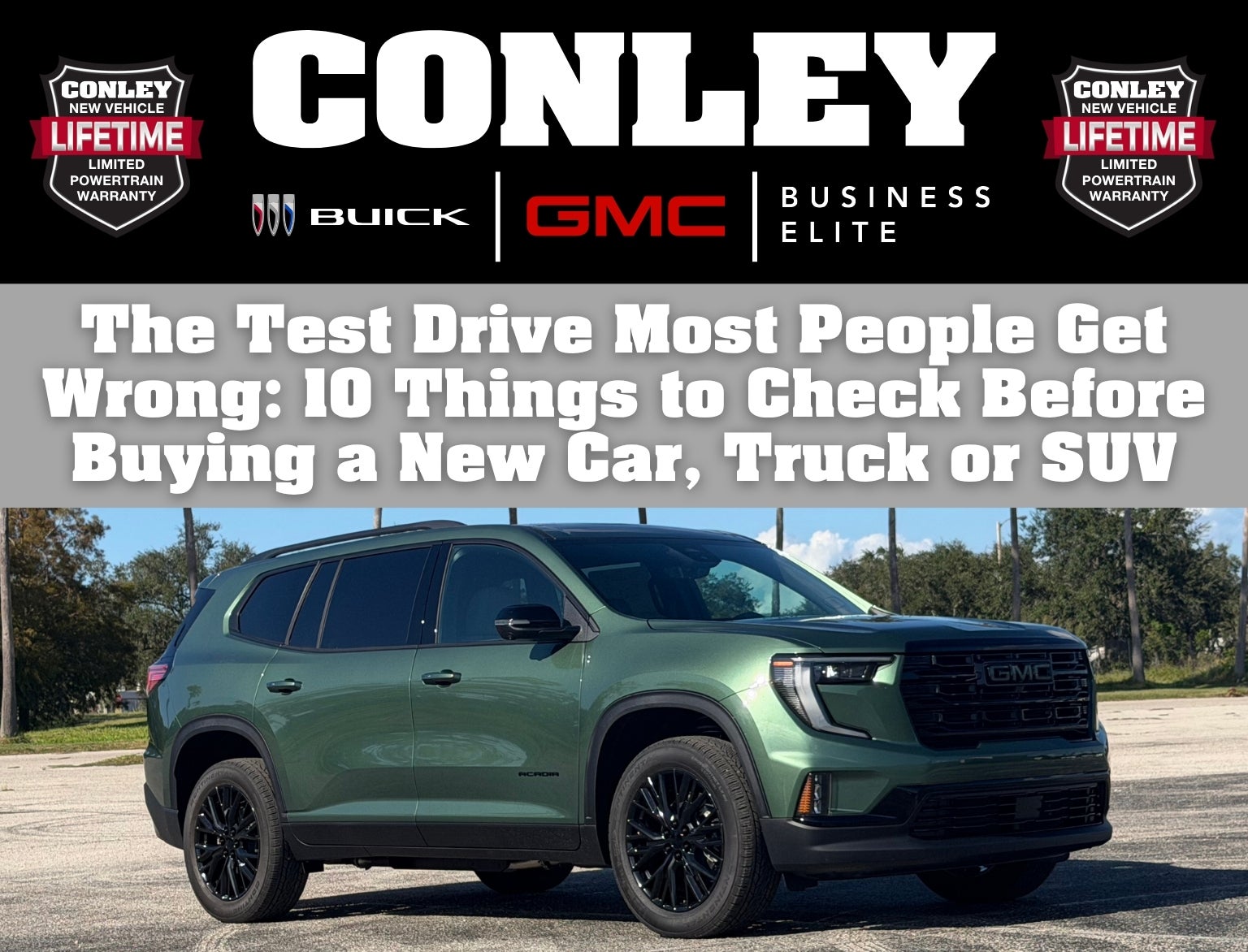
The Test Drive Most People Get Wrong: 10 Things to Check Before Buying a New Car, Truck or SUV

The Test Drive Most People Get Wrong: 10 Things to Check Before Buying a New Car, Truck or SUV You've researched the vehicle. You've compared prices. You've watched YouTube reviews. You've studied the features. You've probably spent more time looking at pictures of the vehicle than you'd care to admit. Then you finally arrive at the dealership. You get behind the wheel. Drive around for 10 minutes. Make a few turns. Accelerate onto a main road. And say: "Yeah, I like it." Congratulations. You've just completed the same test drive that thousands of shoppers take every year. But did you actually learn enough about the vehicle? A test drive should be more than a quick lap around the dealership. It's your opportunity to discover whether a vehicle fits your driving habits, your passengers, your comfort preferences and your everyday life. At Conley Buick GMC in Bradenton, Florida, we offer everything from Buick crossovers and family SUVs to GMC trucks and full-size luxury vehicles. And whether you're considering a Buick Envista, GMC Acadia, Yukon or Sierra, there's one thing every shopper should remember: A vehicle can look perfect on paper and still feel completely different once you're behind the wheel. Here are 10 things you should actually test before making your decision. 1. Don't Just Drive It. Park It. Most people spend their test drive evaluating how a vehicle moves. Acceleration. Steering. Braking. Ride quality. Those things matter. But here's a question: How often do you drive your vehicle without eventually having to park it? Exactly. Parking is part of ownership. And it's something many buyers barely evaluate. If you're considering a larger vehicle like a GMC Yukon XL or Sierra 1500, don't simply drive it down a wide road and assume you'll be comfortable with its size. Find an appropriate parking space. Pull in. Back out. Try backing into a space. Use the available camera systems. Pay attention to turning radius and visibility. A vehicle that feels enormous during the first five minutes may become surprisingly manageable once you're familiar with it. Or you may discover that you'd prefer something smaller. Either result is valuable. 2. Drive on the Roads You Actually Use A test drive should resemble your real life. If you commute on I-75, highway driving matters. If you spend most of your time navigating Cortez Road, stop-and-go traffic matters. If you frequently drive through downtown Bradenton or Sarasota, maneuverability matters. If you travel long distances, highway comfort matters. Don't judge a vehicle exclusively by how it performs on one short stretch of road. With an appropriate test-drive route approved by the dealership, try to experience several different driving conditions. City streets. Normal traffic. A safe stretch of highway. Turns. Parking. Acceleration. Braking. You want to understand the vehicle beyond its first impression. 3. Pay Attention to the Seats After the First Five Minutes A seat can feel fantastic when you first sit down. Then, 30 minutes later, you realize something isn't quite right. Maybe the lower back support doesn't suit you. Maybe the seating position feels too high. Maybe the headrest isn't comfortable. Maybe your legs don't have the support you prefer. Comfort is personal. And it's especially important if you spend a significant amount of time driving. Buick models such as the Envision and Enclave, along with premium GMC trims like Denali and Denali Ultimate, emphasize comfort and upscale cabin experiences. But no specification sheet can tell you whether a particular seat fits your body. Adjust everything. Seat height. Distance from the pedals. Seatback angle. Steering wheel. Lumbar support, if equipped. Then actually spend time driving. The most luxurious seat in the world isn't particularly luxurious if it doesn't fit you. 4. Turn the Radio Off This sounds strange. Especially if you're testing a vehicle with an excellent sound system. But for part of the test drive, turn everything off. No music. No podcast. No phone call. Just drive. Listen. How much road noise enters the cabin? How noticeable is wind noise? Does the engine sound intrusive? Are there rattles or unusual noises? How does the vehicle sound over uneven pavement? This can be particularly useful when comparing different types of vehicles. A compact crossover will naturally have a different driving character from a full-size pickup. A rugged off-road-oriented truck may feel different from a luxury-focused SUV. Neither is automatically better. The important question is which experience you prefer. And after you've listened to the quiet? Go ahead and turn the sound system back on. That deserves a test, too. 5. Test the Technology Before You Leave the Parking Lot Modern vehicles have become incredibly sophisticated. Large touchscreens. Digital instrument clusters. Camera systems. Wireless smartphone connectivity. Navigation. Voice controls. Driver-assistance features. But here's the thing: Technology is only convenient if you find it convenient. Before driving away, spend a few minutes exploring the controls while parked. Connect your phone. Find the climate settings. Adjust the audio. Look through the menus. Try the cameras. Locate commonly used functions. Ask how available driver-assistance features work and what their limitations are. You don't need to master every feature during a test drive. But you should feel comfortable with the basic interface. A vehicle shouldn't require a scavenger hunt every time you want to change the air-conditioning settings. 6. Sit in the Back Seat Even if you're the one buying the vehicle. Especially if you're the one buying the vehicle. Here's why. A vehicle may feel spacious from the driver's seat while offering a completely different experience for passengers. Get out. Sit behind your normal driving position. Check legroom. Headroom. Door openings. Seat comfort. Air vents. Charging ports. Cupholders. Then consider who will actually ride there. Children? Teenagers? Adults? Friends? Coworkers? If you're considering a three-row SUV like the Buick Enclave, GMC Acadia or GMC Yukon, try the third row as well. Don't just look at it. Climb in. See how easy it is to access. Check the space. Imagine someone spending an hour back there. A third row is only useful if it works for the passengers you intend to carry. 7. Open Everything Seriously. Open the doors. Open the liftgate. Open the glove box. Open the center console. Fold the seats. Inspect the storage compartments. If you're considering a truck, open the tailgate and examine the bed. This is where you begin discovering how a vehicle actually works. For SUV shoppers, pay attention to cargo access. Is the loading height comfortable? Can you easily reach the back? How much room remains when the rear seats are occupied? Can you fold the seats without frustration? For pickup shoppers, think about bed access. Can you comfortably reach inside? Would the available tailgate features be useful? Where would your equipment go? A GMC Sierra with an available MultiPro Tailgate offers a different cargo experience from a conventional tailgate. But the best way to understand whether that matters to you is to see how it works. 8. Test Visibility, Not Just the Cameras Modern camera systems are impressive. But don't forget about the windows. From the driver's seat, check: Forward visibility. Side visibility. Rear visibility. Mirror placement. Blind spots. Visibility around pillars. How easily you can judge the corners of the vehicle. Different body styles naturally create different sightlines. A Buick Encore GX will feel different from a GMC Sierra HD. A Yukon XL will feel different from an Envista. Available cameras and driver-assistance systems can provide valuable support, but they don't replace attentive driving or direct observation. Make sure you're comfortable with what you can see. And what you can't. 9. Bring Something You Actually Carry This might be the most underrated test-drive tip. If you have a stroller, bring it. If you carry golf clubs, bring them. If you regularly transport a large cooler, measure it or bring it along. If you're shopping for a family vehicle, consider bringing the child safety seat you'll actually use. If you're buying a truck for work, bring the dimensions of the equipment you need to transport. Why guess? Cargo measurements on a website are useful, but the shape of the space matters too. A cargo area can have impressive volume and still be awkward for a particular item. A truck bed can look enormous until you realize your equipment needs a different configuration. Practical testing beats assumptions. Just make sure any cargo or child seat is secured appropriately before driving. 10. Ask Yourself the Most Important Question After you've driven the vehicle, parked it, explored the technology, checked the cargo area and tested the seats, ask yourself: "Would I enjoy driving this every day?" Not just today. Not just while it's new. Every day. Imagine an ordinary Tuesday. You're running late. Traffic is heavy. It's 94 degrees outside. You have groceries in the back. Your phone is ringing. You need to park. Would you still like this vehicle? That's a much more useful question than: "Does it look cool?" Of course, looking cool is a bonus. But everyday satisfaction comes from how well the vehicle fits your routine. The Three Biggest Test-Drive Mistakes Beyond those 10 checks, there are three common mistakes worth avoiding. Mistake #1: Testing Only One Vehicle If you're undecided between two models, drive both. A shopper comparing the GMC Terrain and Acadia may discover that one feels more natural for everyday driving. Someone comparing a GMC Canyon and Sierra 1500 may realize they prefer the dimensions of one over the other. You can research specifications for hours. Sometimes five minutes behind the wheel tells you more. Mistake #2: Focusing Only on Horsepower Acceleration can be exciting. But most drivers spend considerably more time cruising, parking and sitting in traffic than accelerating aggressively. Pay attention to ride quality. Comfort. Steering. Braking. Visibility. Cabin noise. Ease of use. The vehicle with the most horsepower isn't automatically the vehicle you'll enjoy owning most. Mistake #3: Forgetting to Compare the Actual Trims Here's a detail that can make a major difference. Two vehicles with the same model name can feel quite different depending on their trim and equipment. Wheel and tire packages may affect ride characteristics. Seating materials and adjustments may change comfort. Suspension configurations may differ. Technology packages may change the cabin experience. A GMC Sierra Elevation and Sierra Denali Ultimate aren't necessarily going to deliver identical ownership experiences. Neither are a Buick Enclave Preferred and a properly equipped Enclave Avenir. If you're considering a particular trim, try to test that trim or the closest available configuration. Should You Test Drive a Used Vehicle Differently? Absolutely. The basic principles still apply. But when shopping pre-owned, there are additional things to consider. Pay attention to unusual noises. Check for vibrations. Test the air conditioning. Inspect interior wear. Look at tire condition. Make sure electronics operate as expected. Review the vehicle history and available inspection information. And don't assume that two used vehicles of the same model and year will feel identical. Mileage, maintenance, tire condition and prior usage can all affect how a vehicle drives. Conley Buick GMC offers a selection of pre-owned vehicles alongside its new Buick and GMC inventory, giving shoppers options across different budgets and vehicle categories. Don't Let the Price Tag Make the Entire Decision Price matters. Of course it does. But a vehicle purchase is more than a single transaction. You may spend years driving it. Thousands of hours sitting in it. Countless trips loading and unloading it. Hundreds of parking spaces navigating it. A slightly lower price on a vehicle you don't particularly enjoy may not be the bargain you think it is. Likewise, the most expensive model isn't automatically the best choice. The objective is to find the right combination of: Comfort. Capability. Convenience. Technology. Practicality. Price. And personal preference. That's where a thoughtful test drive becomes valuable. Try the "One-Year Test" Before making your final decision, imagine you've already owned the vehicle for one year. The excitement of buying something new has worn off. It's no longer the newest thing in the driveway. Now ask: What would I still love about it? What might annoy me? Would I wish I'd bought something smaller? Would I regret not having more cargo room? Would I still appreciate the technology? Would the seating position be comfortable on long drives? Would I enjoy parking it? Would I use the truck bed as much as I expected? These questions can help separate short-term excitement from long-term satisfaction. Why Shopping at Conley Buick GMC Makes Comparing Easier One advantage of shopping at a dealership with a broad lineup is the ability to compare different vehicles in one place. At Conley Buick GMC, shoppers can explore Buick crossovers and SUVs along with GMC trucks and SUVs. That includes models such as: Buick Envista, Encore GX, Envision and Enclave GMC Terrain and Acadia GMC Yukon and Yukon XL GMC Canyon GMC Sierra 1500 GMC Sierra HD Different vehicles serve different purposes. Some emphasize maneuverability and everyday efficiency. Others prioritize family space, towing capability, truck utility or premium comfort. And while researching online is a great starting point, the best way to discover those differences is to experience them firsthand. Make Your Next Test Drive Count at Conley Buick GMC in Bradenton, FL Located at 800 Cortez Road West in Bradenton, Florida, Conley Buick GMC proudly serves drivers throughout Bradenton, Sarasota, Lakewood Ranch, Palmetto, Venice and the surrounding Gulf Coast communities. As a third-generation, family-owned dealership, Conley Buick GMC offers new Buick and GMC vehicles, a wide selection of pre-owned inventory, financing resources, service and genuine GM parts. Whether you're considering your first Buick, upgrading to a larger GMC SUV or shopping for a new pickup truck, our team can help you explore the available options. Browse our inventory online, compare models and contact us to arrange a test drive. And when you arrive? Don't just take a quick trip around the block. Adjust the seats. Test the technology. Park it. Check the cargo space. Sit in the back. Drive it like you actually own it. Because the best vehicle isn't necessarily the one that impresses you most in the showroom. It's the one that still impresses you on an ordinary Tuesday, three years later.

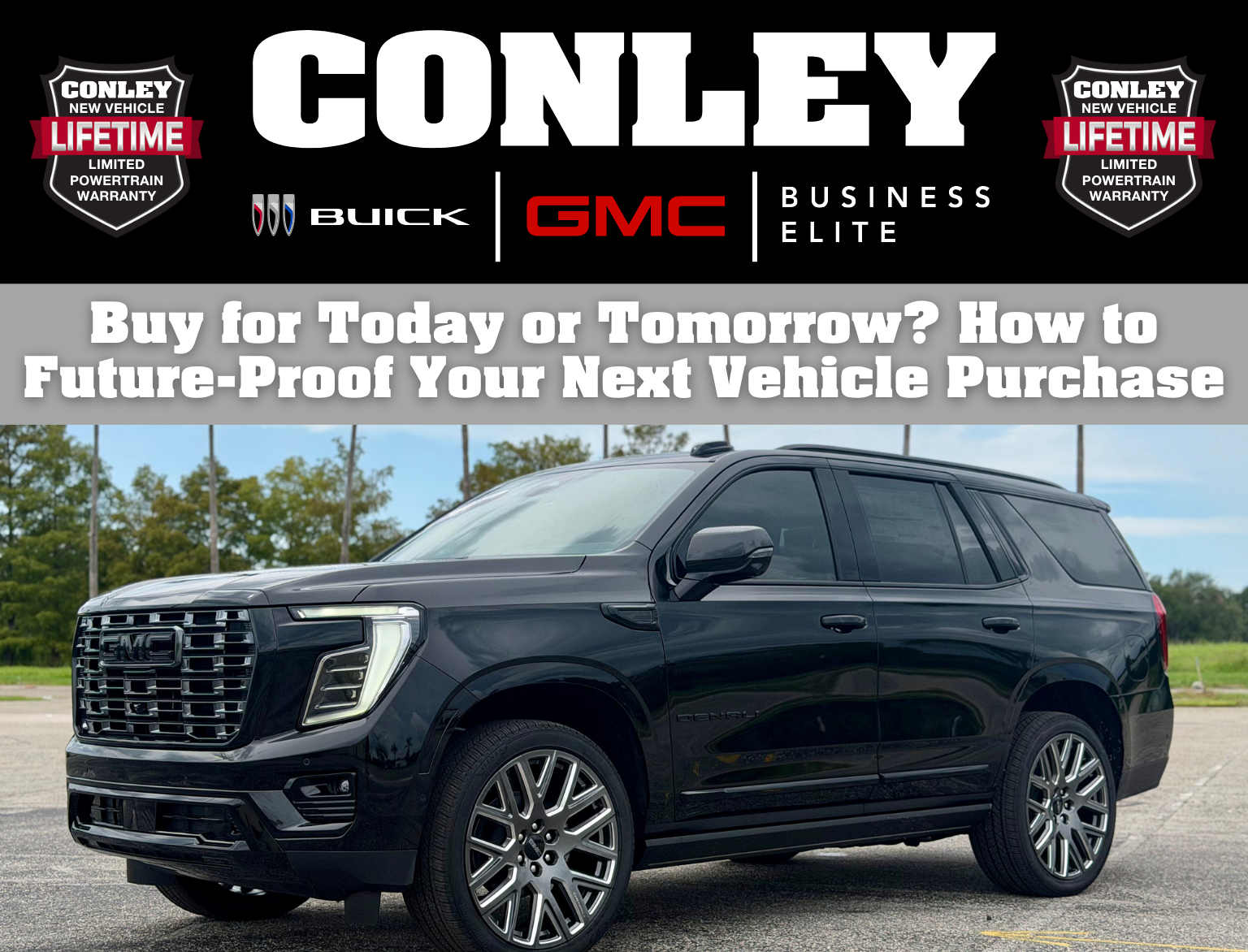
Buy for Today or Tomorrow? How to Future-Proof Your Next Vehicle Purchase

Buy for Today or Tomorrow? How to Future-Proof Your Next Vehicle Purchase

Buying a vehicle would be much easier if your life stayed exactly the same. Same commute. Same family. Same hobbies. Same house. Same job. Same amount of stuff. But that's rarely how life works. The compact SUV that perfectly fits your needs today may feel a little tight three years from now. The full-size pickup you think you need today might spend the next five years carrying nothing heavier than groceries. Or maybe the opposite happens. You buy the smaller vehicle to save money, then six months later buy a boat and discover you probably should have thought about towing capacity. That's why one of the most useful questions you can ask before buying your next vehicle isn't: "What do I need right now?" It's: "What am I realistically going to need during the years I own this?" At Conley Buick GMC in Bradenton, Florida, shoppers can choose from everything from smaller Buick and GMC crossovers to three-row SUVs, midsize trucks, full-size pickups and heavy-duty trucks. Having choices is great. Choosing the right one requires thinking a little further ahead. Here's how to do it. Start With One Simple Question: How Long Do You Keep Your Vehicles? This changes everything. If you typically replace your vehicle every two or three years, predicting your life a decade from now isn't particularly useful. But suppose you usually keep vehicles for: Six years. Eight years. Ten years. Or until the wheels metaphorically fall off. Now future needs matter much more. Imagine buying a vehicle at age 30 and keeping it until you're 38. Think about how much your life changed between 22 and 30. That's essentially the time horizon you're shopping for. You don't need to predict everything. You should simply acknowledge that you're not only buying transportation for the person standing in the dealership today. You're buying it for future you, too. Don't Buy for a Fantasy Version of Your Future There's an important distinction here. Future-proofing doesn't mean inventing hypothetical situations to justify buying more vehicle. "Maybe someday I'll buy a 30-foot boat." Are you actually planning to buy a boat? "Well... no." Then maybe don't structure your entire vehicle purchase around towing one. The same goes for: Imaginary children. Imaginary cross-country road trips. Imaginary construction projects. Imaginary off-road adventures. Imaginary trailers. There's a difference between likely future needs and possible future needs. Almost anything is possible. Good vehicle shopping focuses on what's probable. Think in Three Time Frames Here's a useful exercise. Divide your ownership period into three categories: Today What does the vehicle need to do immediately? Three Years From Now What changes are reasonably likely? Five to Seven Years From Now If you still own the vehicle, what might matter then? You don't need perfect answers. You're looking for patterns. If your requirements remain almost identical across all three categories, great. If they change dramatically, that deserves attention. The Family Question Family changes are probably the clearest example. Maybe you're a couple today. If children are realistically part of your near future, think beyond whether a car seat technically fits. Think about everything surrounding it. Stroller. Diaper bag. Groceries. Travel gear. Grandparents. Friends. Sports equipment later. Then possibly another child. Suddenly, cargo space and rear-seat room feel very different. That doesn't automatically mean buying the largest SUV available. It means evaluating space with your future needs in mind. Two Rows or Three? This is where Buick and GMC give shoppers several interesting choices. A smaller SUV can be fantastic for everyday life. Easy to park. Easy to maneuver. Plenty of room for many households. But if you regularly expect to carry more passengers, a three-row vehicle may eventually make more sense. Vehicles such as the Buick Enclave, GMC Acadia and GMC Yukon give shoppers different approaches to three-row utility. The important question isn't simply: "Do I need the third row today?" Ask: "How often would I realistically use one over the years I plan to own this?" If the answer is twice a year, you may not need to carry an extra row around every day. If the answer is twice a week? That's different. Children Get Bigger This seems obvious. Yet it's surprisingly easy to forget while shopping. The six-year-old sitting comfortably in the second row today will not remain six. Teenagers require more space. Their sports equipment gets larger. Their friends come along. Road trips change. If you intend to keep an SUV throughout a significant portion of your children's childhood, sit in the back yourself. Don't simply look at it. Actually sit there. Imagine someone substantially larger than your child occupying that seat later. Future-proofing sometimes means testing a vehicle from the wrong seat. Dogs Count as Passengers Too Florida families don't only travel with humans. If there's a dog—or several dogs—in your future, think about that now. Where will they ride? What happens when the cargo area is full? Can you easily load them? Is the cargo opening practical? Would a lower load floor make life easier? If you travel with pets regularly, their space requirements should be part of your vehicle decision. A 70-pound Labrador does not particularly care that you forgot to include him in the cargo calculation. Your Commute May Change Maybe you currently work five miles from home. That's great. But are you likely to change jobs during your ownership period? Move? Start traveling for work? Begin working remotely? A change in commute can dramatically change what you value in a vehicle. Someone driving 10 minutes each way may prioritize things differently from someone spending 90 minutes per day behind the wheel. Comfort. Fuel consumption. Driver-assistance technology. Audio. Seat quality. Ride. Cabin noise. Storage. Features that seem like luxuries during a short test drive can become much more important when you spend hundreds of hours per year in the vehicle. Think About Your House Your vehicle needs to fit your life. It also needs to literally fit where you live. Are you planning to move? Does your current garage barely fit your vehicle? Do you live somewhere with limited driveway space? Is there an HOA? Do you regularly park downtown? Would a larger vehicle create a daily inconvenience? Buying more vehicle "just in case" can backfire if you spend the next six years annoyed every time you park it. Capability has value. So does convenience. The Boat Question We're in Florida. We have to talk about boats. If you already own one, towing requirements should obviously factor into your purchase. If you're genuinely planning to buy one soon, that's worth considering too. But don't simply say: "I need something that can tow." Find out what you need to tow. Boat. Motor. Trailer. Fuel. Gear. Everything involved. Then compare those requirements with the properly equipped vehicle's ratings. Depending on the application, a GMC Canyon, Sierra 1500, Sierra HD or properly configured GMC SUV may enter the conversation. The right answer depends on the actual load. Buy for the boat you're realistically going to own, not the largest boat you've ever seen. Will Your Hobbies Change? This is where vehicle shopping gets fun. What do you want to do during the next five years? Camping? Kayaking? Fishing? Cycling? Golf? Road trips? Home improvement? Boating? Outdoor recreation? Some hobbies barely affect your vehicle needs. Others completely change them. A truck bed can suddenly become extremely useful. So can roof rails. Cargo capacity. Towing capability. All-wheel-drive capability. A larger rear cargo area. Think about what you already enjoy and what you're genuinely becoming interested in. Your vehicle is often part of how you access those hobbies. Are You Becoming a Homeowner? This is one people underestimate. Apartment life and homeowner life can involve very different vehicle demands. Suddenly you're buying: Mulch. Plants. Lumber. Furniture. Patio equipment. Tools. Grills. Landscaping supplies. Things from the hardware store you absolutely did not intend to buy when you walked in. Does that mean every homeowner needs a pickup? Of course not. Delivery exists. So do trailers and rentals. But if you're regularly doing home projects, the utility of a GMC Canyon or Sierra may become more appealing than it seemed before. Midsize Truck or Full-Size Truck? Future-proofing doesn't always mean buying bigger. Suppose you want a pickup because you regularly carry equipment, tackle home projects and occasionally tow. You might assume: "I should buy the biggest truck I can afford so I'll never outgrow it." Not necessarily. A GMC Canyon may provide the utility you realistically need while remaining easier to maneuver and park. A Sierra 1500 may make more sense if your passenger, bed, payload or towing requirements point toward a full-size pickup. And Sierra HD exists for substantially more demanding applications. The goal isn't maximum capability. It's appropriate capability with reasonable room to grow. That's a very different philosophy. Don't Buy Too Close to Your Maximum Requirement There's another side to that argument. Suppose your towing or payload needs are already near the upper edge of what you're considering. And you reasonably expect those needs to increase. Buying a vehicle with essentially no room for growth could leave you shopping again sooner than expected. This is where a sensible capability buffer can be useful. Not an absurd buffer. A realistic one. If your needs are likely to increase, account for it. Your Career Can Affect Your Vehicle Choice Career changes can alter vehicle requirements in unexpected ways. Maybe you enter sales and begin driving considerably more. Maybe you start a business. Maybe your new job requires carrying equipment. Maybe you begin meeting clients and care more about presentation. Maybe you start working from home and barely drive at all. You obviously can't predict every career move. But if you already know a change is coming, factor it into the purchase. Buying a vehicle while ignoring a major life change six months away doesn't make much sense. Could Your Personal Vehicle Become a Business Vehicle? This is particularly relevant for entrepreneurs and small-business owners. Maybe your pickup is currently personal transportation. But you're building a side business. Landscaping. Construction. Mobile services. Real estate. Property maintenance. Contracting. If that business grows, the vehicle may eventually serve two roles. That could change how you think about: Bed size. Towing. Cab configuration. Storage. Durability. Appearance. Payload. Again, don't buy a commercial-level vehicle because you sold one item on Facebook Marketplace. But if you're actively building a business, your future vehicle needs may already be visible. Think About Aging Parents Future family transportation doesn't only involve children. Many adults eventually find themselves helping aging parents. That can change what matters. Easy entry and exit. Comfortable rear seating. Door opening size. Cargo room for mobility equipment. Ride quality. Climate control. Space for additional passengers. If this is likely to become part of your life during the years you plan to own the vehicle, it's worth considering. A feature or dimension that doesn't matter today may matter enormously later. Technology Ages Differently Than Mechanical Capability Here's an interesting question: What will still matter five years from now? Some technology will feel dated. That's inevitable. But certain capabilities remain useful regardless of technological trends. Comfortable seats. Useful cargo space. Appropriate towing capability. Good visibility. Flexible storage. A practical passenger layout. A vehicle that's easy to live with. Don't choose a vehicle entirely because one screen animation looks cooler than another. You're buying the whole machine. Buy the Features You'll Grow Into This is slightly different from buying a bigger vehicle. Sometimes future-proofing means choosing the right equipment. Maybe you don't take many highway trips today but expect to travel more. Driver-assistance technology may become more valuable. Maybe you don't tow frequently today but expect that to change. Available trailering technology may deserve consideration. Maybe your vehicle currently stays in a garage but you're moving somewhere without covered parking. Remote-start and climate features might suddenly become much more valuable in Florida. Think about which features have a realistic chance of becoming more useful over time. But Don't Pay Thousands for "Maybe" There's a trap hidden in everything we've discussed. You can justify almost anything with the phrase: "I might need it someday." You might need a third row. You might need maximum towing. You might need off-road capability. You might need a giant cargo area. You might need every option. Eventually you've built a vehicle for twelve hypothetical lives instead of the one you actually live. Use probabilities. Ask yourself: Is this likely enough to justify paying for it every month? That's a much better test. Try the 80/20 Rule Here's a simple strategy. Buy a vehicle that is excellent for approximately 80% of your real-world use and capable of reasonably handling the remaining 20%. Don't buy for the strangest thing you do once every three years. Suppose you commute alone most days, carry family regularly and make one enormous furniture purchase every few years. You probably don't need to structure the entire purchase around transporting a couch. Furniture stores deliver. Rental trucks exist. Friends own pickups. Your everyday life should dominate the decision. Rent for the Exception This concept can save people a lot of money. Sometimes it's cheaper to buy the vehicle that's right for your normal life and rent something specialized on rare occasions. Need an enormous truck once every two years? Rent one. Need a trailer for one weekend? Rent it. Need extra passenger capacity for a single vacation? There are options. Owning capability has a cost. Purchase price. Fuel. Insurance. Parking. Potentially tires and maintenance. Make sure you're actually using what you're paying for. Do the "Tuesday Test" Forget the fantasy road trip for a moment. Picture a completely ordinary Tuesday three years from now. You wake up. Where are you going? Who is in the vehicle? What are you carrying? Where are you parking? How far are you driving? What do you wish the vehicle did better? That's arguably a more useful thought experiment than imagining the one perfect weekend adventure. Vehicles spend most of their lives doing ordinary things. Buy one that's great at those. Then Do the "Worst Week Test" Now do the opposite. Imagine the busiest realistic week your vehicle might face. Family visiting. Road trip. Kids. Dogs. Luggage. Boat. Home-improvement project. Whatever actually applies to your life. Can the vehicle handle that week without becoming completely impractical? If yes, you've probably found a reasonable balance. You don't need unlimited capability. You need enough. Buick Makes a Strong Case for Buyers Who Don't Need Maximum Size Future-proofing doesn't automatically mean jumping into a huge SUV. Buick's current crossover and SUV lineup gives shoppers several ways to balance everyday practicality with useful passenger and cargo space. Models such as the Envista, Encore GX and Envision can make sense for drivers who want SUV versatility without full-size dimensions. For shoppers needing substantially more passenger space, the Enclave provides a three-row option. The important part is matching the vehicle to the direction your life is realistically heading. Not simply buying the largest model available. GMC Gives You Room to Scale Up GMC's lineup makes the progression particularly clear. Need a manageable SUV? Terrain. Need three rows and additional versatility? Acadia. Need full-size SUV space and capability? Yukon or Yukon XL. Want a pickup without jumping immediately into full-size territory? Canyon. Need a full-size truck? Sierra 1500. Have substantially heavier-duty requirements? Sierra HD. That's useful because shoppers don't have to make a binary choice between "small vehicle" and "giant truck." There are steps in between. Test Drive the Vehicle Like You Already Own It Don't test drive only for acceleration and ride quality. Pretend it's yours. Park it. Back it into a space. Get into the second row. Open the cargo area. Fold the seats. Put your work bag somewhere. Check cupholders. Look at storage. Imagine a car seat. Imagine luggage. If you're considering a truck, stand at the bed and think about what you'll actually put there. If you tow, discuss the exact configuration and requirements. You're trying to discover future annoyances before they become your annoyances. Bring the Family If other people are going to spend substantial time in the vehicle, bring them. Yes, even the kids. Especially the kids. Have everyone sit where they'd normally sit. Check legroom. Check access. Check cargo space with everyone aboard. One person's perfect SUV can become significantly less perfect once the entire household gets inside. Buying a family vehicle without the family is a little like buying someone shoes without knowing their size. You might get lucky. Don't Forget the Financial Future Future-proofing isn't only about physical space. Think about your budget several years from now. A larger or more expensive vehicle can affect: Monthly payment. Insurance. Fuel. Tires. Maintenance. Registration. Long-term ownership costs. The vehicle should fit your future financial life too. Stretching your budget today because you might need additional capability years from now isn't necessarily good planning. Flexibility includes financial flexibility. The Perfect Vehicle Isn't the One That Can Do Everything It doesn't exist. A vehicle that's amazing at towing a huge trailer won't necessarily be the easiest thing to park downtown. A tiny crossover that's fantastic around town won't replace a heavy-duty pickup. A three-row SUV offers passenger flexibility but may be unnecessary for someone who almost always drives alone. Every vehicle involves tradeoffs. The goal isn't eliminating them. It's choosing the right ones. Find the Buick or GMC That Fits Where You're Going At Conley Buick GMC in Bradenton, Florida, shoppers can compare vehicles across a wide range of sizes, capabilities and configurations. That includes Buick SUVs and crossovers as well as GMC SUVs, midsize pickups, full-size trucks and heavy-duty trucks. Instead of beginning with: "What's the biggest vehicle I can get?" or: "What's the cheapest vehicle that works today?" Start somewhere in the middle. Ask: What does my life look like now? What is genuinely likely to change? How long will I own this vehicle? What capabilities will I actually use? What will make everyday life easier? Those questions can lead you toward a vehicle that fits today without feeling wrong tomorrow. Because a great vehicle purchase shouldn't only make sense when you drive off the lot. It should still make sense when your life looks a little di fferent several years down the road.

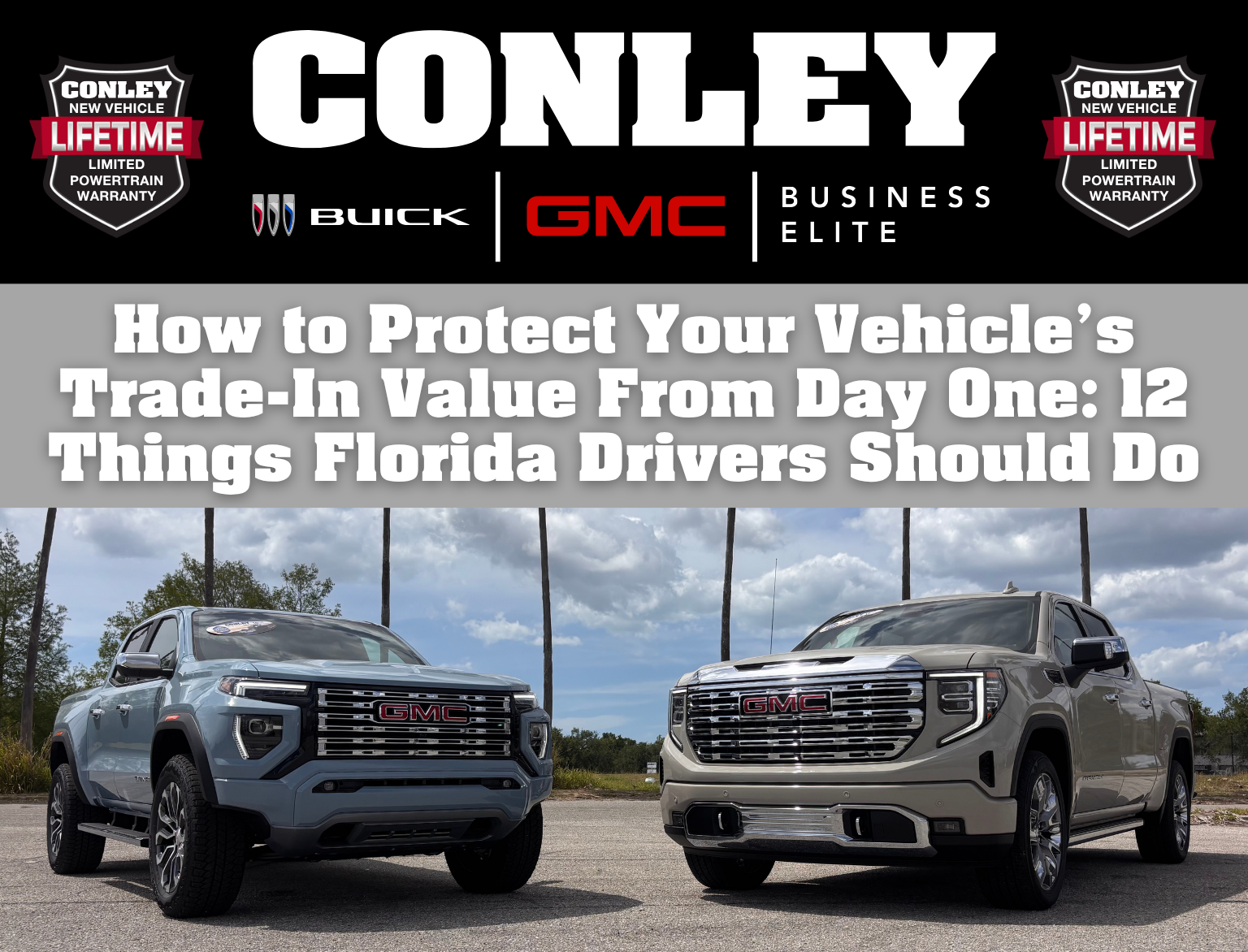
How to Protect Your Vehicle’s Trade-In Value From Day One: 12 Things Florida Drivers Should Do

How to Protect Your Vehicle’s Trade-In Value From Day One: 12 Things Florida Drivers Should Do

The day you buy a new vehicle, selling it is probably the last thing on your mind. You're learning the touchscreen. Adjusting the seat. Connecting your phone. Admiring it through the window every time you walk past your house. You're definitely not thinking: "I wonder what this will be worth six years from now." But maybe you should be. Your vehicle is one of the largest purchases you'll make, and eventually there's a good chance you'll sell it or trade it toward something else. How much value remains at that point isn't entirely outside your control. Mileage matters. Market conditions matter. The vehicle itself matters. But how you own it matters, too. At Conley Buick GMC in Bradenton, Florida, customers can shop new and pre-owned vehicles, maintain them through our service department and eventually use our online trade-in tools or in-person appraisal process when they're ready for something different. So what can you do between buying and selling? Quite a bit. Here are 12 ways to help protect your vehicle's trade-in value from day one. 1. Keep Your Maintenance Records Let's start with something incredibly simple. Keep records. When your vehicle is serviced, maintain documentation showing what was done and when. That could include: Oil changes Tire rotations Brake service Battery replacement Fluid services Alignments Warranty repairs Major mechanical repairs Replacement parts Recommended scheduled maintenance Why? Because there's a big difference between saying: "I always maintained it." and being able to show it. A documented maintenance history can give a future buyer or appraiser a clearer picture of how the vehicle was cared for. This becomes increasingly important as mileage accumulates. A 70,000-mile vehicle with consistent maintenance records tells a different story than a 70,000-mile vehicle with an unknown history. 2. Don't Skip Maintenance Because "Nothing Is Wrong" This is one of the easiest traps in vehicle ownership. The vehicle starts. No warning lights. No weird noises. Air conditioning works. Everything seems fine. So maintenance gets delayed. The problem is that preventive maintenance exists specifically to address things before something feels wrong. Oil changes are an obvious example, but maintenance can also include inspections, tire care, brakes, batteries, fluids and other manufacturer-recommended services. Conley Buick GMC currently operates a full-service center in Bradenton for routine maintenance and more involved repairs, along with a parts department supporting Buick and GMC owners. Keeping up with those needs isn't simply about avoiding a breakdown. You're helping preserve the condition of the vehicle you're eventually going to sell. 3. Mileage Matters, But Don't Become Obsessed With It Yes, mileage influences vehicle value. No, that doesn't mean you should be afraid to drive your vehicle. You bought it to use it. Take the road trip. Go to the beach. Drive to Orlando. Visit family. Tow the boat. Use your truck like a truck. The goal isn't to preserve your vehicle like a museum exhibit. Instead, understand that mileage becomes one factor in the overall value equation. If you're deciding between taking your vehicle or unnecessarily adding thousands of miles when another transportation option makes more sense, mileage can be worth considering. But enjoying your vehicle has value, too. There's little point buying a beautiful new GMC Yukon and refusing to take it anywhere because you're worried about the odometer. 4. Florida Sun Is Hard on Vehicles If you've lived in Florida long enough, you already know what sunlight can do. Paint. Plastic. Rubber. Interior surfaces. Leather. Headlights. Trim. Florida gives vehicles plenty of exposure to heat and UV radiation. Whenever practical, covered parking can help reduce constant exposure. That doesn't mean everyone needs a climate-controlled garage. Many people don't have one. But you can still take reasonable steps. Regular washing and appropriate paint protection can help maintain the exterior. Interior protectants designed for automotive materials can help. Windshield sunshades can reduce direct sunlight entering the cabin while parked. Tinting, where legal and properly installed, can also make a difference in everyday comfort. A vehicle spends a lot more time parked than most people realize. Where and how it's parked becomes part of its ownership story. 5. Wash Off More Than Just Dirt A vehicle doesn't only collect dirt. Florida exposes vehicles to: Salt. Sand. Bugs. Bird droppings. Tree sap. Pollen. Road grime. Mud. Hard-water spots. And whatever mysterious substance appears on your hood immediately after you finish washing it. Some contaminants are more than cosmetic. Leaving certain substances on paint for extended periods can make them harder to remove and potentially affect the finish. Regular washing isn't purely about having a shiny vehicle. It's part of exterior maintenance. If you spend time around beaches, boat ramps or coastal environments, paying attention to the exterior and underbody becomes even more sensible. 6. Fix Small Damage Before It Becomes Big Damage There's a tiny chip in the windshield. A small scratch on the bumper. One little door ding. A minor tear beginning on the driver's seat. It's easy to say: "I'll deal with that later." Then three years pass. Small problems sometimes stay small. Sometimes they don't. A windshield chip can spread. A small upholstery tear can grow. Paint damage can become more noticeable. Minor issues accumulate until the vehicle begins to look significantly more worn than its age suggests. You don't have to repair every microscopic imperfection immediately. Vehicles live in the real world. But periodically walking around the vehicle and addressing reasonable problems can help prevent a long list of little issues from becoming one big first impression. 7. Take Care of the Interior People sometimes obsess over the paint and forget where the next owner is actually going to sit. The interior matters. A lot. Think about what an appraiser sees when the driver's door opens. Seat condition. Carpet. Dashboard. Steering wheel. Door panels. Headliner. Odors. Stains. Pet hair. Wear. Missing trim. You don't need to ban food from your vehicle or force everyone to wear white gloves. But basic care goes a long way. Use floor mats. Clean spills quickly. Vacuum periodically. Condition appropriate materials. Don't let trash accumulate. And if something breaks, consider fixing it rather than allowing several small interior problems to pile up. 8. Be Careful With Permanent Modifications Customization is personal. That's what makes it fun. But personalization and resale value don't always point in the same direction. Suppose you install something you absolutely love. That's great while you own the vehicle. But the future buyer needs to love it, too. Certain modifications may have broad appeal. Others significantly narrow the audience. This is particularly relevant with trucks. A GMC Sierra 1500 can be customized in countless ways. Wheels. Tires. Suspension. Exterior trim. Lighting. Bed accessories. Appearance packages. The important thing is to think about quality. Professionally installed, tasteful modifications are very different from poorly executed permanent alterations. And whenever you modify a vehicle, keep any original components that might be useful later. Sometimes returning a vehicle closer to its original configuration before selling can broaden its appeal. 9. Don't Forget About Your Wheels Curb rash. We've all seen it. You hear the noise. You immediately know what happened. And you spend the next five seconds pretending maybe it wasn't your wheel. Wheels have an enormous impact on how a vehicle presents itself. A beautiful SUV with four heavily damaged wheels can instantly look neglected. Take extra care when parking near curbs. Maintain proper tire pressure. Rotate tires as recommended. Address alignment issues. And occasionally inspect both the tires and wheels for damage. This is especially important on premium trims where larger or distinctive wheel designs are a significant part of the vehicle's appearance. 10. Tires Tell a Story Imagine two otherwise identical used vehicles. One has four matching tires with healthy tread. The other has: One brand on the front. Another brand on the rear. One tire that looks suspiciously newer than everything else. And tread that appears ready for retirement. Which vehicle seems better maintained? Tires are consumable items. Nobody expects them to last forever. But their condition can affect how a vehicle presents itself during an appraisal. Proper tire maintenance also affects safety, ride quality and performance throughout ownership. Check pressures. Rotate appropriately. Maintain alignment. Inspect tread. Replace tires when necessary. Those are things you should be doing regardless of resale value. Protecting your investment is simply another benefit. 11. Don't Ignore Warning Lights A warning light is your vehicle attempting to communicate with you. Ignoring it doesn't make the problem disappear. Sometimes the issue is minor. Sometimes it isn't. Either way, diagnosing warning lights promptly is usually better than hoping they'll become bored and turn themselves off. The same goes for: Unusual noises. Vibrations. Fluid leaks. Changes in braking. Starting difficulties. Air-conditioning problems. Steering changes. Transmission behavior. A small mechanical issue can become more expensive if left unattended. And when you're eventually ready to trade the vehicle, multiple unresolved warning lights are not exactly an ideal opening argument for maximum value. 12. Know When It's Time to Trade Here's the part nobody talks about enough. There can be a difference between: How long a vehicle can last and how long you personally should keep it. Modern vehicles can provide many years of useful service when properly maintained. But everyone's situation is different. Maybe your family is growing. Maybe your commute changed. Maybe you bought a boat. Maybe you no longer need a full-size truck. Maybe you suddenly do need a full-size truck. Maybe you want newer safety and convenience technology. Maybe repair costs are beginning to increase. Maybe the vehicle still has meaningful trade value and you're ready for something new. Don't automatically assume the correct strategy is driving every vehicle until it has virtually no value left. For some owners, that works perfectly. For others, trading earlier makes more financial and practical sense. Think About Cost Per Year, Not Just Purchase Price Here's an interesting way to think about vehicle ownership. Imagine two vehicles. Vehicle A costs less initially but depreciates significantly and requires considerable repair work. Vehicle B costs more but remains desirable, is well maintained and retains stronger value when sold. Which one actually cost more to own? Purchase price alone doesn't answer that question. You have to consider: Purchase price. Financing. Maintenance. Repairs. Fuel. Insurance. Depreciation. Trade-in or resale value. That's your broader ownership picture. This is why maintaining your vehicle matters financially. You're not only spending money on maintenance. You're maintaining an asset that may eventually become part of the down payment on your next vehicle. How Does Conley Determine Trade-In Value? Conley Buick GMC offers an online trade-in estimator that allows owners to begin the valuation process from home. According to Conley's current appraisal information, owners provide details such as the vehicle's: Year Make Model Trim Body style Condition Mileage The dealership can also perform an in-person appraisal. Vehicle condition is examined and compared with similar vehicles in the market when determining value. That's important because it illustrates something every owner should understand: Trade-in value isn't determined by mileage alone. The entire vehicle matters. Should You Detail Your Vehicle Before Trading It? Yes—with some perspective. You probably don't need to spend a fortune trying to transform a heavily used vehicle into something it isn't. Professional appraisers understand used vehicles. They're not going to forget the mileage because the dashboard smells like tropical coconut. But presentation still matters. Before an appraisal: Remove trash. Take personal belongings out. Vacuum the interior. Wash the exterior. Remove unnecessary items from the cargo area. Gather keys. Gather maintenance records if available. Make sure important equipment is present. A clean vehicle is easier to inspect and gives a clearer picture of its condition. There's no need for tricks. Just present the vehicle properly. Should You Repair Your Vehicle Before Trading It? Maybe. This is where owners sometimes make expensive mistakes. Imagine you're about to trade a vehicle that needs a $3,000 repair. Should you spend the $3,000? Not automatically. First ask: Will that repair increase the trade value by more than it costs? If the answer is no, repairing it solely for the trade may not make financial sense. Small fixes are different. Replacing an inexpensive missing item or addressing a simple issue may be worthwhile. But before making major repairs solely because you're planning to trade the vehicle, consider having it appraised. You may be better off selling it as-is and allowing the next owner or dealer to handle the repair. Your Next Vehicle Can Change the Equation Trade-in value becomes particularly interesting when your needs change. Maybe you're currently driving a compact SUV but your family now needs three rows. A GMC Acadia or Yukon may make more sense. Maybe you own a large SUV but your children have moved out and you'd prefer something smaller. A Buick Envision, Encore GX or Envista might better fit your lifestyle. Maybe you've started towing a boat. Now a GMC Canyon or Sierra 1500 deserves consideration. Maybe your towing or payload requirements have become substantially more demanding. That's where Sierra HD enters the conversation. Conley's current new inventory spans SUVs and trucks across a broad range of sizes and configurations, which makes a trade-in less about simply replacing an old vehicle and more about reassessing what you actually need today. Protecting Your Next Vehicle Starts at Purchase Here's where the cycle starts again. Once you've traded your current vehicle and purchased another one, start thinking long-term immediately. Understand the recommended maintenance. Keep your paperwork organized. Learn the features. Protect the interior. Take care of the exterior. Don't ignore problems. And understand whatever warranty coverage comes with the vehicle. Conley Buick GMC currently advertises a Lifetime Limited Powertrain Warranty on qualifying new vehicles, with exclusions including diesel engines and vehicles covered by commercial insurance or used commercially. Customers should contact the dealership for complete coverage requirements, limitations and maintenance terms. Knowing exactly what coverage you have—and what you need to do to maintain it—is part of responsible ownership. Use Genuine Parts and Qualified Service When repairs eventually become necessary, quality matters. Conley Buick GMC maintains an onsite service and repair center along with a parts department, and its service information emphasizes certified technicians and genuine GM parts. That can help owners maintain their Buick or GMC properly throughout its life. The goal isn't simply: "Make it to the next oil change." The bigger goal is keeping the vehicle dependable, safe, enjoyable and well maintained for however long you decide to own it. Don't Maintain Your Vehicle Only for the Next Owner There's an irony in all of this. The things that can help protect future trade-in value are mostly the same things that make the vehicle better for you. Good tires? You benefit. Regular maintenance? You benefit. Clean interior? You benefit. Healthy brakes? Definitely you. Fixing small problems before they become big ones? You again. Protecting resale value isn't about spending years caring for a vehicle so some stranger can enjoy it later. It's about getting more value from the vehicle throughout ownership—and potentially getting more value back when you're finished. Find Your Next Buick or GMC at Conley Buick GMC in Bradenton, FL At Conley Buick GMC, vehicle ownership doesn't begin and end with the sale. Located at 800 Cortez Road West in Bradenton, Florida, Conley Buick GMC offers: New Buick SUVs New GMC trucks and SUVs Quality pre-owned vehicles Vehicle trade-in and appraisal tools Financing resources Buick and GMC service Genuine GM parts Maintenance and repair support Conley Buick GMC proudly serves drivers throughout Bradenton, Sarasota, Lakewood Ranch, Venice, Palmetto and Florida's Gulf Coast. Whether you're buying your first new vehicle, maintaining the one already in your driveway or trying to determine what your current vehicle is worth, thinking long-term can pay off. Because the value of your next trade-in doesn't start the day you sell it. It starts the day you buy it.

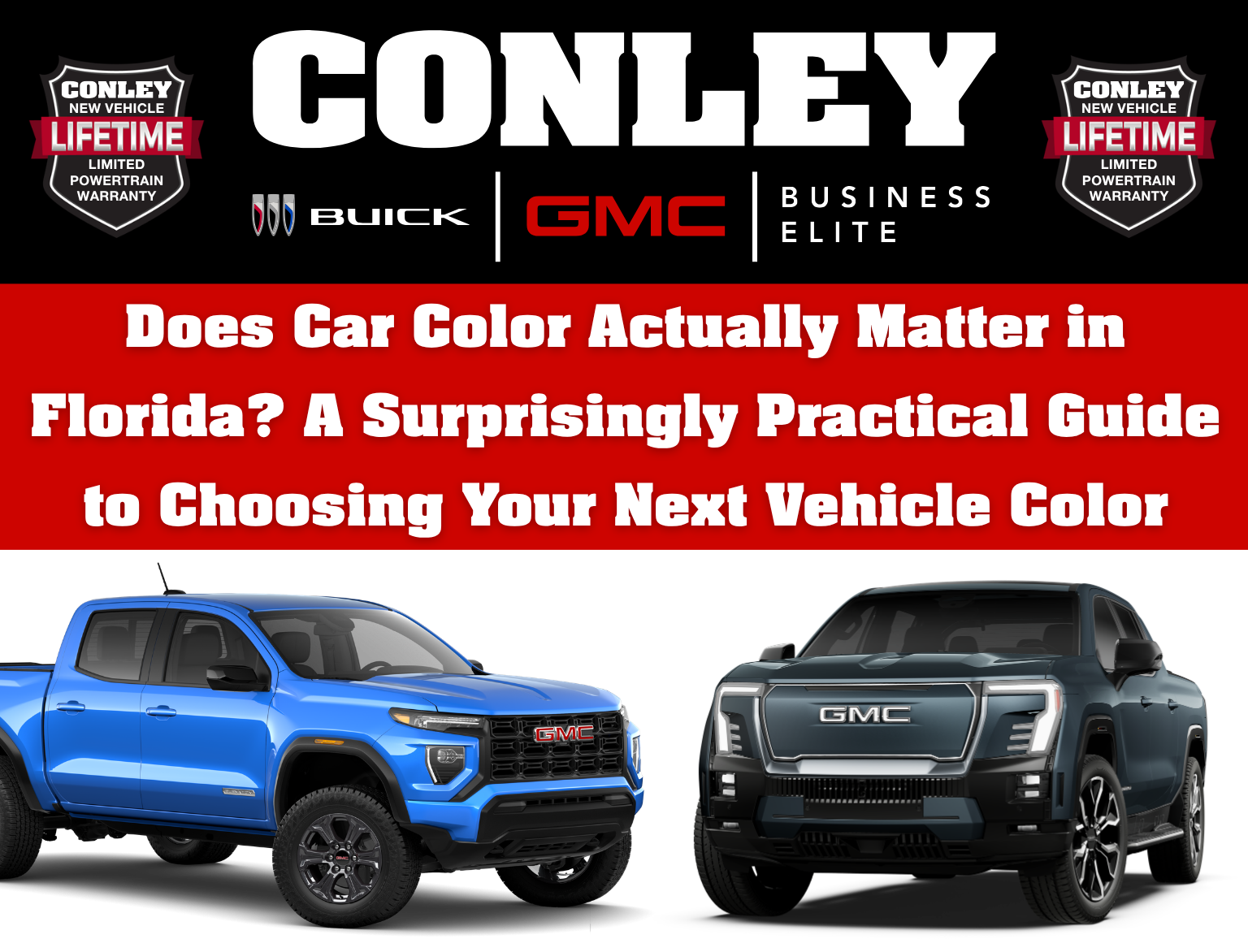
Does Car Color Actually Matter in Florida? A Surprisingly Practical Guide to Choosing Your Next Vehicle Color

Does Car Color Actually Matter in Florida? A Surprisingly Practical Guide to Choosing Your Next Vehicle Color

You found the vehicle. Right model. Right trim. Right engine. Right features. Right price. There's just one problem. What color do you want? Vehicle color seems like one of the least complicated parts of buying a new car, truck or SUV. Pick the one that looks best. Done. But when you live in Florida, there's actually more to the decision than appearance. Sunlight, heat, pollen, rain, road grime, water spots, interior temperatures and even how often you're willing to wash your vehicle can influence which colors you'll enjoy owning. And then there's the most important consideration: Some vehicles simply look ridiculously good in certain colors. At Conley Buick GMC in Bradenton, Florida, shoppers can find Buick and GMC vehicles in everything from understated neutrals to bold metallic finishes, blacked-out combinations and colors that completely change a vehicle's personality. So before automatically choosing black, white or silver, let's answer a surprisingly complicated question: Does your vehicle's color actually matter in Florida? Yes, Dark Vehicles Can Get Hot Let's get the obvious question out of the way. Florida sunshine is intense. And darker exterior surfaces generally absorb more solar energy than lighter ones. That doesn't mean buying a black vehicle in Florida is a terrible idea. Far from it. Black remains popular for a reason. A black GMC Sierra, for example, can look fantastic—especially when paired with dark wheels and black exterior accents. A black Buick Envista Sport Touring can have an entirely different personality than the same vehicle in a lighter finish. But if your vehicle regularly spends hours parked outside, exterior color is one factor worth considering. There's another factor that's arguably even more important. Don't Forget About Interior Color People obsess over exterior paint and sometimes barely consider the cabin. But that's where you're actually sitting. If Florida heat is one of your concerns, think about the complete vehicle. Exterior color. Interior color. Seat material. Window tint. Ventilated seating. Remote-start capability. Climate-control features. Where the vehicle will normally be parked. A dark exterior with a dark interior sitting in direct Bradenton sunshine creates a different experience from a vehicle regularly parked inside a garage. That's why there isn't one universal "best Florida color." Your parking situation matters. Black Looks Incredible — for Approximately 11 Minutes After You Wash It Black vehicles deserve their own section. When clean, they're hard to beat. A freshly detailed black GMC Yukon Denali or Sierra Denali can look incredibly upscale. Black can emphasize body lines. Chrome pops against it. Dark wheels create a sinister monochromatic appearance. And on Sport Touring or other black-accented vehicles, the result can be especially sharp. Then Florida happens. Pollen. Dust. Afternoon rain. Water spots. Road grime. Black tends to reveal contamination more easily than many lighter or mid-tone colors. That's not a reason to avoid it. It's simply part of the ownership equation. If you're the type of person who enjoys washing and detailing your vehicle, black can be tremendously rewarding. If your philosophy is "the rain will wash it eventually," another color might make life easier. White Is Popular for a Reason There's a reason you see so many white vehicles throughout Florida. White is clean. Timeless. Easy to pair with different wheel designs. It provides strong contrast with black trim. And lighter exterior colors can be appealing in a sunny climate. White can look particularly good on vehicles with aggressive dark accents. Imagine a white GMC Canyon AT4 with dark wheels and rugged exterior details. Or a white Buick Sport Touring model with black accents. The contrast makes the design elements stand out. White also tends to hide certain types of dust better than black. Of course, Florida has a special talent for finding entirely new ways to make any color dirty. Silver and Gray Might Be the Low-Maintenance Champions If your primary objective is: "I want my vehicle to look reasonably clean without thinking about it constantly," silver and certain gray finishes deserve serious consideration. These colors tend to be forgiving when it comes to light dust and everyday road grime. They're also neutral enough to work across almost any type of vehicle. A gray GMC Sierra AT4 can look rugged. The right metallic gray on a Buick Envision can look sophisticated. Silver on a family SUV can look clean and timeless. And modern gray isn't necessarily boring. Automakers now offer shades ranging from light metallic silver to deep charcoal and more distinctive contemporary finishes. Color doesn't need to shout to have personality. Then There Are the Colors You Buy With Your Heart Red. Blue. Deep metallic finishes. Unusual premium colors. These are the colors that make someone walk across a parking lot and say: "That's the one." And there's nothing wrong with that. Vehicle purchases aren't purely mathematical decisions. You're potentially going to look at this thing every day for years. If a particular color makes you turn around after parking just to look at the vehicle again, that has value. A bold color can also completely change how a vehicle presents itself. A bright or deep blue GMC Canyon can feel adventurous. A rich red Sierra can emphasize the truck's size and styling. A distinctive metallic finish on a Buick can make an already premium-looking vehicle feel much more special. Sometimes the practical answer isn't the right answer. Sometimes you should buy the color you love. Metallic Paint Changes More Than You Might Think Paint isn't simply "blue" or "gray" anymore. Metallic and pearl finishes interact with light. That means the same vehicle can look dramatically different depending on where it's parked. Bright Florida sunshine can bring out metallic flake and depth that isn't nearly as obvious under indoor dealership lighting. Cloudy weather can make the color appear darker. Sunset can reveal undertones you didn't notice earlier. That's why it's always a good idea to look at a vehicle's paint outside before making the final decision. Walk around it. Look at it from different angles. Step back. Look at it in direct sunlight and shade. A small paint sample on a website can't fully communicate how a color behaves across an entire SUV or pickup. The Trim Level Can Change Which Color Looks Best Here's where vehicle design gets interesting. Color doesn't exist independently from trim. The same paint can look completely different depending on the wheels, grille, badging and exterior accents surrounding it. Consider GMC Denali. Denali models often incorporate premium exterior detailing that can create strong contrast with darker or lighter paints. Now consider GMC AT4. Its rugged styling creates a different personality entirely. Then look at Buick Sport Touring. ST models use sportier visual details and dark exterior accents that can dramatically change how certain colors appear. This is why you shouldn't choose a paint color from an online configurator without considering the actual trim. You're choosing a combination. Black-on-Black Is a Whole Personality There are regular black vehicles. And then there's: Black paint. Black wheels. Black accents. Dark interior. That's not simply a color anymore. That's a statement. The black-on-black look works particularly well on vehicles with sporty or aggressive styling. A Buick Envista Sport Touring can become much more dramatic when its ST details are combined with a dark exterior. A blacked-out GMC Sierra can look imposing. A dark Yukon can go from family SUV to something that looks like it should be transporting a head of state. Is it the easiest combination to keep spotless? Absolutely not. Does it look fantastic when clean? Also absolutely. Your Wheels Matter More Than You Think Here's something shoppers often discover while comparing vehicles side by side: Sometimes what you thought was a paint preference was actually a wheel preference. Wheels occupy a large amount of visual space. Dark wheels can make lighter paint look sportier. Bright-finish wheels can create contrast against dark colors. Larger wheel designs can make the entire vehicle appear different. Before rejecting a color, look at the entire combination. Paint. Wheels. Grille. Trim. Badging. Interior. Two vehicles with identical paint but different exterior packages can feel surprisingly different. Think About Where You'll Park Do you have a garage? A carport? Covered parking at work? Or is your vehicle going to spend most of its life outdoors? That matters in Florida. Constant exposure to sunlight, rain, environmental contaminants and other elements makes regular exterior care important regardless of paint color. If the vehicle lives outside, washing and protecting the finish becomes more important. If it's garaged at home and covered at work, your ownership environment is completely different. Again, there's no universally correct paint color. There are simply colors that fit different owners and circumstances better. Florida Rain Creates the Water-Spot Problem You washed your vehicle yesterday. Naturally, it rains today. For eleven minutes. Then the sun returns immediately. Welcome to Florida. Water spots can be particularly noticeable on certain darker finishes. Regular washing and proper drying can help maintain the appearance, and keeping a layer of appropriate paint protection on the vehicle can make ongoing care easier. This is one of those small ownership realities you don't necessarily think about while choosing a vehicle under dealership lights. The color that looks best perfectly clean may not necessarily be the color that's easiest to keep looking that way. What About Lovebugs? Florida residents knew this section was coming. Certain times of year bring another challenge for vehicle paint: Bugs. Lots of bugs. Bug residue isn't something you want to leave sitting on the exterior indefinitely. Regardless of vehicle color, removing contaminants promptly and using proper washing techniques can help maintain the finish. The same principle applies to bird droppings, tree sap and other environmental contamination. Your paint is designed to protect the vehicle. But protecting the paint itself is part of good long-term ownership. Beach Trips Create Their Own Challenges Bradenton gives us access to some incredible coastal destinations. It also gives vehicles exposure to environments that deserve extra attention. Sand. Salt. Moisture. Sun. If your vehicle regularly spends time around coastal areas, exterior maintenance becomes even more important. That doesn't mean you should leave the new Yukon in the garage every time the family wants to go to the beach. Vehicles are meant to be used. It simply means occasionally giving the vehicle some attention afterward. A little maintenance today can help preserve the appearance you paid for. Color Can Change How Large a Vehicle Looks This is more visual psychology than mechanical engineering, but it's interesting. Dark colors can visually reduce or streamline certain shapes. Light colors can make body surfaces and contrasts more apparent. Bright colors naturally draw attention. On something as large as a GMC Yukon XL or Sierra HD, paint selection can significantly influence the vehicle's visual presence. A black Yukon XL can look sleek and imposing. A white one may emphasize the contrast of dark glass and trim. A bold Sierra color can make an already large pickup impossible to ignore. Same vehicle. Different personality. Your Interior Color Changes the Personality Too Exterior paint gets all the attention, but don't overlook interior combinations. A light premium interior can make a cabin feel airy and upscale. A dark interior can feel sporty, sophisticated and easier to coordinate with certain exterior finishes. Different materials and accent treatments can completely change the character of the vehicle. This becomes particularly noticeable as you move into premium trims such as Buick Avenir, GMC Denali and Denali Ultimate, depending on model availability. If you're spending an hour every day inside the vehicle, the color you see from the driver's seat may ultimately matter more than the color everyone else sees outside. Think About Cleaning the Interior, Too Florida lifestyles can be messy. Beach sand. Kids. Dogs. Golf equipment. Sports uniforms. Fishing gear. Work clothes. Coffee. An interior that looks stunning in a showroom also needs to fit your actual life. Someone without children who keeps their vehicle immaculate may love a lighter interior. A family with three children, two dogs and a permanent supply of Goldfish crackers in the second row may evaluate that decision differently. Neither choice is wrong. The key is knowing yourself. Does Vehicle Color Affect Resale Value? Color can influence desirability on the used market, although it's only one part of a much larger resale equation. Mileage matters. Condition matters. Vehicle history matters. Trim and equipment matter. Market demand matters. And yes, color can matter. Neutral colors such as black, white, gray and silver tend to appeal to broad groups of buyers. More unusual colors may appeal strongly to a smaller audience. But that doesn't automatically make a bold color a bad choice. If you're keeping the vehicle for many years, buying a color you don't like solely because you think someone else might prefer it someday can be a strange compromise. Future resale matters. So does enjoying the vehicle while you actually own it. Don't Choose From a Computer Screen This might be the most useful piece of advice in the entire article. See the color in person. Phone displays vary. Computer monitors vary. Photography changes colors. Lighting changes colors. Online vehicle renderings can only tell you so much. If you're deciding between two colors, see actual vehicles outside. Florida sunshine is one of the best paint demonstrations available. Look at the vehicle from different angles. Look at it next to another color. Stand 30 feet away. Then get close. You may immediately change your mind. Use the "Parking Lot Test" Here's another unconventional buying trick. Imagine you've owned the vehicle for six months. You're walking through a crowded parking lot toward it. Which one do you want to see waiting for you? Not which color seems safest. Not which one the salesperson likes. Not which one your neighbor would choose. Which one makes you happy that it's yours? That's your parking lot test. For a purchase you may live with for years, that's not an insignificant question. The Best Florida Vehicle Color Is... Ready for the definitive answer? There isn't one. If you prioritize lower-maintenance appearance, a silver or gray may make sense. If Florida heat is a major concern, you may lean toward lighter exterior and interior combinations. If you want timeless simplicity, white is difficult to argue with. If you enjoy detailing and want maximum drama, black can look incredible. If you want personality, choose the red, blue or distinctive metallic finish that catches your eye. And if you fall in love with a color the moment you see it? Maybe stop overthinking it. Find Your Color at Conley Buick GMC in Bradenton, FL One of the best ways to choose a vehicle color is to compare several vehicles in person. At Conley Buick GMC, you can explore new Buick and GMC cars, crossovers, SUVs and trucks in a variety of trims, configurations and exterior finishes. Our lineup includes vehicles such as the Buick Envista, Encore GX, Envision and Enclave, along with the GMC Terrain, Acadia, Yukon, Yukon XL, Canyon, Sierra 1500 and Sierra HD. Located at 800 Cortez Road West in Bradenton, Florida, Conley Buick GMC proudly serves drivers throughout Bradenton, Sarasota, Lakewood Ranch, Palmetto, Venice and Florida's Gulf Coast. We also offer quality pre-owned vehicles, financing resources, certified service and parts support to help take care of your vehicle after the perfect color is sitting in your driveway. Specifications, features, colors, interior combinations and availability vary by model, trim and vehicle. See Conley Buick GMC for current inventory and complete vehicle details. There are plenty of important numbers to compare when buying your next Buick or GMC. Horsepower. MPG. Towing capacity. Cargo space. Price. But once you've found a vehicle that checks all the practical boxes, don't be afraid to make the final decision with your eyes. Because nobody has ever turned around for one last look at their new vehicle because they loved its GVWR.

12 Buick & GMC Features You Don’t Think You Need Until You Own Them

12 Buick & GMC Features You Don’t Think You Need Until You Own Them

There are two kinds of vehicle features. The first kind sells the vehicle. Horsepower. Big wheels. Leather seats. Towing capacity. Huge touchscreens. They're easy to notice during a test drive. Then there's the second category. These are the features you barely think about when buying the vehicle. Six months later, you use them constantly. And once you've owned a vehicle with them? Going back feels surprisingly difficult. Modern Buick and GMC vehicles are loaded with technology designed around these small moments. Some make towing easier. Others make parking less stressful. Some are particularly nice to have during a Florida summer. At Conley Buick GMC in Bradenton, Florida, we think some of the most interesting vehicle features aren't necessarily the ones with the biggest numbers. They're the ones that quietly make owning the vehicle better. Here are 12 examples. 1. Ventilated Seats: The Florida Essential We'll start with an easy one. If you live in Florida, you already understand. It's August. Your vehicle has been sitting in a Bradenton parking lot for two hours. You open the door and discover that the interior has apparently been relocated to the surface of the sun. This is when ventilated front seats stop feeling like an unnecessary luxury. Depending on model and trim, Buick and GMC vehicles offer available ventilated seating that can make hot-weather driving considerably more comfortable. And unlike some expensive options you might use occasionally, this is a feature Florida drivers can appreciate regularly. That's an important distinction when deciding which vehicle options are worth paying for. The best feature isn't always the most impressive one. Sometimes it's the one you press every afternoon. 2. A 360-Degree Camera View The first time you see a surround-view camera system demonstrated, it's easy to think: "That's neat." Then you start using it. Suddenly you're checking it while pulling into parking spaces. You're using it near curbs. You're using it in the garage. You're using it when maneuvering a large SUV. And if you drive a full-size pickup? It can become even more valuable. Modern vehicles have grown more capable, but parking spaces haven't exactly grown with them. For drivers of vehicles such as a GMC Sierra or Yukon, available camera technology can help make a large vehicle feel much more manageable in everyday situations. The ironic part is that one of the most useful pieces of technology on a rugged full-size truck might reveal its value in the Publix parking lot. 3. GMC MultiPro Tailgate A tailgate seems pretty simple. It goes up. It goes down. GMC looked at that arrangement and apparently decided: "We can do more with this." The available GMC MultiPro Tailgate uses multiple configurations designed to make the bed more versatile. Depending on how it's configured, it can help with loading, accessing the bed, managing cargo and even creating a work surface. And this is exactly the type of feature that can sound unnecessary until you actually own a truck equipped with it. If you're constantly climbing into the bed of a pickup, easier access matters. If you use your Sierra for work, a useful work surface matters. If you regularly carry cargo, additional flexibility matters. The traditional tailgate still works. MultiPro simply asks whether it could work harder. 4. Head-Up Display At first, a head-up display can seem slightly futuristic. Then it becomes normal. A properly equipped Buick or GMC can project useful driving information into the driver's field of view, allowing you to see certain information without looking as far away from the road. Speed is an obvious example. Depending on the system and vehicle, additional information may also be displayed. The magic of a head-up display isn't that it completely transforms driving. It's the opposite. It integrates itself into driving so naturally that eventually you barely think about it. Then you get into a vehicle without one and immediately look toward the windshield expecting information that isn't there. That's when you realize you've been converted. 5. Super Cruise Some features make a task slightly easier. Others change the way you think about the task. Super Cruise falls into the second category. Available on select Buick and GMC vehicles and configurations, Super Cruise is an advanced driver-assistance technology that can allow hands-free driving on compatible roads when operating conditions and system requirements are met. This is particularly interesting for Florida drivers. Think about longer drives: Bradenton to Orlando. Bradenton to Miami. Bradenton to Jacksonville. A family road trip up I-75. Hours of highway driving can be mentally tiring even when traffic is relatively easy. Technology designed to assist with the driving workload can change the experience. Super Cruise doesn't mean the driver stops being responsible for operating the vehicle. Drivers must understand and follow the system's requirements and remain attentive as required. But when used properly in compatible conditions, it's a fascinating example of how far modern vehicle technology has evolved. 6. Wireless Apple CarPlay and Android Auto Remember plugging your phone into the vehicle every single time you got in? Then finding out the cable stopped working? Then flipping the connector around even though you knew perfectly well that wouldn't fix anything? Wireless smartphone integration eliminates one of those tiny inconveniences. And that's why it's such a good example for this list. Connecting a cable isn't difficult. But if you get into your vehicle multiple times every day, eliminating that little step becomes surprisingly nice. Your phone stays in your pocket or bag. Your compatible apps and media can become accessible through the vehicle's infotainment system. You drive away. That's it. Great convenience technology often works exactly like this. It doesn't make you say "wow" every day. It simply removes something annoying. 7. Google Built-In Smartphones have transformed what drivers expect from vehicles. Navigation. Music. Voice commands. Search. Apps. Information. Modern Buick and GMC infotainment systems have responded with increasingly sophisticated built-in technology. Select vehicles offer Google built-in compatibility, bringing features such as Google Maps, Google Assistant and compatible apps directly into the vehicle's infotainment experience. The interesting part is that this can reduce the feeling that the touchscreen is simply a giant radio. It becomes more integrated into the way you actually navigate and interact with the vehicle. For drivers constantly moving around Bradenton, Sarasota and the rest of Florida, having familiar navigation technology built into the dashboard can be extremely convenient. 8. Hands-Free Liftgate Your hands are full. That's the entire sales pitch. Groceries. Suitcases. Sports equipment. Shopping bags. Baby gear. Beach supplies. You reach the back of the SUV and realize opening the liftgate requires a hand you currently don't have available. Depending on model and equipment, a power or hands-free liftgate can make loading an SUV considerably easier. Is this the feature that makes someone buy an entire vehicle? Probably not. Will you appreciate it the 300th time you use it? Very possibly. This is especially relevant for SUVs such as the Buick Enclave, Buick Envision, GMC Acadia and GMC Yukon, where cargo versatility is a major reason people purchase the vehicle in the first place. 9. Trailering Camera Technology If you don't tow, this may mean absolutely nothing to you. If you do tow? Keep reading. GMC has developed sophisticated available camera and trailering technologies across its truck lineup designed to help drivers with different parts of the towing process. Depending on the truck and configuration, available technologies can assist with visibility around the vehicle and trailer, hitching and other trailering tasks. That's a big deal because towing isn't only about maximum capacity. A truck can have enormous towing capability. The driver still has to connect the trailer. Back up. Maneuver. Change lanes. Park. Monitor what's happening. This is why technology can sometimes be just as meaningful as raw capability. For Florida drivers towing boats, campers, utility trailers or recreational equipment, features that make those tasks easier can become some of the most appreciated equipment on the truck. 10. Remote Start Remote start isn't new. Florida simply makes an unusually good argument for it. Your vehicle has been parked outside. It's hot. Very hot. Instead of opening the door and immediately experiencing what can only be described as automotive preheating, remote start allows the vehicle to begin running before you get inside when equipped and used appropriately. Depending on the vehicle's climate-control settings and system operation, that can give the cabin a head start toward becoming comfortable. Again, it's not exotic technology. That's exactly why it belongs on this list. You don't need every useful feature to feel like science fiction. Sometimes you just want the air conditioning running sooner. 11. Digital Rearview Mirror Normally, a rearview mirror shows you whatever happens to be visible through the rear window. That's great. Unless the rear window's view is blocked. Passengers. Cargo. Headrests. Luggage. Other obstructions. Available camera-based rearview mirror technology on select vehicles can provide another way to see what's behind you. For large SUVs carrying passengers and cargo, that can be particularly useful. Imagine loading a vehicle for vacation. Every seat occupied. Luggage stacked behind everyone. Traditional rear visibility may not be what it normally is. Technology that provides another view becomes much more meaningful in that situation. It's another example of a feature that solves a problem you may not appreciate until the problem actually happens. 12. Driver Memory Settings This one is for households where two people share a vehicle. Person A gets in. Moves the seat. Moves the mirrors. Changes everything. Person B gets in. "Who was driving this thing?" Then begins the ritual of trying to find exactly where the seat used to be. Available driver memory settings can eliminate much of that annoyance by storing preferred configurations on properly equipped vehicles. Press a button and the vehicle can return certain adjustable settings to your preference. It's a small thing. Until you share a vehicle. Then it's wonderful. The Best Technology Often Disappears There's an interesting pattern connecting almost everything on this list. Good technology eventually becomes invisible. You stop thinking about the surround-view camera. You simply use it. You stop celebrating wireless smartphone connectivity. Your phone simply connects. You stop thinking about the ventilated seats. You simply turn them on. You stop thinking about the hands-free liftgate. You simply load the groceries. That's when a feature has really succeeded. It has stopped feeling like an option and started feeling like part of the vehicle. Don't Judge Technology by the Test Drive Alone This is one reason vehicle shopping can be difficult. A normal test drive lasts a tiny fraction of the time you'll eventually spend with the vehicle. You might drive for 15 or 20 minutes. You may own the vehicle for five, seven or ten years. Features that seem incredibly exciting during those first 20 minutes might not matter much six months later. Meanwhile, something you barely noticed could become something you use every day. That's why shoppers should think beyond first impressions. Ask: How would this feature fit into my normal routine? That's where the real value appears. Florida Changes Which Features Matter Where you live should influence how you evaluate vehicle equipment. A heated steering wheel might be a must-have for someone in Minnesota. In Bradenton? Probably a slightly different priority. Ventilated seats become more interesting. Remote start and climate comfort become more interesting. Camera technology can be useful in crowded seasonal traffic and parking lots. Trailering features become valuable for boat owners. Cargo convenience matters for beach days, golf trips, sports equipment and family travel. The vehicle doesn't exist in a vacuum. It exists in your life. Don't Pay for Technology Just Because It's Available There's an important counterpoint. You don't need all of this. Seriously. If you never tow, sophisticated trailering equipment may have little value to you. If you always drive alone, certain passenger-oriented conveniences may not matter. If you rarely travel on compatible highways, advanced highway-driving technology might rank lower on your list. Technology is valuable when it solves your problems. Not someone else's. That's why comparing trims and equipment carefully is so important. Buick and GMC Approach Technology Differently Another interesting part of shopping across Buick and GMC is seeing how similar technologies fit different types of vehicles. Buick models such as the Envista, Encore GX, Envision and Enclave emphasize technology alongside comfort, design and everyday usability. GMC stretches across an enormous range of applications. The Terrain and Acadia serve SUV shoppers. The Yukon and Yukon XL move into full-size territory. The Canyon provides midsize pickup capability. The Sierra 1500 moves into full-size truck territory. And Sierra HD models serve drivers who need substantially more heavy-duty capability. The feature that matters most can therefore change dramatically depending on what you're buying. An Envista shopper and a Sierra HD buyer may both care about technology. They're simply asking that technology to solve different problems. Test the Features, Not Just the Vehicle When you test drive your next vehicle, don't simply drive around the block. Explore it. Connect your phone. Try the cameras. Sit in every row. Open the cargo area. Test the liftgate. Explore the touchscreen. Adjust the seats. Look through the available menus. If you're considering a truck, inspect the bed and tailgate. If trailering matters, ask about the available towing technology. If you're interested in Super Cruise, ask how the system works and which vehicles and roads support it. You're not just testing the engine. You're testing the experience you'll potentially live with for years. Find the Features That Matter to You at Conley Buick GMC At Conley Buick GMC in Bradenton, Florida, we offer a wide range of new Buick and GMC vehicles with technology spanning everything from everyday convenience features to advanced trailering and driver-assistance systems. Our lineup includes vehicles such as the Buick Envista, Encore GX, Envision and Enclave, along with the GMC Terrain, Acadia, Yukon, Yukon XL, Canyon, Sierra 1500 and Sierra HD. That variety gives shoppers an opportunity to compare not only vehicles, but different combinations of equipment and trim levels. Conley Buick GMC also offers pre-owned vehicles, financing resources, certified service and parts support for drivers throughout Bradenton, Sarasota, Lakewood Ranch, Palmetto, Venice and Florida's Gulf Coast. The next time you're shopping for a vehicle, don't only ask: "What features does it have?" Ask a better question: "Which of these features will I still be happy I bought five years from now?" Because sometimes the best feature on your new Buick or GMC isn't the one you show everyone on the first day. It's the one you can't imagine giving up by year five.

How Much Vehicle Do You Really Need? A Florida Driver’s Guide to Choosing the Right Size SUV or Truck

How Much Vehicle Do You Really Need? A Florida Driver’s Guide to Choosing the Right Size SUV or Truck

Bigger isn't always better. But sometimes it absolutely is. That's the problem facing modern vehicle shoppers. Today's Buick and GMC lineups give drivers an enormous range of choices, from compact crossovers and midsize SUVs to three-row family vehicles, midsize pickups, full-size trucks and enormous SUVs. A shopper could walk into Conley Buick GMC in Bradenton, Florida, intending to buy a compact SUV and discover that a larger vehicle makes much more sense. Another shopper could arrive convinced they need a full-size SUV and realize a smaller vehicle can handle 99% of their lifestyle while being easier to park and drive every day. So how much vehicle do you actually need? Forget what's biggest. Forget what's most expensive. Let's figure out what's right. Start With the 90% Rule Here's one of the best ways to approach vehicle shopping: What will you do with this vehicle 90% of the time? Not twice a year. Not during the hypothetical cross-country camping expedition you've been talking about since 2019. What happens on a normal Tuesday? Do you commute alone? Take children to school? Carry clients? Transport sports equipment? Tow a boat? Visit construction sites? Drive around Bradenton and Sarasota? Make frequent highway trips? Carry six passengers? The vehicle that handles your real life exceptionally well will usually be a better choice than one optimized around rare situations. The Case for Going Small There's a reason compact SUVs have become so popular. For many drivers, they're enough. Vehicles such as the Buick Envista, Buick Encore GX and GMC Terrain provide SUV practicality without the footprint of a full-size vehicle. That matters more than people sometimes realize. A smaller SUV can be easier to: Park. Maneuver through crowded lots. Fit inside a garage. Navigate downtown areas. Drive through tight residential streets. Use as an everyday commuter. And today's smaller SUVs don't necessarily feel basic. Modern Buick and GMC models can offer large displays, advanced safety technology, smartphone connectivity, premium styling and comfort features that once required moving into a significantly larger vehicle. If you're mostly carrying one to four people and don't have substantial towing or cargo requirements, a smaller SUV may be all the vehicle you need. Think About Your Garage Before Your Driveway This sounds ridiculous until you buy a vehicle that barely fits. Garages aren't getting bigger simply because vehicles are. Before purchasing a larger SUV or pickup, measure your available space. Not just length. Consider width. Mirror clearance. Garage-door height. Storage cabinets. Bicycles. Trash cans. Workbenches. And the amount of room you'll need to actually open the doors. A truck that technically fits but requires everyone to perform gymnastics to get out isn't necessarily a great fit. If you park outside, this matters less. But for garage-kept vehicles, physical dimensions should be part of the buying decision. Florida Parking Lots Deserve Consideration, Too If you've ever tried maneuvering a full-size vehicle through a packed Florida shopping center in January, you understand. Parking should not determine your entire vehicle purchase. But it shouldn't be ignored either. If most of your driving involves: School pickup lines. Grocery stores. Restaurants. Downtown Sarasota. Medical offices. Shopping centers. Parking garages. A smaller SUV or midsize truck can offer real everyday convenience. This is where something like the GMC Canyon becomes particularly interesting. The Canyon gives drivers genuine pickup-truck utility in a midsize package. For someone who wants an open bed, truck capability and rugged styling but doesn't need the dimensions of a full-size Sierra, that can be a very attractive middle ground. When Does a Buick Envision Make More Sense? Move beyond the smallest SUVs and you enter an interesting part of the market. The Buick Envision is designed for drivers who want a more substantial premium SUV experience without jumping into a large three-row vehicle. That's a sweet spot for many buyers. Maybe the children have moved out. Maybe you rarely carry more than four people. Maybe you want room for luggage, golf clubs, groceries and everyday cargo but don't need three rows of seating. Maybe you simply want something comfortable and upscale without driving a massive vehicle. That's the key. Buying the right size vehicle isn't about maximizing space. It's about having enough space without paying for and maneuvering space you rarely use. The Third-Row Question Here's where vehicle shopping gets more complicated. Do you need a third row? If you regularly carry six or seven people, the answer is easy. Yes. But many buyers aren't that clear-cut. Maybe you have two children but frequently bring their friends. Maybe grandparents visit. Maybe you carpool. Maybe you take road trips with extended family. Maybe the third row would only be used occasionally, but those occasions are important. That's where vehicles such as the GMC Acadia become compelling. The Acadia provides three-row flexibility without immediately requiring buyers to move into the largest SUV GMC makes. You can use the additional seating when needed and take advantage of cargo flexibility when you don't. For many families, that combination hits the sweet spot. Think About Your Kids Five Years From Now Here's a mistake that's easy to make: Buying for your family exactly as it exists today. Children grow. Fast. Two young children in the second row might leave plenty of space. Two teenagers, backpacks, sports equipment and luggage? Different story. If you're planning to keep a vehicle for many years, think about how your passengers will change during that ownership period. Will car seats become sports equipment? Will elementary-school passengers become six-foot teenagers? Will another child join the family? Will you start taking more road trips? Sometimes buying slightly more vehicle today prevents you from needing an entirely different vehicle sooner than expected. When the Yukon Starts Making Sense Then we reach the full-size SUV. The GMC Yukon isn't trying to pretend it's compact. That's the point. For drivers who genuinely need substantial passenger space, cargo flexibility, towing capability and full-size SUV utility, moving up can make perfect sense. Large families are an obvious example. But they're not the only ones. Someone who regularly tows a boat may have completely different needs from a commuter. Someone who takes long family road trips may value passenger space far more. Someone carrying large amounts of luggage or recreational equipment may appreciate the additional capacity every weekend. A full-size SUV may seem excessive for one driver and absolutely necessary for another. Again, lifestyle determines value. And Then There's the Yukon XL What happens when a Yukon still isn't enough? That's where the GMC Yukon XL enters the conversation. The XL format provides additional overall length and cargo capacity, making it especially appealing for drivers who need to combine passenger seating with substantial storage. That's an important distinction. Plenty of vehicles can carry a lot of passengers. The problem is what happens to the luggage once all those passengers climb aboard. Imagine a large family heading across Florida for vacation. Seven people. Seven bags. Coolers. Beach gear. Maybe a stroller. Suddenly, passenger count is only half of the equation. A larger SUV can provide the space to carry the people and the stuff that comes with the people. Cargo Volume Isn't the Same as Useful Cargo Space Specification sheets are helpful. Reality is better. Two cargo areas with similar numbers can feel completely different depending on shape, seat configuration, loading height and the objects you're actually carrying. That's why we recommend bringing your lifestyle into the buying process. Have a large stroller? Bring it. Golf frequently? See how the clubs fit. Transport musical instruments? Measure them. Have a giant dog crate? Know its dimensions. You don't have to literally bring everything to the dealership, but you should think about the items you regularly transport. The best cargo area isn't necessarily the one with the biggest number. It's the one that works with your stuff. Don't Buy a Truck Just Because You Occasionally Need a Truck Bed Pickups are incredibly useful. But ask yourself how often you actually need the bed. If you haul dirty, oversized, tall or awkward cargo regularly, a pickup bed is hard to beat. Landscaping materials? Absolutely. Home-improvement supplies? Great. Tools? Perfect. Motorcycles or recreational equipment? Now we're talking. But if the bed would spend 360 days per year empty because you might buy a refrigerator someday, an SUV could potentially make more sense. Renting or borrowing additional capability on rare occasions can sometimes be smarter than living with it every day. On the Other Hand, Don't Buy an SUV When You Really Need a Truck This works both ways. Some drivers try to make an SUV perform jobs better suited to a pickup. If you routinely carry things you don't want inside your passenger compartment, a truck deserves serious consideration. Think: Mulch. Gas cans. Dirty equipment. Construction supplies. Fishing equipment. Large tools. Wet beach gear. Home-improvement materials. There's something incredibly useful about having a cargo area that's physically separated from the passenger cabin. Throw the dirty stuff in the bed. Clean it later. That's a fundamentally different kind of practicality. Canyon or Sierra? Once you've decided you want a pickup, there's another question. Midsize or full-size? The GMC Canyon makes sense for drivers who want truck capability while keeping overall size relatively manageable. It can be a great option for daily driving, outdoor recreation and lighter-duty truck use while still delivering the basic advantages of a pickup bed. The GMC Sierra 1500, on the other hand, moves into full-size territory. That opens additional possibilities for configurations, powertrains, towing requirements, passenger space and capability. If you regularly tow, haul or use your truck for demanding work, the additional capability may be extremely valuable. If you rarely use those capabilities, the Canyon's smaller footprint might make your daily life easier. There is no universal winner. That's why both exist. What About Heavy-Duty Trucks? Then there are drivers whose answer isn't Canyon or Sierra 1500. It's Sierra HD. Heavy-duty pickups exist because some jobs simply demand more truck. If your towing or hauling requirements extend beyond what a properly configured light-duty truck is designed to handle, moving into the Sierra 2500 HD or 3500 HD family may be appropriate. But don't buy an HD truck exclusively because the numbers sound impressive. Heavy-duty capability comes with a larger vehicle and a different driving experience. If you need it, you'll probably be glad you have it. If you don't, another truck may fit your lifestyle better. The right truck is determined by the work. Boats Change the Conversation in Florida This is Florida. We have to talk about boats. For plenty of Bradenton and Sarasota drivers, towing isn't hypothetical. It's part of the weekend. If you own a boat, towing requirements should influence your vehicle choice from the beginning. Know the weight you're actually towing. That includes more than the boat itself. Trailer. Fuel. Equipment. Coolers. Gear. Accessories. The correct tow vehicle needs to be selected based on the complete setup and the manufacturer's ratings for the specific configuration. This is one area where buying "just enough" vehicle deserves careful consideration. You want the vehicle appropriately equipped for the job. How Often Do You Actually Tow? Frequency matters, too. Someone towing a significant trailer every weekend has different priorities from someone towing a small trailer twice a year. Frequent towing may make features designed around trailering much more valuable. GMC offers a variety of towing and camera technologies on properly equipped trucks and SUVs that can help with tasks such as hitching, maneuvering and monitoring a trailer. For a frequent tower, those aren't gimmicks. They're tools. Don't Forget the People in the Back Drivers spend so much time evaluating the front seats that rear-seat passengers sometimes become an afterthought. If you rarely carry anyone, fine. If you have a family, bring them into the equation. Sit in the second row. Try the third row. Look at legroom. Look at access. Consider climate control. Think about charging devices. Check cupholders and storage. Imagine a three-hour drive instead of a three-minute test drive. A vehicle that feels enormous from the driver's seat can feel surprisingly different from row three. Road Trips Change What "Enough" Means A compact SUV might be absolutely perfect for your daily commute. Then Thanksgiving arrives. Four people. Four suitcases. Gifts. Cooler. Dog. Suddenly, you're playing automotive Tetris in the driveway. Again, the 90% rule matters. Don't buy an enormous vehicle exclusively around one trip per year. But if long-distance family travel is something you genuinely do regularly, additional space can improve the entire experience. There's a difference between technically fitting and comfortably fitting. Fuel Economy Deserves Context Smaller vehicles often have an advantage when it comes to efficiency, but the correct comparison depends on what you're replacing and how you'll use the vehicle. Don't simply ask: "Which vehicle gets better mileage?" Ask: "Which vehicle gets acceptable mileage while doing everything I actually need?" A vehicle that uses less fuel but can't perform the job isn't efficient. Likewise, buying far more capability than you'll ever use may mean accepting operating costs without receiving meaningful benefits. Efficiency is another balancing act. Luxury Doesn't Require a Giant Vehicle This is something Buick demonstrates particularly well. There was a time when moving into a premium vehicle often meant moving into something physically larger. That's no longer necessarily true. Models like the Buick Envista, Encore GX and Envision allow buyers to prioritize design, technology and comfort without automatically choosing a huge SUV. That can be particularly appealing to downsizers. Maybe you previously needed a three-row vehicle because children lived at home. Now you don't. You may still want premium features. You simply don't need three rows anymore. Downsizing the vehicle doesn't have to mean downgrading the experience. Bigger Vehicles Have Benefits You Can't See on a Spec Sheet It's easy to make this article sound anti-big-vehicle. It isn't. Large vehicles exist because they solve real problems. Passenger flexibility. Cargo capacity. Towing. Interior room. Road-trip comfort. Truck capability. The ability to carry people and cargo simultaneously. For the right owner, these benefits are worth far more than the convenience of driving something smaller. The point isn't to buy small. The point is to buy intentionally. Smaller Vehicles Have Benefits You Can't See on a Spec Sheet, Too The reverse is also true. Driving something smaller can make everyday life easier in subtle ways. Parking takes less thought. Garages feel larger. Tight turns are easier. Crowded areas become less stressful. You may consume less fuel depending on the vehicle and driving conditions. If the smaller vehicle still handles everything you need, those conveniences add up over years of ownership. Try the "Empty Seat" Test Here's an unusual way to evaluate your needs. For the next week, pay attention to your current vehicle. How many seats are empty? How much cargo space is unused? How often is the truck bed empty? How often do you actually tow? How often do you fill the third row? Now reverse the question. How often do you wish you had another seat? How often do you run out of cargo space? How often do you borrow someone else's truck? How often does your vehicle prevent you from doing something? Your current vehicle is giving you data. Use it. Don't Forget What You Want After all this practical analysis, there's something important to remember: You're allowed to buy a vehicle simply because you love it. Maybe you don't need a Yukon Denali Ultimate. Maybe you don't need a Sierra AT4X. Maybe an Envista would technically accomplish everything you need, but you've wanted a truck for ten years. Vehicles aren't spreadsheets. For most people, they're one of the largest purchases they'll make and something they'll interact with nearly every day. Practicality matters. So does enjoyment. The best purchase often exists somewhere between the two. Compare Sizes Side by Side at Conley Buick GMC in Bradenton, FL This is one of the biggest advantages of shopping somewhere with a broad selection. You don't have to make the decision based on pictures. At Conley Buick GMC, you can compare different types of Buick and GMC vehicles and see how dramatically the experience changes as you move through the lineup. Look at an Envista. Sit inside an Envision. Compare a Terrain with an Acadia. Try the third row of a Yukon. Park a Canyon. Drive a Sierra 1500. If you need serious truck capability, explore Sierra HD models. Sometimes five minutes inside two different vehicles answers a question that hours of online research couldn't. Conley Buick GMC offers a large selection of new Buick and GMC vehicles along with pre-owned cars, trucks and SUVs, financing resources, certified service, parts and commercial vehicles in Bradenton, Florida. We proudly serve drivers throughout Bradenton, Sarasota, Lakewood Ranch, Palmetto, Venice and Florida's Gulf Coast. The goal isn't to put the biggest vehicle possible in your driveway. And it isn't to convince you to settle for the smallest. It's to find the one where, six months after you buy it, you realize: This is exactly enough vehicle for me. Visit Conley Buick GMC at 800 Cortez Road West in Bradenton, FL, and compare your options for yourself.

Is a Higher Trim Level Actually Worth It? How to Decide What Features Are Worth Paying For

Is a Higher Trim Level Actually Worth It? How to Decide What Features Are Worth Paying For

Shopping for a new vehicle used to seem relatively simple. Choose the model. Pick a color. Decide whether you wanted a few options. Drive home. Today? You can choose between multiple trims, appearance packages, powertrains, wheel sizes, technology packages, driver-assistance features, luxury upgrades, off-road equipment and enough combinations to make two versions of the same vehicle feel completely different. Look at the modern GMC lineup and you'll see names like Elevation, AT4, AT4X, Denali and Denali Ultimate. Shop Buick and you'll find different interpretations of the same idea, including Preferred, Sport Touring and Avenir, depending on the model. That creates an important question: Is moving up to the expensive trim actually worth it? The answer isn't always yes. But it isn't always no, either. At Conley Buick GMC in Bradenton, Florida, we believe the smarter question is what you're actually getting for the additional money—and whether those features will improve the way you use your vehicle. Let's break it down. Stop Thinking of Trims as "Good, Better, Best" This is one of the easiest mistakes to make when shopping for a new vehicle. We naturally assume the trim hierarchy works like this: Base trim = okay. Middle trim = better. Top trim = best. But that's not really how modern vehicles work. A better way to think about trims is: Different versions of the vehicle for different drivers. Consider GMC. A driver interested in premium comfort might gravitate toward a Denali. Someone who wants a more rugged personality and genuine off-road-oriented equipment may prefer an AT4. A buyer looking for even more extreme capability might consider an AT4X where available. Another shopper may love the styling and equipment of an Elevation and have absolutely no reason to move beyond it. "Best" depends on the person sitting behind the wheel. Start With the Features You'll Use Every Day This is where spending more can make a lot of sense. People often evaluate expensive options based on how exciting they sound in the showroom. Instead, evaluate them based on frequency. Suppose an upgraded trim gives you a feature you'll use twice a year. That's nice. Now suppose another feature improves something you interact with every single time you drive. Over five years of ownership, that's potentially thousands of uses. Things like: Heated and ventilated seats. Premium audio. Larger infotainment displays. Surround-view camera systems. Head-up displays. Power-adjustable seating. Driver-assistance technology. Premium interior materials. Wireless smartphone connectivity. Those aren't features you'll necessarily show your neighbor every weekend. They're features that can make ordinary Tuesday mornings better. That's an important distinction. The "Cost Per Drive" Test Here's an interesting way to think about vehicle options. Instead of asking: "Is this feature worth $2,000?" Ask: "How often will I use it?" Imagine keeping a vehicle for six years and driving it roughly 300 days per year. That's approximately 1,800 days behind the wheel. An upgrade that costs $2,000 but improves your experience nearly every time you drive works out to a little over a dollar per driving day. Obviously, that's a simplified calculation. But it changes how you think about value. Compare that with an expensive option you might use five times. Suddenly, the less exciting everyday feature might be the better investment. When GMC Denali Starts Making Sense Denali has become one of the most recognizable names in GMC's lineup. And there's a reason. Denali models are designed to combine the underlying capability of GMC vehicles with a more premium experience. That can mean distinctive exterior styling, upgraded interior materials, additional technology, premium seating and comfort features, larger displays or wheels, and other enhancements depending on the vehicle. The important part is that you're not necessarily moving away from capability to get luxury. That's the appeal. Consider something like a GMC Sierra Denali. It's still a truck. It can still be selected for serious towing and hauling applications when properly configured. But the environment surrounding the driver can feel substantially different from what people traditionally associate with a work-oriented pickup. For someone who spends a significant amount of time in their truck, that matters. Then There's Denali Ultimate If Denali asks, "What if a GMC were more luxurious?" Denali Ultimate essentially asks: "How far can we take that idea?" Denali Ultimate sits at the premium end of portions of the GMC lineup and is intended for buyers who want capability without sacrificing high-end materials, design and technology. Vehicles such as the GMC Sierra, Yukon and Yukon XL demonstrate why this combination has become so appealing. A Yukon XL Denali Ultimate, for example, isn't simply transportation for a large family. It's the type of vehicle someone could use for a long Florida road trip, towing duty, business transportation, daily commuting and family hauling without feeling like they had to choose between utility and luxury. Is that necessary? No. But that's not really the question. If you're going to spend hundreds or thousands of hours inside the vehicle, premium comfort may have genuine value to you. AT4 Is a Completely Different Proposition This is why comparing trims purely by price doesn't work. AT4 isn't simply "Denali but cheaper." It represents a different philosophy. AT4 models emphasize a more adventurous, rugged side of GMC. Depending on the model, AT4 equipment can include off-road-oriented suspension components, all-terrain tires, increased capability, unique styling and other equipment intended for drivers whose adventures don't always stop where the pavement does. For Florida drivers, that can make sense in more situations than you might initially think. Camping. Boat ramps. Unpaved access roads. Hunting property. Rural job sites. Beach-adjacent adventures. Weekend trips. AT4 isn't necessarily about spending every Saturday rock crawling. It's about having additional capability available when the road gets less predictable. What About AT4X? Then GMC takes the concept another step. On vehicles where it's offered, AT4X pushes farther into serious off-road capability while still maintaining the comfort and technology expected from a modern GMC. This is where knowing yourself as a buyer becomes important. Do you genuinely want the additional capability? If yes, fantastic. If you're never going to use it and simply like rugged styling, another trim might provide the appearance and equipment you want at a different price point. Neither decision is wrong. The key is understanding what you're paying for. The GMC Canyon Is a Great Example The GMC Canyon demonstrates how dramatically trim choice can change the personality of one vehicle. At its core, the Canyon is a midsize pickup. But different versions can make it feel like an everyday truck, an adventure vehicle or something approaching a premium off-road machine. That's important because "I want a Canyon" doesn't completely answer the shopping question. How are you going to use it? Do you commute every day? Do you tow? Do you go off-road? Is parking a full-size truck difficult where you live? Do you prioritize technology? Do you want luxury? Do you care more about rugged capability? Once you answer those questions, the trim decision becomes much easier. Buick Takes a Different Approach Buick shoppers face a similar decision, but Buick's lineup has a different personality. Vehicles such as the Envista, Encore GX, Envision and Enclave focus heavily on combining everyday practicality with premium design and comfort. That's what makes trims such as Sport Touring and Avenir interesting. A buyer might start by looking at the vehicle purely because the size and price make sense. Then the trim allows them to decide what personality they want. When Sport Touring Makes Sense Buick's Sport Touring, or ST, treatment is particularly interesting for shoppers who care about design. Not everyone wants chrome-heavy luxury. Some buyers want something darker, sportier and more modern. That's where ST can become appealing. Depending on the model, Sport Touring treatments can introduce unique wheels, darker exterior accents, ST-specific details and other styling changes. Take something like the Buick Envista Sport Touring. The fundamental vehicle doesn't suddenly become impractical because you chose the stylish version. You still have the everyday usability of the Envista. You simply get a vehicle with more visual attitude. For someone who walks into the garage every morning and cares about what they see, styling has value too. Avenir Is About a Different Kind of Value At the other end of Buick's personality spectrum is Avenir. Avenir is Buick's premium expression. Rather than focusing on a sportier appearance, Avenir models typically emphasize upscale design, comfort, materials and amenities. Again, that doesn't mean everyone should buy one. It means a particular type of buyer may find the additional equipment worthwhile. Someone driving five minutes to work may evaluate luxury features differently from someone spending an hour or more in the vehicle every day. Someone who frequently takes long road trips may care much more about seating comfort. Someone transporting clients may place greater value on interior presentation. Your lifestyle determines the value. Don't Forget About Florida Heat Here's one factor shoppers in other parts of the country may not appreciate quite as much: Bradenton gets hot. Very hot. That changes the value equation for certain features. Ventilated seating might sound like a luxury on a specification sheet. Spend an August afternoon with your vehicle sitting in a Florida parking lot and your opinion may change quickly. Remote-start capability can become more valuable. Automatic climate features become more noticeable. Window tinting and interior materials matter. Even something as simple as the color combination you choose can affect your experience. This is why buying based exclusively on national reviews can be misleading. A feature's value depends partly on where you live. Cameras Are Another Feature Worth Considering Carefully Vehicles have gotten larger. Parking spaces have not received the memo. For trucks and full-size SUVs, advanced camera technology can become one of those features that sounds unnecessary until you start using it. Depending on model and configuration, modern GMC vehicles can offer sophisticated camera views designed to help drivers maneuver, park, connect trailers and see areas around the vehicle. For someone driving a large Sierra, Yukon or Yukon XL around Bradenton and Sarasota every day, that technology can have practical value. You may appreciate it more in a Publix parking lot than you ever do on an empty highway. And that's exactly the point. Everyday usefulness matters. Towing Technology Can Be Worth More Than Horsepower Truck buyers naturally love engine specifications. Horsepower. Torque. Maximum towing capacity. Those numbers matter. But if you actually tow, technology that makes towing easier may ultimately improve your ownership experience more than simply chasing the largest possible number. Modern GMC trucks can offer technologies designed to assist with hitching, trailer monitoring, camera visibility and other aspects of towing, depending on model and equipment. Think about someone regularly towing a boat around Southwest Florida. The ability to confidently hitch, maneuver and monitor the trailer can be incredibly valuable. Capability isn't simply about what the truck can pull. It's about how confidently the driver can use that capability. Don't Pay for Capability You Don't Need There's a flip side to all of this. Higher trims aren't automatically smarter purchases. Suppose you don't tow. You don't go off-road. You rarely take long trips. You're indifferent about premium audio. You don't care about larger wheels. And the standard seating is perfectly comfortable. Great. Don't let anyone convince you that you need features simply because they're available. One of the smartest vehicle purchases you can make is a lower or mid-level trim that includes exactly what you need and nothing you don't. Money saved on unnecessary equipment is still money saved. But Don't Automatically Reject Features as "Luxuries" This mistake goes the other direction. Sometimes shoppers eliminate a feature because it sounds unnecessary without considering how often they'll actually use it. A great example is a surround-view camera. Is it necessary to drive? No. Neither are power windows. But convenience accumulates. A feature used every day for six years can become something you appreciate far more than an impressive specification you rarely use. The goal isn't minimalism. It's intentionality. Think About Resale Appeal, Too Your ownership experience isn't necessarily the end of the vehicle's story. Eventually, you may trade or sell it. Trim level, equipment, condition, mileage, market demand and other factors can all influence resale value. Popular combinations may be attractive to future used-vehicle shoppers because they want the same comfort, technology, appearance or capability that originally appealed to you. That doesn't mean you should buy an expensive trim exclusively for resale. But when comparing the true cost difference between two vehicles, future value deserves consideration alongside today's purchase price. Warranty Coverage Can Change the Long-Term Equation Long-term ownership is another area where dealership benefits matter. Conley Buick GMC offers a Lifetime Limited Powertrain Warranty on qualifying vehicles at no additional cost. For qualifying purchases, the program provides coverage for major powertrain components for as long as the original purchaser owns the vehicle, provided required maintenance guidelines and program terms are followed. That changes the conversation from simply: "What does this vehicle cost today?" to: "What does ownership look like years from now?" If you're buying a vehicle you plan to keep for a long time, long-term protection can become a significant part of the overall value proposition. Always see Conley Buick GMC for complete eligibility, coverage, maintenance requirements, exclusions and warranty details. Don't Forget the Dealership After You Buy The relationship with your vehicle doesn't end when you drive away. Eventually you'll need: Oil changes. Tires. Brakes. Filters. Batteries. Routine maintenance. Repairs. Parts. Possibly warranty work. That's why choosing a dealership isn't completely separate from choosing the vehicle. Conley Buick GMC is a full-service dealership with dedicated sales, service and parts operations in Bradenton. Having one place where you can purchase, maintain and service the vehicle simplifies long-term ownership. The Best Trim Is the One You'd Buy Again Here's a simple test. Imagine yourself three years after buying the vehicle. Which sentence would bother you more? "I paid for a few features I don't use very often." Or: "I wish I would've gotten that feature." There's no universal answer. Some buyers hate paying for things they don't need. Others would rather spend more upfront and avoid wishing they'd chosen differently. Know which type of buyer you are. Build Your Personal "Must-Have" List Before shopping, divide features into three categories. Must Have Features that genuinely influence whether you'll purchase the vehicle. Maybe that's four-wheel drive. A particular engine. Three-row seating. Ventilated seats. Towing equipment. A certain safety or driver-assistance feature. Nice to Have Features you'd enjoy but wouldn't choose the entire vehicle around. Premium audio might fall here. So might larger wheels or an appearance package. Don't Care This category is equally important. If you genuinely don't care about a feature, don't let it influence the purchase simply because the brochure tells you it's impressive. Once you've created those three categories, comparing trims becomes much easier. Test Drive More Than One Version Here's another piece of advice that sounds obvious but is often overlooked. If you're seriously deciding between two trims, drive both. Pictures can't tell you how a seat feels. A specification sheet can't tell you whether you'll notice the upgraded audio system. You can't fully appreciate a camera system without using it. Interior materials need to be seen and touched. Wheel and tire combinations can affect the character of a vehicle. Even something as simple as interior color can look dramatically different in person. The difference between trims becomes much easier to understand when they're sitting next to each other. Find Your Buick or GMC at Conley Buick GMC in Bradenton, FL At Conley Buick GMC, we don't believe the right vehicle is automatically the most expensive one. It's the one that makes the most sense for you. Located at 800 Cortez Road West in Bradenton, Florida, Conley Buick GMC offers new Buick and GMC vehicles, quality pre-owned vehicles, financing resources, certified service and parts support for drivers throughout Bradenton, Sarasota, Venice, Lakewood Ranch and Florida's Gulf Coast. Whether you're comparing a GMC Sierra 1500 Elevation and Denali, Canyon AT4 and AT4X, Yukon Denali Ultimate, Buick Envista Sport Touring, Envision Avenir, or another Buick or GMC, take the time to look beyond the trim badge. Ask what you're getting. Ask what you'll actually use. Ask what will make you enjoy the vehicle more five years from now. Because the most valuable feature isn't necessarily the most expensive one. It's the one you still appreciate every time you get behind the wheel.

WE BUY TRUCKS (4)

AWD vs. 4WD: What's the Difference? Which Drivetrain Is Right for You?

If you've ever shopped for an SUV or truck, you've probably come across two common terms: All-Wheel Drive (AWD) and Four-Wheel Drive (4WD). At first glance, they sound like the same thing. After all, both systems send power to all four wheels. But the truth is, they're designed for very different purposes. Understanding the difference can help you choose a vehicle that fits your lifestyle, whether you're commuting around Bradenton, heading to the beach, towing your boat, or exploring off the beaten path. At Conley Buick GMC, we often help customers compare AWD and 4WD models. Here's what every driver should know before making a decision. What Is All-Wheel Drive (AWD)? All-Wheel Drive is a system that automatically sends power to all four wheels whenever additional traction is needed. Unlike traditional four-wheel drive systems, AWD requires little to no driver input. The vehicle continuously monitors road conditions and adjusts power delivery almost instantly. If one wheel begins to slip, the system automatically transfers power to the wheels with the most traction. This makes AWD ideal for everyday driving and changing road conditions. Benefits of AWD AWD offers several advantages for daily drivers, including: Improved traction on wet roads Better handling during heavy rain Increased confidence on slippery pavement Enhanced cornering stability Automatic operation with no buttons or levers to engage For many Florida drivers, AWD provides added confidence during sudden summer downpours without changing the way they drive. What Is Four-Wheel Drive (4WD)? Four-Wheel Drive is built with capability in mind. While AWD focuses on everyday traction, 4WD is designed to tackle challenging terrain and demanding workloads. Most 4WD systems allow the driver to manually engage four-wheel drive when conditions require it. Many also include a low-range gear (4LO), providing additional torque for difficult situations. This makes 4WD especially useful when driving through: Deep sand Mud Loose gravel Uneven trails Boat ramps Construction sites Off-road terrain It's the system trusted by contractors, outdoor enthusiasts, and anyone who regularly ventures beyond paved roads. AWD vs. 4WD: What's the Biggest Difference? The easiest way to think about it is this: AWD is designed for confidence. 4WD is designed for capability. AWD continuously works in the background to improve traction during everyday driving. 4WD is engineered to help vehicles conquer terrain where standard drivetrains simply can't. Which System Is Better for Florida? Many people assume Florida doesn't require either system because snow is rarely an issue. In reality, Florida presents plenty of driving situations where additional traction is beneficial. AWD Is Great For: Heavy rain Slick roads Daily commuting Family road trips Weekend travel Driving confidence 4WD Is Great For: Boat owners Beach driving (where permitted) Hunting property Construction sites Campgrounds Towing heavy trailers Off-road adventures For many Florida drivers, the answer depends more on hobbies than weather. Buick Models with Available AWD Buick has embraced AWD across much of its SUV lineup. Drivers looking for added confidence during daily driving can find available AWD on popular models like: Buick Encore GX Compact, efficient, and easy to maneuver, the Encore GX offers available AWD for drivers who want added traction without sacrificing fuel economy. Buick Envision The Envision pairs premium comfort with available AWD, making it an excellent choice for commuters and families alike. Buick Enclave With three rows of seating and available AWD, the Enclave is built for families who enjoy road trips and everyday versatility. These vehicles prioritize comfort, refinement, and confidence over extreme off-road capability. GMC Models with Available AWD Many GMC SUVs also offer AWD for drivers who want improved traction while maintaining excellent on-road performance. Popular models include: GMC Terrain GMC Acadia GMC Yukon These SUVs combine premium interiors, advanced safety technology, and intelligent AWD systems that help drivers stay confident in changing road conditions. GMC Trucks Offer True 4WD Capability When capability becomes the priority, GMC trucks shine. GMC Canyon The Canyon offers available four-wheel drive for drivers who want midsize maneuverability without sacrificing off-road confidence. Whether you're launching a boat or heading down a remote trail, the Canyon is ready. GMC Sierra 1500 The Sierra 1500 is one of the most versatile trucks on the road. Available 4WD systems make it ideal for towing, hauling, job sites, and outdoor adventures. Many trims also include selectable drive modes that optimize performance for different surfaces. GMC Sierra HD When serious towing and heavy-duty work are involved, the Sierra HD delivers exceptional capability. Its available 4WD system helps drivers maintain confidence while towing equipment, campers, horse trailers, or large boats. Do AWD and 4WD Affect Fuel Economy? Generally speaking, yes. Because both systems add weight and additional drivetrain components, they may slightly reduce fuel economy compared to two-wheel-drive models. However, advances in engineering have significantly improved efficiency. Many modern AWD systems disengage portions of the drivetrain when extra traction isn't needed, helping maximize fuel economy during normal driving. For many buyers, the added confidence is well worth the minimal tradeoff. Which System Requires More Maintenance? Both AWD and 4WD systems are designed to provide years of dependable performance. Routine maintenance typically includes servicing drivetrain fluids according to the manufacturer's recommended schedule. Because 4WD systems are often subjected to heavier workloads—including towing and off-road driving—they may require more frequent inspections depending on how they're used. Following your vehicle's maintenance schedule is the best way to ensure long-term reliability. So...Which One Should You Choose? Ask yourself a few simple questions. Do you mostly drive on paved roads? Do you want added confidence during rainy weather? Do you value a system that works automatically? If so, AWD may be the ideal choice. On the other hand, if you regularly: Tow boats Visit campsites Work on construction sites Drive on sand or rough terrain Need maximum capability then a 4WD truck or SUV may better suit your lifestyle. Find the Right Drivetrain at Conley Buick GMC There's no universal answer to the AWD vs. 4WD debate because every driver has different needs. Some customers prioritize everyday comfort and confidence. Others need serious towing capability and off-road performance. At Conley Buick GMC in Bradenton, our team can help you compare AWD and 4WD models side by side so you can choose the vehicle that best matches your lifestyle. Whether you're interested in a Buick SUV with intelligent All-Wheel Drive or a Professional Grade GMC truck with true Four-Wheel Drive capability, we'll help you find a vehicle that's ready for wherever the road—or trail—takes you.

WE BUY TRUCKS (3)

Horsepower vs. Torque: What Actually Matters? A Florida Driver's Guide

If you've ever shopped for a new vehicle, you've probably seen two numbers advertised more than almost anything else: Horsepower and torque. Manufacturers proudly display them, automotive reviewers debate them, and truck owners argue about them. But what do those numbers actually mean? More importantly—which one should matter to you? The answer depends entirely on how you drive. At Conley Buick GMC, we help drivers find the right vehicle every day, and understanding horsepower and torque is one of the best ways to choose a vehicle you'll love for years to come. What Is Horsepower? Horsepower measures how quickly an engine can perform work. Think of it as your vehicle's ability to maintain speed and continue accelerating once it's already moving. Higher horsepower generally benefits drivers who enjoy: Quick highway acceleration Confident passing power Higher-speed driving Performance-oriented vehicles If you've ever merged onto I-75 and wanted effortless acceleration, horsepower played a major role. What Is Torque? Torque is rotational force. In simple terms, torque is what gets a vehicle moving. It's what you feel when you accelerate from a stoplight or begin pulling a trailer. Torque matters most when you're: Towing a boat Hauling a trailer Carrying heavy cargo Driving up steep grades Pulling equipment This is why truck buyers often pay more attention to torque than horsepower. Why Diesel Engines Produce So Much Torque One reason the GMC Sierra HD with the available Duramax diesel engine is so respected is its incredible torque output. Diesel engines naturally create more low-end torque than most gasoline engines. That means they don't have to work as hard when pulling heavy loads. For Florida drivers towing: Center-console boats Travel trailers Utility trailers Work equipment Campers high torque translates into a smoother, more confident towing experience. Why Horsepower Still Matters While truck owners often focus on torque, horsepower shouldn't be overlooked. Horsepower becomes increasingly important when: Merging onto highways Passing slower traffic Driving at interstate speeds Maintaining performance under acceleration The best engines strike a balance between both. Florida Drivers Have Different Needs Living on Florida's Gulf Coast creates unique driving situations. Some drivers spend weekends towing boats to Anna Maria Island. Others commute daily between Bradenton, Sarasota, and Tampa. Some simply want a comfortable SUV with enough power to confidently merge into traffic. Different lifestyles require different engine characteristics. That's why GMC and Buick offer several engine options across their lineup. Which Buick or GMC Is Right for You? GMC Sierra 1500 Best for drivers who want an excellent balance of towing capability, horsepower, and everyday comfort. Ideal for: Contractors Boat owners Weekend adventurers Homeowners GMC Canyon Don't underestimate midsize trucks. The Canyon delivers impressive torque and capability while remaining easier to park and maneuver around town. Perfect for: Small business owners Outdoor enthusiasts Daily commuters who occasionally tow GMC Yukon Despite its premium interior, the Yukon remains incredibly capable. Its powerful engine options make towing large boats and campers surprisingly effortless while still providing exceptional passenger comfort. GMC Acadia Families who need confident acceleration, spacious seating, and modern technology often gravitate toward the Acadia. It delivers a great balance between efficiency and performance. Buick Enclave The Enclave focuses on smooth power delivery. Its refined driving experience makes highway travel comfortable while still providing enough power for family vacations and everyday driving. Buick Envista The Envista proves you don't need massive horsepower numbers to enjoy driving. Modern turbocharged engines provide responsive acceleration while maximizing fuel efficiency. For many drivers, this combination makes more sense than chasing the biggest engine available. Bigger Numbers Aren't Always Better One of the biggest misconceptions in the automotive world is that higher horsepower automatically means a better vehicle. That's rarely true. A family commuting around Bradenton probably doesn't need a heavy-duty diesel truck. Likewise, someone towing a 9,000-pound boat shouldn't choose a compact crossover simply because it has respectable horsepower. The "best" engine depends entirely on how you plan to use it. The Best Vehicle Is the One That Fits Your Life That's why conversations matter. Instead of asking, "What's your most powerful vehicle?" Our team prefers asking: What will you tow? How far do you commute? Do you travel often? Do you need three rows? Do you value fuel economy? Do you spend weekends on the water? Those answers tell us far more than horsepower numbers alone. Let Conley Buick GMC Help You Find the Right Balance Whether you're searching for a powerful GMC Sierra, a capable Canyon, a spacious Yukon, or a refined Buick SUV, understanding horsepower and torque helps you make a smarter buying decision. At Conley Buick GMC, our goal isn't to sell you the biggest engine—it's to help you find the vehicle that performs exactly the way you need it to. Because when horsepower, torque, technology, and capability all match your lifestyle, every drive becomes more enjoyable.

Best SUVs For Florida Drivers

Why More Florida Drivers Are Choosing SUVs Over Sedans

Over the last decade, the automotive market has experienced a dramatic shift. While sedans once dominated driveways across America, today's drivers are increasingly choosing SUVs for their versatility, comfort, technology, and practicality. Nowhere is this trend more apparent than in Florida. From growing families and busy professionals to retirees and outdoor enthusiasts, drivers throughout Bradenton, Sarasota, Lakewood Ranch, and the Gulf Coast are discovering the many advantages that modern SUVs offer over traditional passenger cars. At Conley Buick GMC, SUVs consistently rank among the most popular vehicles on the lot—and for good reason. The Rise of the SUV SUVs have evolved significantly over the years. Older sport utility vehicles were often larger, less fuel-efficient, and designed primarily for rugged capability. Today's SUVs combine many of the benefits of a traditional sedan with added versatility and modern technology. Modern SUVs offer: Comfortable ride quality Excellent fuel efficiency Advanced safety technology Flexible cargo space Elevated driving position Family-friendly interiors As a result, many buyers who once considered sedans are now choosing SUVs instead. Better Visibility on Florida Roads One of the most commonly cited reasons drivers choose SUVs is visibility. The elevated seating position provides a clearer view of traffic, helping drivers feel more confident behind the wheel. This advantage can be especially valuable in Florida's busy traffic conditions, crowded parking lots, and high-volume tourist areas. Whether commuting through Sarasota or navigating seasonal traffic near the beaches, many drivers appreciate the added confidence that comes from sitting higher on the road. More Space for Everyday Life Life requires flexibility. SUVs offer significantly more cargo space than most sedans, making them ideal for: Grocery runs Family vacations Sporting equipment Beach gear Home improvement projects Pet transportation Florida residents often lead active lifestyles, and having additional cargo capacity can make everyday tasks much easier. Many modern SUVs also feature folding rear seats, allowing owners to quickly adapt the interior to changing needs. Family-Friendly Features Families continue to drive much of the SUV market's growth. Parents appreciate the convenience of: Easier child-seat installation Spacious rear seating Multiple USB ports Advanced safety technologies Ample cargo room SUVs provide the flexibility needed to handle school drop-offs, road trips, sports practices, and everything in between. Advanced Safety Technology Safety remains a top priority for vehicle shoppers. Many modern Buick and GMC SUVs offer advanced driver-assistance features designed to help drivers remain aware of their surroundings. Available technologies may include: Forward collision alert Automatic emergency braking Lane keeping assistance Blind zone alerts Rear cross-traffic alerts Adaptive cruise control HD surround vision cameras These systems can provide added peace of mind for families and commuters alike. Buick SUVs: Premium Comfort Meets Everyday Practicality Buick has become one of the most popular SUV brands for drivers seeking comfort, refinement, and value. Buick Encore GX The Encore GX is ideal for drivers who want a compact SUV that is easy to park while still offering excellent cargo flexibility and modern technology. Buick Envista The Envista has quickly become one of Buick's most talked-about vehicles thanks to its stylish design, impressive value, and premium feel. Buick Envision The Envision offers midsize SUV practicality combined with upscale materials and advanced technology. Buick Enclave For larger families, the Enclave provides three rows of seating, generous cargo space, and premium comfort features. Together, these models offer solutions for a wide variety of lifestyles and budgets. GMC SUVs Deliver Professional Grade Capability Drivers seeking a more rugged and capable SUV often gravitate toward GMC. GMC Terrain The Terrain offers compact SUV practicality with bold styling and everyday versatility. GMC Acadia The Acadia provides additional passenger space and flexibility, making it a popular choice for growing families. GMC Yukon For drivers who need maximum capability, the Yukon delivers exceptional space, towing performance, and premium luxury features. The Yukon continues to be one of the most respected full-size SUVs available today. SUVs Are Built for Florida Adventures One reason SUVs perform so well in Florida is their ability to support an active lifestyle. SUV owners regularly use their vehicles for: Beach trips Boating weekends Camping adventures Golf outings Family vacations Outdoor recreation The combination of passenger comfort and cargo flexibility makes SUVs an ideal companion for Florida living. Improved Fuel Efficiency Changes the Equation Years ago, many shoppers chose sedans because they offered substantially better fuel economy. Today's SUV market has changed that perception. Modern engineering has allowed manufacturers to create SUVs that deliver impressive efficiency while still providing the space and versatility drivers want. As fuel economy continues to improve, more shoppers are finding fewer reasons to compromise on practicality. Why Florida Drivers Are Making the Switch The SUV's popularity comes down to one simple reality: versatility. Modern SUVs can comfortably handle: Daily commuting Family transportation Weekend travel Cargo hauling Recreational activities Rather than purchasing a vehicle designed for only one purpose, many drivers prefer a vehicle capable of adapting to multiple aspects of their lives. Find Your Next SUV at Conley Buick GMC Whether you're looking for a compact crossover, a family-friendly midsize SUV, or a premium full-size SUV with exceptional capability, Conley Buick GMC offers a wide selection of Buick and GMC models designed for Florida drivers. From the Buick Encore GX and Envista to the GMC Terrain, Acadia, and Yukon, there's an SUV available for every lifestyle and budget. Visit Conley Buick GMC in Bradenton and discover why more Florida drivers are choosing SUVs for the road ahead.

Sierra 1500

Why the GMC Sierra 1500 Continues to Be One of Florida's Most Popular Pickup Trucks

When Florida drivers need a truck that can handle work during the week and recreation on the weekends, one name consistently rises to the top: the GMC Sierra 1500. Known for its combination of premium comfort, advanced technology, powerful performance, and professional-grade capability, the GMC Sierra 1500 has become one of the most sought-after pickup trucks in America. Whether you're towing a boat to Anna Maria Island, hauling equipment to a jobsite in Sarasota, or navigating daily life around Bradenton, the Sierra 1500 delivers the versatility modern drivers demand. At Conley Buick GMC in Bradenton, Florida, drivers can explore a wide selection of GMC Sierra 1500 models, trims, and configurations designed to fit virtually any lifestyle. Built for Florida's Diverse Driving Needs Florida presents unique challenges for truck owners. Drivers need vehicles capable of handling: Heavy towing Construction projects Boat transportation Family travel Weekend adventures Daily commuting The GMC Sierra 1500 was engineered to excel in each of these situations. Unlike trucks that focus solely on work capability, the Sierra balances rugged performance with refined comfort, making it a practical solution for both personal and professional use. Powerful Engine Options for Every Driver One of the Sierra's greatest strengths is its wide range of available powertrains. Depending on trim level and configuration, buyers can choose from multiple engine options designed to prioritize performance, towing, efficiency, or a combination of all three. Whether you're a contractor hauling equipment across Manatee County or an outdoor enthusiast towing a camper throughout Florida, there's a Sierra powertrain built for your needs. Popular engine options have included: Turbocharged four-cylinder engines V8 gasoline engines Duramax diesel powertrains High-output performance configurations This flexibility allows drivers to choose a truck that aligns perfectly with their workload and driving habits. Towing Capability That Inspires Confidence For many truck buyers, towing capability remains a top priority. The GMC Sierra 1500 has earned its reputation by offering impressive towing performance across its lineup. Properly equipped models can handle boats, trailers, campers, utility equipment, and recreational vehicles with confidence. Advanced towing technologies further improve the experience by helping drivers: Monitor trailer status Improve visibility Enhance stability Simplify hitching procedures Increase confidence while towing For Florida residents who regularly tow watercraft, travel trailers, or work equipment, these features provide significant value. Premium Interior Design Sets the Sierra Apart One reason many buyers choose the Sierra over competing trucks is its upscale interior. Modern Sierra models offer a cabin experience that feels more like a luxury SUV than a traditional pickup truck. Depending on trim level, drivers may enjoy: Premium leather seating Heated and ventilated seats Large touchscreen displays Digital driver information centers Wireless smartphone integration Premium audio systems Advanced connectivity features These amenities make long drives, daily commutes, and road trips significantly more enjoyable. Advanced Technology for Modern Drivers Technology continues to play a major role in today's truck market. The Sierra lineup offers an impressive collection of features designed to improve convenience, safety, and productivity. Available technologies may include: Wireless Smartphone Integration Drivers can access navigation, music, messaging, and apps without connecting cables. Large Infotainment Displays Modern touchscreen systems provide intuitive access to vehicle settings, entertainment, and communication tools. Multiple Camera Views Available camera systems improve visibility when parking, towing, and maneuvering in tight spaces. Driver Assistance Features Available safety technologies help drivers remain aware of their surroundings and respond to potential hazards. These features contribute to a more confident and connected driving experience. Trim Levels for Every Lifestyle Another reason for the Sierra's popularity is the variety of available trim levels. Whether you're searching for a work-focused truck or a luxury pickup loaded with premium features, there's likely a Sierra that fits your needs. Popular trim levels often include: Sierra Pro Built for drivers who prioritize capability, durability, and value. Sierra SLE Adds additional comfort and technology while maintaining excellent functionality. Sierra Elevation One of GMC's most popular trims thanks to its bold appearance and modern styling. Sierra SLT Offers upscale amenities and premium interior appointments. Sierra AT4 Designed for drivers who want enhanced off-road capability and adventure-focused features. Sierra Denali The Denali trim represents GMC luxury, combining premium materials, advanced technology, and refined styling. Sierra Denali Ultimate The flagship Sierra experience with elevated craftsmanship, comfort, and technology. This broad lineup allows buyers to select the exact balance of capability and luxury they desire. Why Florida Truck Buyers Love the Sierra AT4 Florida drivers often need a truck that can transition seamlessly from work environments to outdoor recreation. The Sierra AT4 has become particularly popular because it offers: Off-road capability Aggressive styling Premium interior features Advanced suspension technology Enhanced versatility Whether exploring backroads, launching a boat, or handling a demanding workday, the AT4 provides impressive flexibility. The Sierra as a Family Vehicle Modern pickup trucks have evolved dramatically. Many families now choose full-size trucks instead of traditional SUVs because they offer: Spacious rear seating Advanced safety systems Comfortable interiors Cargo flexibility Excellent towing capability The Sierra 1500 excels in each of these areas, making it an increasingly popular family vehicle throughout Florida. Crew Cab models provide substantial passenger space while maintaining the versatility that truck owners appreciate. GMC's Commitment to Professional Grade Excellence For decades, GMC has built its reputation around a simple promise: Professional Grade. That philosophy remains evident throughout the Sierra lineup. Every component—from the frame and powertrain to the technology and interior materials—is engineered with durability and long-term ownership satisfaction in mind. This commitment has helped GMC develop one of the most loyal truck owner communities in the industry. Why Buy Your Sierra from Conley Buick GMC? Choosing the right dealership is just as important as choosing the right truck. At Conley Buick GMC, customers benefit from a full-service automotive experience that includes: New GMC inventory GMC Sierra 1500 models Certified pre-owned vehicles Used truck inventory Competitive financing options Professional service technicians Genuine GM parts Ongoing maintenance support The dealership proudly serves drivers throughout Bradenton, Sarasota, Lakewood Ranch, Venice, St. Petersburg, and surrounding Gulf Coast communities. Conley Buick GMC also offers new Buick and GMC vehicles, pre-owned inventory, service and repair facilities, parts support, financing assistance, and a Lifetime Powertrain Warranty on qualifying vehicles. Experience the GMC Sierra 1500 for Yourself The GMC Sierra 1500 continues to earn its place among America's most respected pickup trucks because it delivers what drivers truly want: capability, comfort, technology, versatility, and long-term value. Whether you're searching for a dependable work truck, a family-friendly daily driver, an off-road adventure vehicle, or a premium luxury pickup, the Sierra lineup offers a model designed specifically for your needs. Visit Conley Buick GMC in Bradenton, Florida, to explore the latest GMC Sierra 1500 inventory and discover why so many Florida drivers continue to choose GMC's Professional Grade pickup.

Contact Us

Fill out this form below and we'll contact you shortly
*Required Fields