


Bigger isn't always better.
But sometimes it absolutely is.
That's the problem facing modern vehicle shoppers.
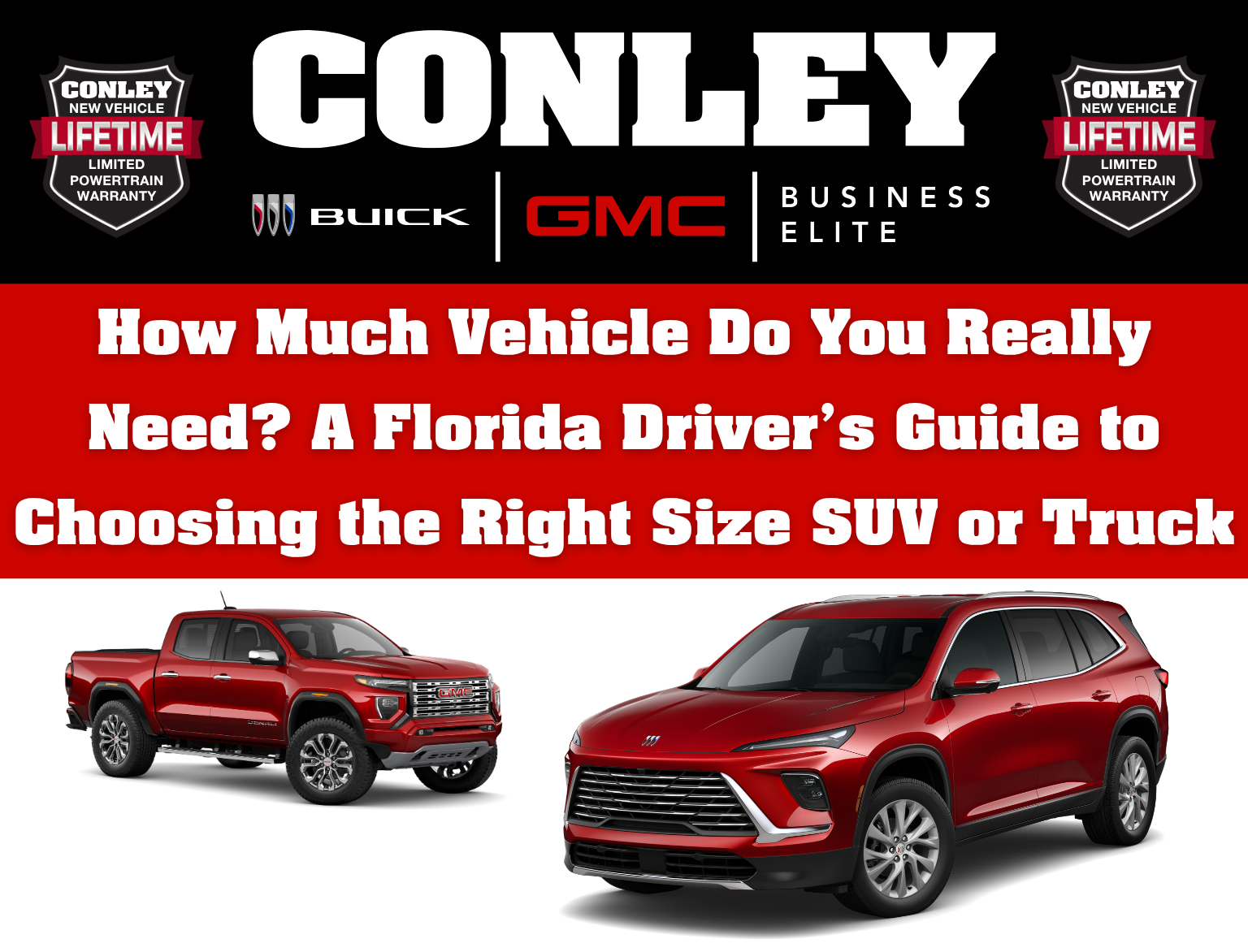
Today's Buick and GMC lineups give drivers an enormous range of choices, from compact crossovers and midsize SUVs to three-row family vehicles, midsize pickups, full-size trucks and enormous SUVs.
A shopper could walk into Conley Buick GMC in Bradenton, Florida, intending to buy a compact SUV and discover that a larger vehicle makes much more sense.
Another shopper could arrive convinced they need a full-size SUV and realize a smaller vehicle can handle 99% of their lifestyle while being easier to park and drive every day.
So how much vehicle do you actually need?
Forget what's biggest.
Forget what's most expensive.
Let's figure out what's right.
Start With the 90% Rule
Here's one of the best ways to approach vehicle shopping:
What will you do with this vehicle 90% of the time?
Not twice a year.
Not during the hypothetical cross-country camping expedition you've been talking about since 2019.
What happens on a normal Tuesday?
Do you commute alone?
Take children to school?
Carry clients?
Transport sports equipment?
Tow a boat?
Visit construction sites?
Drive around Bradenton and Sarasota?
Make frequent highway trips?
Carry six passengers?
The vehicle that handles your real life exceptionally well will usually be a better choice than one optimized around rare situations.
The Case for Going Small
There's a reason compact SUVs have become so popular.
For many drivers, they're enough.
Vehicles such as the Buick Envista, Buick Encore GX and GMC Terrain provide SUV practicality without the footprint of a full-size vehicle.
That matters more than people sometimes realize.
A smaller SUV can be easier to:
Park.
Maneuver through crowded lots.
Fit inside a garage.
Navigate downtown areas.
Drive through tight residential streets.
Use as an everyday commuter.
And today's smaller SUVs don't necessarily feel basic.
Modern Buick and GMC models can offer large displays, advanced safety technology, smartphone connectivity, premium styling and comfort features that once required moving into a significantly larger vehicle.
If you're mostly carrying one to four people and don't have substantial towing or cargo requirements, a smaller SUV may be all the vehicle you need.
Think About Your Garage Before Your Driveway
This sounds ridiculous until you buy a vehicle that barely fits.
Garages aren't getting bigger simply because vehicles are.
Before purchasing a larger SUV or pickup, measure your available space.
Not just length.
Consider width.
Mirror clearance.
Garage-door height.
Storage cabinets.
Bicycles.
Trash cans.
Workbenches.
And the amount of room you'll need to actually open the doors.
A truck that technically fits but requires everyone to perform gymnastics to get out isn't necessarily a great fit.
If you park outside, this matters less.
But for garage-kept vehicles, physical dimensions should be part of the buying decision.
Florida Parking Lots Deserve Consideration, Too
If you've ever tried maneuvering a full-size vehicle through a packed Florida shopping center in January, you understand.
Parking should not determine your entire vehicle purchase.
But it shouldn't be ignored either.
If most of your driving involves:
School pickup lines.
Grocery stores.
Restaurants.
Downtown Sarasota.
Medical offices.
Shopping centers.
Parking garages.
A smaller SUV or midsize truck can offer real everyday convenience.
This is where something like the GMC Canyon becomes particularly interesting.
The Canyon gives drivers genuine pickup-truck utility in a midsize package.
For someone who wants an open bed, truck capability and rugged styling but doesn't need the dimensions of a full-size Sierra, that can be a very attractive middle ground.
When Does a Buick Envision Make More Sense?
Move beyond the smallest SUVs and you enter an interesting part of the market.
The Buick Envision is designed for drivers who want a more substantial premium SUV experience without jumping into a large three-row vehicle.
That's a sweet spot for many buyers.
Maybe the children have moved out.
Maybe you rarely carry more than four people.
Maybe you want room for luggage, golf clubs, groceries and everyday cargo but don't need three rows of seating.
Maybe you simply want something comfortable and upscale without driving a massive vehicle.
That's the key.
Buying the right size vehicle isn't about maximizing space.
It's about having enough space without paying for and maneuvering space you rarely use.
The Third-Row Question
Here's where vehicle shopping gets more complicated.
Do you need a third row?
If you regularly carry six or seven people, the answer is easy.
Yes.
But many buyers aren't that clear-cut.
Maybe you have two children but frequently bring their friends.
Maybe grandparents visit.
Maybe you carpool.
Maybe you take road trips with extended family.
Maybe the third row would only be used occasionally, but those occasions are important.
That's where vehicles such as the GMC Acadia become compelling.
The Acadia provides three-row flexibility without immediately requiring buyers to move into the largest SUV GMC makes.
You can use the additional seating when needed and take advantage of cargo flexibility when you don't.
For many families, that combination hits the sweet spot.
Think About Your Kids Five Years From Now
Here's a mistake that's easy to make:
Buying for your family exactly as it exists today.
Children grow.
Fast.
Two young children in the second row might leave plenty of space.
Two teenagers, backpacks, sports equipment and luggage?
Different story.
If you're planning to keep a vehicle for many years, think about how your passengers will change during that ownership period.
Will car seats become sports equipment?
Will elementary-school passengers become six-foot teenagers?
Will another child join the family?
Will you start taking more road trips?
Sometimes buying slightly more vehicle today prevents you from needing an entirely different vehicle sooner than expected.
When the Yukon Starts Making Sense
Then we reach the full-size SUV.
The GMC Yukon isn't trying to pretend it's compact.
That's the point.
For drivers who genuinely need substantial passenger space, cargo flexibility, towing capability and full-size SUV utility, moving up can make perfect sense.
Large families are an obvious example.
But they're not the only ones.
Someone who regularly tows a boat may have completely different needs from a commuter.
Someone who takes long family road trips may value passenger space far more.
Someone carrying large amounts of luggage or recreational equipment may appreciate the additional capacity every weekend.
A full-size SUV may seem excessive for one driver and absolutely necessary for another.
Again, lifestyle determines value.
And Then There's the Yukon XL
What happens when a Yukon still isn't enough?
That's where the GMC Yukon XL enters the conversation.
The XL format provides additional overall length and cargo capacity, making it especially appealing for drivers who need to combine passenger seating with substantial storage.
That's an important distinction.
Plenty of vehicles can carry a lot of passengers.
The problem is what happens to the luggage once all those passengers climb aboard.
Imagine a large family heading across Florida for vacation.
Seven people.
Seven bags.
Coolers.
Beach gear.
Maybe a stroller.
Suddenly, passenger count is only half of the equation.
A larger SUV can provide the space to carry the people and the stuff that comes with the people.
Cargo Volume Isn't the Same as Useful Cargo Space
Specification sheets are helpful.
Reality is better.
Two cargo areas with similar numbers can feel completely different depending on shape, seat configuration, loading height and the objects you're actually carrying.
That's why we recommend bringing your lifestyle into the buying process.
Have a large stroller?
Bring it.
Golf frequently?
See how the clubs fit.
Transport musical instruments?
Measure them.
Have a giant dog crate?
Know its dimensions.
You don't have to literally bring everything to the dealership, but you should think about the items you regularly transport.
The best cargo area isn't necessarily the one with the biggest number.
It's the one that works with your stuff.
Don't Buy a Truck Just Because You Occasionally Need a Truck Bed
Pickups are incredibly useful.
But ask yourself how often you actually need the bed.
If you haul dirty, oversized, tall or awkward cargo regularly, a pickup bed is hard to beat.
Landscaping materials?
Absolutely.
Home-improvement supplies?
Great.
Tools?
Perfect.
Motorcycles or recreational equipment?
Now we're talking.
But if the bed would spend 360 days per year empty because you might buy a refrigerator someday, an SUV could potentially make more sense.
Renting or borrowing additional capability on rare occasions can sometimes be smarter than living with it every day.
On the Other Hand, Don't Buy an SUV When You Really Need a Truck
This works both ways.
Some drivers try to make an SUV perform jobs better suited to a pickup.
If you routinely carry things you don't want inside your passenger compartment, a truck deserves serious consideration.
Think:
Mulch.
Gas cans.
Dirty equipment.
Construction supplies.
Fishing equipment.
Large tools.
Wet beach gear.
Home-improvement materials.
There's something incredibly useful about having a cargo area that's physically separated from the passenger cabin.
Throw the dirty stuff in the bed.
Clean it later.
That's a fundamentally different kind of practicality.
Canyon or Sierra?
Once you've decided you want a pickup, there's another question.
Midsize or full-size?
The GMC Canyon makes sense for drivers who want truck capability while keeping overall size relatively manageable.
It can be a great option for daily driving, outdoor recreation and lighter-duty truck use while still delivering the basic advantages of a pickup bed.
The GMC Sierra 1500, on the other hand, moves into full-size territory.
That opens additional possibilities for configurations, powertrains, towing requirements, passenger space and capability.
If you regularly tow, haul or use your truck for demanding work, the additional capability may be extremely valuable.
If you rarely use those capabilities, the Canyon's smaller footprint might make your daily life easier.
There is no universal winner.
That's why both exist.
What About Heavy-Duty Trucks?
Then there are drivers whose answer isn't Canyon or Sierra 1500.
It's Sierra HD.
Heavy-duty pickups exist because some jobs simply demand more truck.
If your towing or hauling requirements extend beyond what a properly configured light-duty truck is designed to handle, moving into the Sierra 2500 HD or 3500 HD family may be appropriate.
But don't buy an HD truck exclusively because the numbers sound impressive.
Heavy-duty capability comes with a larger vehicle and a different driving experience.
If you need it, you'll probably be glad you have it.
If you don't, another truck may fit your lifestyle better.
The right truck is determined by the work.
Boats Change the Conversation in Florida
This is Florida.
We have to talk about boats.
For plenty of Bradenton and Sarasota drivers, towing isn't hypothetical.
It's part of the weekend.
If you own a boat, towing requirements should influence your vehicle choice from the beginning.
Know the weight you're actually towing.
That includes more than the boat itself.
Trailer.
Fuel.
Equipment.
Coolers.
Gear.
Accessories.
The correct tow vehicle needs to be selected based on the complete setup and the manufacturer's ratings for the specific configuration.
This is one area where buying "just enough" vehicle deserves careful consideration.
You want the vehicle appropriately equipped for the job.
How Often Do You Actually Tow?
Frequency matters, too.
Someone towing a significant trailer every weekend has different priorities from someone towing a small trailer twice a year.
Frequent towing may make features designed around trailering much more valuable.
GMC offers a variety of towing and camera technologies on properly equipped trucks and SUVs that can help with tasks such as hitching, maneuvering and monitoring a trailer.
For a frequent tower, those aren't gimmicks.
They're tools.
Don't Forget the People in the Back
Drivers spend so much time evaluating the front seats that rear-seat passengers sometimes become an afterthought.
If you rarely carry anyone, fine.
If you have a family, bring them into the equation.
Sit in the second row.
Try the third row.
Look at legroom.
Look at access.
Consider climate control.
Think about charging devices.
Check cupholders and storage.
Imagine a three-hour drive instead of a three-minute test drive.
A vehicle that feels enormous from the driver's seat can feel surprisingly different from row three.
Road Trips Change What "Enough" Means
A compact SUV might be absolutely perfect for your daily commute.
Then Thanksgiving arrives.
Four people.
Four suitcases.
Gifts.
Cooler.
Dog.
Suddenly, you're playing automotive Tetris in the driveway.
Again, the 90% rule matters.
Don't buy an enormous vehicle exclusively around one trip per year.
But if long-distance family travel is something you genuinely do regularly, additional space can improve the entire experience.
There's a difference between technically fitting and comfortably fitting.
Fuel Economy Deserves Context
Smaller vehicles often have an advantage when it comes to efficiency, but the correct comparison depends on what you're replacing and how you'll use the vehicle.
Don't simply ask:
"Which vehicle gets better mileage?"
Ask:
"Which vehicle gets acceptable mileage while doing everything I actually need?"
A vehicle that uses less fuel but can't perform the job isn't efficient.
Likewise, buying far more capability than you'll ever use may mean accepting operating costs without receiving meaningful benefits.
Efficiency is another balancing act.
Luxury Doesn't Require a Giant Vehicle
This is something Buick demonstrates particularly well.
There was a time when moving into a premium vehicle often meant moving into something physically larger.
That's no longer necessarily true.
Models like the Buick Envista, Encore GX and Envision allow buyers to prioritize design, technology and comfort without automatically choosing a huge SUV.
That can be particularly appealing to downsizers.
Maybe you previously needed a three-row vehicle because children lived at home.
Now you don't.
You may still want premium features.
You simply don't need three rows anymore.
Downsizing the vehicle doesn't have to mean downgrading the experience.
Bigger Vehicles Have Benefits You Can't See on a Spec Sheet
It's easy to make this article sound anti-big-vehicle.
It isn't.
Large vehicles exist because they solve real problems.
Passenger flexibility.
Cargo capacity.
Towing.
Interior room.
Road-trip comfort.
Truck capability.
The ability to carry people and cargo simultaneously.
For the right owner, these benefits are worth far more than the convenience of driving something smaller.
The point isn't to buy small.
The point is to buy intentionally.
Smaller Vehicles Have Benefits You Can't See on a Spec Sheet, Too
The reverse is also true.
Driving something smaller can make everyday life easier in subtle ways.
Parking takes less thought.
Garages feel larger.
Tight turns are easier.
Crowded areas become less stressful.
You may consume less fuel depending on the vehicle and driving conditions.
If the smaller vehicle still handles everything you need, those conveniences add up over years of ownership.
Try the "Empty Seat" Test
Here's an unusual way to evaluate your needs.
For the next week, pay attention to your current vehicle.
How many seats are empty?
How much cargo space is unused?
How often is the truck bed empty?
How often do you actually tow?
How often do you fill the third row?
Now reverse the question.
How often do you wish you had another seat?
How often do you run out of cargo space?
How often do you borrow someone else's truck?
How often does your vehicle prevent you from doing something?
Your current vehicle is giving you data.
Use it.
Don't Forget What You Want
After all this practical analysis, there's something important to remember:
You're allowed to buy a vehicle simply because you love it.
Maybe you don't need a Yukon Denali Ultimate.
Maybe you don't need a Sierra AT4X.
Maybe an Envista would technically accomplish everything you need, but you've wanted a truck for ten years.
Vehicles aren't spreadsheets.
For most people, they're one of the largest purchases they'll make and something they'll interact with nearly every day.
Practicality matters.
So does enjoyment.
The best purchase often exists somewhere between the two.
Compare Sizes Side by Side at Conley Buick GMC in Bradenton, FL
This is one of the biggest advantages of shopping somewhere with a broad selection.
You don't have to make the decision based on pictures.
At Conley Buick GMC, you can compare different types of Buick and GMC vehicles and see how dramatically the experience changes as you move through the lineup.
Look at an Envista.
Sit inside an Envision.
Compare a Terrain with an Acadia.
Try the third row of a Yukon.
Park a Canyon.
Drive a Sierra 1500.
If you need serious truck capability, explore Sierra HD models.
Sometimes five minutes inside two different vehicles answers a question that hours of online research couldn't.
Conley Buick GMC offers a large selection of new Buick and GMC vehicles along with pre-owned cars, trucks and SUVs, financing resources, certified service, parts and commercial vehicles in Bradenton, Florida.
We proudly serve drivers throughout Bradenton, Sarasota, Lakewood Ranch, Palmetto, Venice and Florida's Gulf Coast.
The goal isn't to put the biggest vehicle possible in your driveway.
And it isn't to convince you to settle for the smallest.
It's to find the one where, six months after you buy it, you realize:
This is exactly enough vehicle for me.
Visit Conley Buick GMC at 800 Cortez Road West in Bradenton, FL, and compare your options for yourself.