


Blog / Bradenton Buick GMC Dealer

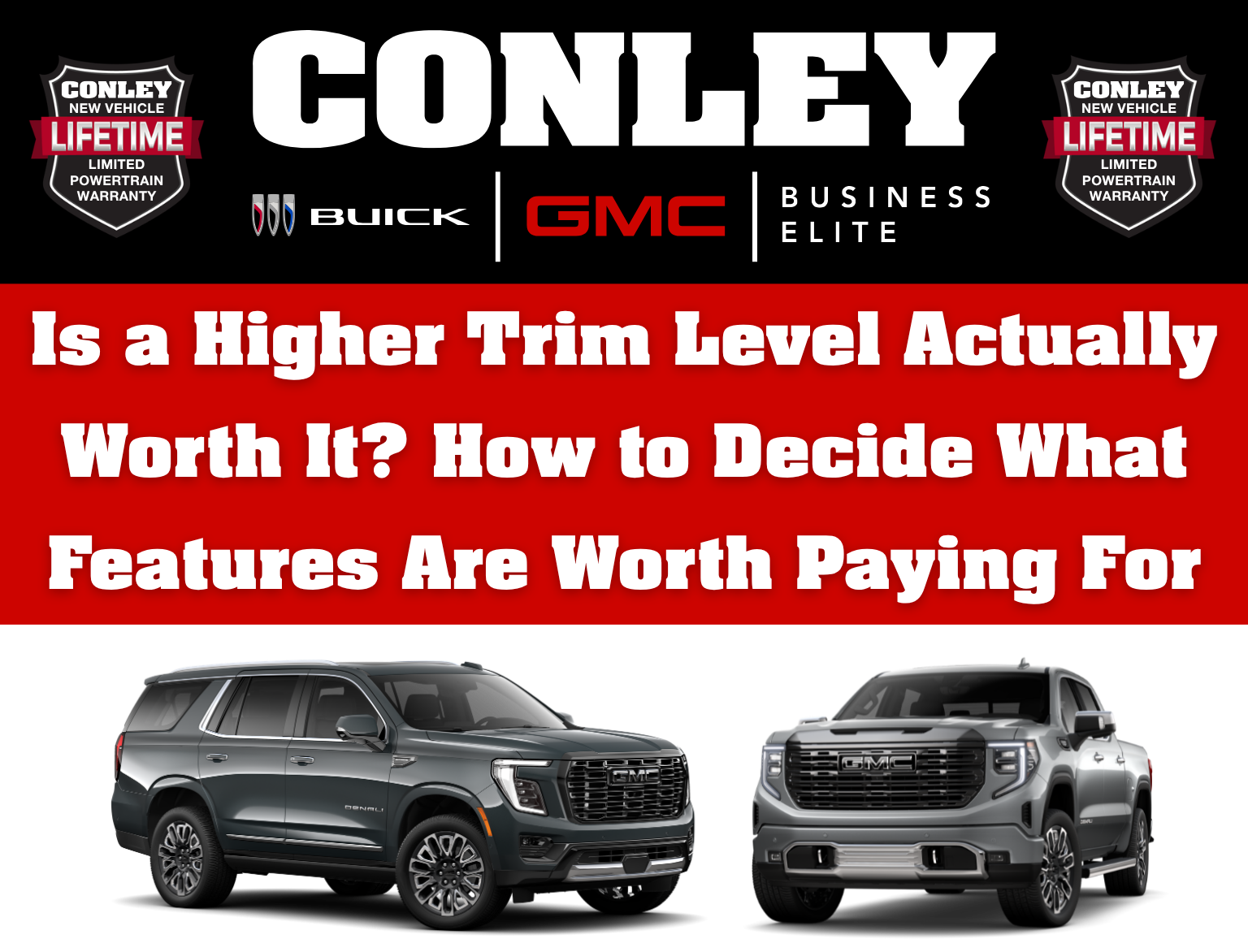
Is a Higher Trim Level Actually Worth It? How to Decide What Features Are Worth Paying For

Is a Higher Trim Level Actually Worth It? How to Decide What Features Are Worth Paying For

Shopping for a new vehicle used to seem relatively simple.

Choose the model.

Pick a color.

Decide whether you wanted a few options.

Drive home.

Today?

You can choose between multiple trims, appearance packages, powertrains, wheel sizes, technology packages, driver-assistance features, luxury upgrades, off-road equipment and enough combinations to make two versions of the same vehicle feel completely different.

Look at the modern GMC lineup and you'll see names like Elevation, AT4, AT4X, Denali and Denali Ultimate.

Shop Buick and you'll find different interpretations of the same idea, including Preferred, Sport Touring and Avenir, depending on the model.

That creates an important question:

Is moving up to the expensive trim actually worth it?

The answer isn't always yes.

But it isn't always no, either.

At Conley Buick GMC in Bradenton, Florida, we believe the smarter question is what you're actually getting for the additional money—and whether those features will improve the way you use your vehicle.

Let's break it down.

Stop Thinking of Trims as "Good, Better, Best"

This is one of the easiest mistakes to make when shopping for a new vehicle.

We naturally assume the trim hierarchy works like this:

Base trim = okay.

Middle trim = better.

Top trim = best.

But that's not really how modern vehicles work.

A better way to think about trims is:

Different versions of the vehicle for different drivers.

Consider GMC.

A driver interested in premium comfort might gravitate toward a Denali.

Someone who wants a more rugged personality and genuine off-road-oriented equipment may prefer an AT4.

A buyer looking for even more extreme capability might consider an AT4X where available.

Another shopper may love the styling and equipment of an Elevation and have absolutely no reason to move beyond it.

"Best" depends on the person sitting behind the wheel.

Start With the Features You'll Use Every Day

This is where spending more can make a lot of sense.

People often evaluate expensive options based on how exciting they sound in the showroom.

Instead, evaluate them based on frequency.

Suppose an upgraded trim gives you a feature you'll use twice a year.

That's nice.

Now suppose another feature improves something you interact with every single time you drive.

Over five years of ownership, that's potentially thousands of uses.

Things like:

Heated and ventilated seats.

Premium audio.

Larger infotainment displays.

Surround-view camera systems.

Head-up displays.

Power-adjustable seating.

Driver-assistance technology.

Premium interior materials.

Wireless smartphone connectivity.

Those aren't features you'll necessarily show your neighbor every weekend.

They're features that can make ordinary Tuesday mornings better.

That's an important distinction.

The "Cost Per Drive" Test

Here's an interesting way to think about vehicle options.

Instead of asking:

"Is this feature worth $2,000?"

Ask:

"How often will I use it?"

Imagine keeping a vehicle for six years and driving it roughly 300 days per year.

That's approximately 1,800 days behind the wheel.

An upgrade that costs $2,000 but improves your experience nearly every time you drive works out to a little over a dollar per driving day.

Obviously, that's a simplified calculation.

But it changes how you think about value.

Compare that with an expensive option you might use five times.

Suddenly, the less exciting everyday feature might be the better investment.

When GMC Denali Starts Making Sense

Denali has become one of the most recognizable names in GMC's lineup.

And there's a reason.

Denali models are designed to combine the underlying capability of GMC vehicles with a more premium experience.

That can mean distinctive exterior styling, upgraded interior materials, additional technology, premium seating and comfort features, larger displays or wheels, and other enhancements depending on the vehicle.

The important part is that you're not necessarily moving away from capability to get luxury.

That's the appeal.

Consider something like a GMC Sierra Denali.

It's still a truck.

It can still be selected for serious towing and hauling applications when properly configured.

But the environment surrounding the driver can feel substantially different from what people traditionally associate with a work-oriented pickup.

For someone who spends a significant amount of time in their truck, that matters.

Then There's Denali Ultimate

If Denali asks, "What if a GMC were more luxurious?"

Denali Ultimate essentially asks:

"How far can we take that idea?"

Denali Ultimate sits at the premium end of portions of the GMC lineup and is intended for buyers who want capability without sacrificing high-end materials, design and technology.

Vehicles such as the GMC Sierra, Yukon and Yukon XL demonstrate why this combination has become so appealing.

A Yukon XL Denali Ultimate, for example, isn't simply transportation for a large family.

It's the type of vehicle someone could use for a long Florida road trip, towing duty, business transportation, daily commuting and family hauling without feeling like they had to choose between utility and luxury.

Is that necessary?

No.

But that's not really the question.

If you're going to spend hundreds or thousands of hours inside the vehicle, premium comfort may have genuine value to you.

AT4 Is a Completely Different Proposition

This is why comparing trims purely by price doesn't work.

AT4 isn't simply "Denali but cheaper."

It represents a different philosophy.

AT4 models emphasize a more adventurous, rugged side of GMC.

Depending on the model, AT4 equipment can include off-road-oriented suspension components, all-terrain tires, increased capability, unique styling and other equipment intended for drivers whose adventures don't always stop where the pavement does.

For Florida drivers, that can make sense in more situations than you might initially think.

Camping.

Boat ramps.

Unpaved access roads.

Hunting property.

Rural job sites.

Beach-adjacent adventures.

Weekend trips.

AT4 isn't necessarily about spending every Saturday rock crawling.

It's about having additional capability available when the road gets less predictable.

What About AT4X?

Then GMC takes the concept another step.

On vehicles where it's offered, AT4X pushes farther into serious off-road capability while still maintaining the comfort and technology expected from a modern GMC.

This is where knowing yourself as a buyer becomes important.

Do you genuinely want the additional capability?

If yes, fantastic.

If you're never going to use it and simply like rugged styling, another trim might provide the appearance and equipment you want at a different price point.

Neither decision is wrong.

The key is understanding what you're paying for.

The GMC Canyon Is a Great Example

The GMC Canyon demonstrates how dramatically trim choice can change the personality of one vehicle.

At its core, the Canyon is a midsize pickup.

But different versions can make it feel like an everyday truck, an adventure vehicle or something approaching a premium off-road machine.

That's important because "I want a Canyon" doesn't completely answer the shopping question.

How are you going to use it?

Do you commute every day?

Do you tow?

Do you go off-road?

Is parking a full-size truck difficult where you live?

Do you prioritize technology?

Do you want luxury?

Do you care more about rugged capability?

Once you answer those questions, the trim decision becomes much easier.

Buick Takes a Different Approach

Buick shoppers face a similar decision, but Buick's lineup has a different personality.

Vehicles such as the Envista, Encore GX, Envision and Enclave focus heavily on combining everyday practicality with premium design and comfort.

That's what makes trims such as Sport Touring and Avenir interesting.

A buyer might start by looking at the vehicle purely because the size and price make sense.

Then the trim allows them to decide what personality they want.

When Sport Touring Makes Sense

Buick's Sport Touring, or ST, treatment is particularly interesting for shoppers who care about design.

Not everyone wants chrome-heavy luxury.

Some buyers want something darker, sportier and more modern.

That's where ST can become appealing.

Depending on the model, Sport Touring treatments can introduce unique wheels, darker exterior accents, ST-specific details and other styling changes.

Take something like the Buick Envista Sport Touring.

The fundamental vehicle doesn't suddenly become impractical because you chose the stylish version.

You still have the everyday usability of the Envista.

You simply get a vehicle with more visual attitude.

For someone who walks into the garage every morning and cares about what they see, styling has value too.

Avenir Is About a Different Kind of Value

At the other end of Buick's personality spectrum is Avenir.

Avenir is Buick's premium expression.

Rather than focusing on a sportier appearance, Avenir models typically emphasize upscale design, comfort, materials and amenities.

Again, that doesn't mean everyone should buy one.

It means a particular type of buyer may find the additional equipment worthwhile.

Someone driving five minutes to work may evaluate luxury features differently from someone spending an hour or more in the vehicle every day.

Someone who frequently takes long road trips may care much more about seating comfort.

Someone transporting clients may place greater value on interior presentation.

Your lifestyle determines the value.

Don't Forget About Florida Heat

Here's one factor shoppers in other parts of the country may not appreciate quite as much:

Bradenton gets hot.

Very hot.

That changes the value equation for certain features.

Ventilated seating might sound like a luxury on a specification sheet.

Spend an August afternoon with your vehicle sitting in a Florida parking lot and your opinion may change quickly.

Remote-start capability can become more valuable.

Automatic climate features become more noticeable.

Window tinting and interior materials matter.

Even something as simple as the color combination you choose can affect your experience.

This is why buying based exclusively on national reviews can be misleading.

A feature's value depends partly on where you live.

Cameras Are Another Feature Worth Considering Carefully

Vehicles have gotten larger.

Parking spaces have not received the memo.

For trucks and full-size SUVs, advanced camera technology can become one of those features that sounds unnecessary until you start using it.

Depending on model and configuration, modern GMC vehicles can offer sophisticated camera views designed to help drivers maneuver, park, connect trailers and see areas around the vehicle.

For someone driving a large Sierra, Yukon or Yukon XL around Bradenton and Sarasota every day, that technology can have practical value.

You may appreciate it more in a Publix parking lot than you ever do on an empty highway.

And that's exactly the point.

Everyday usefulness matters.

Towing Technology Can Be Worth More Than Horsepower

Truck buyers naturally love engine specifications.

Horsepower.

Torque.

Maximum towing capacity.

Those numbers matter.

But if you actually tow, technology that makes towing easier may ultimately improve your ownership experience more than simply chasing the largest possible number.

Modern GMC trucks can offer technologies designed to assist with hitching, trailer monitoring, camera visibility and other aspects of towing, depending on model and equipment.

Think about someone regularly towing a boat around Southwest Florida.

The ability to confidently hitch, maneuver and monitor the trailer can be incredibly valuable.

Capability isn't simply about what the truck can pull.

It's about how confidently the driver can use that capability.

Don't Pay for Capability You Don't Need

There's a flip side to all of this.

Higher trims aren't automatically smarter purchases.

Suppose you don't tow.

You don't go off-road.

You rarely take long trips.

You're indifferent about premium audio.

You don't care about larger wheels.

And the standard seating is perfectly comfortable.

Great.

Don't let anyone convince you that you need features simply because they're available.

One of the smartest vehicle purchases you can make is a lower or mid-level trim that includes exactly what you need and nothing you don't.

Money saved on unnecessary equipment is still money saved.

But Don't Automatically Reject Features as "Luxuries"

This mistake goes the other direction.

Sometimes shoppers eliminate a feature because it sounds unnecessary without considering how often they'll actually use it.

A great example is a surround-view camera.

Is it necessary to drive?

No.

Neither are power windows.

But convenience accumulates.

A feature used every day for six years can become something you appreciate far more than an impressive specification you rarely use.

The goal isn't minimalism.

It's intentionality.

Think About Resale Appeal, Too

Your ownership experience isn't necessarily the end of the vehicle's story.

Eventually, you may trade or sell it.

Trim level, equipment, condition, mileage, market demand and other factors can all influence resale value.

Popular combinations may be attractive to future used-vehicle shoppers because they want the same comfort, technology, appearance or capability that originally appealed to you.

That doesn't mean you should buy an expensive trim exclusively for resale.

But when comparing the true cost difference between two vehicles, future value deserves consideration alongside today's purchase price.

Warranty Coverage Can Change the Long-Term Equation

Long-term ownership is another area where dealership benefits matter.

Conley Buick GMC offers a Lifetime Limited Powertrain Warranty on qualifying vehicles at no additional cost.

For qualifying purchases, the program provides coverage for major powertrain components for as long as the original purchaser owns the vehicle, provided required maintenance guidelines and program terms are followed.

That changes the conversation from simply:

"What does this vehicle cost today?"

to:

"What does ownership look like years from now?"

If you're buying a vehicle you plan to keep for a long time, long-term protection can become a significant part of the overall value proposition.

Always see Conley Buick GMC for complete eligibility, coverage, maintenance requirements, exclusions and warranty details.

Don't Forget the Dealership After You Buy

The relationship with your vehicle doesn't end when you drive away.

Eventually you'll need:

Oil changes.

Tires.

Brakes.

Filters.

Batteries.

Routine maintenance.

Repairs.

Parts.

Possibly warranty work.

That's why choosing a dealership isn't completely separate from choosing the vehicle.

Conley Buick GMC is a full-service dealership with dedicated sales, service and parts operations in Bradenton.

Having one place where you can purchase, maintain and service the vehicle simplifies long-term ownership.

The Best Trim Is the One You'd Buy Again

Here's a simple test.

Imagine yourself three years after buying the vehicle.

Which sentence would bother you more?

"I paid for a few features I don't use very often."

Or:

"I wish I would've gotten that feature."

There's no universal answer.

Some buyers hate paying for things they don't need.

Others would rather spend more upfront and avoid wishing they'd chosen differently.

Know which type of buyer you are.

Build Your Personal "Must-Have" List

Before shopping, divide features into three categories.

Must Have

Features that genuinely influence whether you'll purchase the vehicle.

Maybe that's four-wheel drive.

A particular engine.

Three-row seating.

Ventilated seats.

Towing equipment.

A certain safety or driver-assistance feature.

Nice to Have

Features you'd enjoy but wouldn't choose the entire vehicle around.

Premium audio might fall here.

So might larger wheels or an appearance package.

Don't Care

This category is equally important.

If you genuinely don't care about a feature, don't let it influence the purchase simply because the brochure tells you it's impressive.

Once you've created those three categories, comparing trims becomes much easier.

Test Drive More Than One Version

Here's another piece of advice that sounds obvious but is often overlooked.

If you're seriously deciding between two trims, drive both.

Pictures can't tell you how a seat feels.

A specification sheet can't tell you whether you'll notice the upgraded audio system.

You can't fully appreciate a camera system without using it.

Interior materials need to be seen and touched.

Wheel and tire combinations can affect the character of a vehicle.

Even something as simple as interior color can look dramatically different in person.

The difference between trims becomes much easier to understand when they're sitting next to each other.

Find Your Buick or GMC at Conley Buick GMC in Bradenton, FL

At Conley Buick GMC, we don't believe the right vehicle is automatically the most expensive one.

It's the one that makes the most sense for you.

Located at 800 Cortez Road West in Bradenton, Florida, Conley Buick GMC offers new Buick and GMC vehicles, quality pre-owned vehicles, financing resources, certified service and parts support for drivers throughout Bradenton, Sarasota, Venice, Lakewood Ranch and Florida's Gulf Coast.

Whether you're comparing a GMC Sierra 1500 Elevation and Denali, Canyon AT4 and AT4X, Yukon Denali Ultimate, Buick Envista Sport Touring, Envision Avenir, or another Buick or GMC, take the time to look beyond the trim badge.

Ask what you're getting.

Ask what you'll actually use.

Ask what will make you enjoy the vehicle more five years from now.

Because the most valuable feature isn't necessarily the most expensive one.

It's the one you still appreciate every time you get behind the wheel.
Posted in:

Related Posts

Does Car Color Actually Matter in Florida? A Surprisingly Practical Guide to Choosing Your Next Vehicle Color

Does Car Color Actually Matter in Florida? A Surprisingly Practical Guide to Choosing Your Next Vehicle Color

You found the vehicle. Right model. Right trim. Right engine. Right features. Right price. There's just one problem. What color do you want? Vehicle color seems like one of the least complicated parts of buying a new car, truck or SUV. Pick the one that looks best. Done. But when you live in Florida, there's actually more to the decision than appearance. Sunlight, heat, pollen, rain, road grime, water spots, interior temperatures and even how often you're willing to wash your vehicle can influence which colors you'll enjoy owning. And then there's the most important consideration: Some vehicles simply look ridiculously good in certain colors. At Conley Buick GMC in Bradenton, Florida, shoppers can find Buick and GMC vehicles in everything from understated neutrals to bold metallic finishes, blacked-out combinations and colors that completely change a vehicle's personality. So before automatically choosing black, white or silver, let's answer a surprisingly complicated question: Does your vehicle's color actually matter in Florida? Yes, Dark Vehicles Can Get Hot Let's get the obvious question out of the way. Florida sunshine is intense. And darker exterior surfaces generally absorb more solar energy than lighter ones. That doesn't mean buying a black vehicle in Florida is a terrible idea. Far from it. Black remains popular for a reason. A black GMC Sierra, for example, can look fantastic—especially when paired with dark wheels and black exterior accents. A black Buick Envista Sport Touring can have an entirely different personality than the same vehicle in a lighter finish. But if your vehicle regularly spends hours parked outside, exterior color is one factor worth considering. There's another factor that's arguably even more important. Don't Forget About Interior Color People obsess over exterior paint and sometimes barely consider the cabin. But that's where you're actually sitting. If Florida heat is one of your concerns, think about the complete vehicle. Exterior color. Interior color. Seat material. Window tint. Ventilated seating. Remote-start capability. Climate-control features. Where the vehicle will normally be parked. A dark exterior with a dark interior sitting in direct Bradenton sunshine creates a different experience from a vehicle regularly parked inside a garage. That's why there isn't one universal "best Florida color." Your parking situation matters. Black Looks Incredible — for Approximately 11 Minutes After You Wash It Black vehicles deserve their own section. When clean, they're hard to beat. A freshly detailed black GMC Yukon Denali or Sierra Denali can look incredibly upscale. Black can emphasize body lines. Chrome pops against it. Dark wheels create a sinister monochromatic appearance. And on Sport Touring or other black-accented vehicles, the result can be especially sharp. Then Florida happens. Pollen. Dust. Afternoon rain. Water spots. Road grime. Black tends to reveal contamination more easily than many lighter or mid-tone colors. That's not a reason to avoid it. It's simply part of the ownership equation. If you're the type of person who enjoys washing and detailing your vehicle, black can be tremendously rewarding. If your philosophy is "the rain will wash it eventually," another color might make life easier. White Is Popular for a Reason There's a reason you see so many white vehicles throughout Florida. White is clean. Timeless. Easy to pair with different wheel designs. It provides strong contrast with black trim. And lighter exterior colors can be appealing in a sunny climate. White can look particularly good on vehicles with aggressive dark accents. Imagine a white GMC Canyon AT4 with dark wheels and rugged exterior details. Or a white Buick Sport Touring model with black accents. The contrast makes the design elements stand out. White also tends to hide certain types of dust better than black. Of course, Florida has a special talent for finding entirely new ways to make any color dirty. Silver and Gray Might Be the Low-Maintenance Champions If your primary objective is: "I want my vehicle to look reasonably clean without thinking about it constantly," silver and certain gray finishes deserve serious consideration. These colors tend to be forgiving when it comes to light dust and everyday road grime. They're also neutral enough to work across almost any type of vehicle. A gray GMC Sierra AT4 can look rugged. The right metallic gray on a Buick Envision can look sophisticated. Silver on a family SUV can look clean and timeless. And modern gray isn't necessarily boring. Automakers now offer shades ranging from light metallic silver to deep charcoal and more distinctive contemporary finishes. Color doesn't need to shout to have personality. Then There Are the Colors You Buy With Your Heart Red. Blue. Deep metallic finishes. Unusual premium colors. These are the colors that make someone walk across a parking lot and say: "That's the one." And there's nothing wrong with that. Vehicle purchases aren't purely mathematical decisions. You're potentially going to look at this thing every day for years. If a particular color makes you turn around after parking just to look at the vehicle again, that has value. A bold color can also completely change how a vehicle presents itself. A bright or deep blue GMC Canyon can feel adventurous. A rich red Sierra can emphasize the truck's size and styling. A distinctive metallic finish on a Buick can make an already premium-looking vehicle feel much more special. Sometimes the practical answer isn't the right answer. Sometimes you should buy the color you love. Metallic Paint Changes More Than You Might Think Paint isn't simply "blue" or "gray" anymore. Metallic and pearl finishes interact with light. That means the same vehicle can look dramatically different depending on where it's parked. Bright Florida sunshine can bring out metallic flake and depth that isn't nearly as obvious under indoor dealership lighting. Cloudy weather can make the color appear darker. Sunset can reveal undertones you didn't notice earlier. That's why it's always a good idea to look at a vehicle's paint outside before making the final decision. Walk around it. Look at it from different angles. Step back. Look at it in direct sunlight and shade. A small paint sample on a website can't fully communicate how a color behaves across an entire SUV or pickup. The Trim Level Can Change Which Color Looks Best Here's where vehicle design gets interesting. Color doesn't exist independently from trim. The same paint can look completely different depending on the wheels, grille, badging and exterior accents surrounding it. Consider GMC Denali. Denali models often incorporate premium exterior detailing that can create strong contrast with darker or lighter paints. Now consider GMC AT4. Its rugged styling creates a different personality entirely. Then look at Buick Sport Touring. ST models use sportier visual details and dark exterior accents that can dramatically change how certain colors appear. This is why you shouldn't choose a paint color from an online configurator without considering the actual trim. You're choosing a combination. Black-on-Black Is a Whole Personality There are regular black vehicles. And then there's: Black paint. Black wheels. Black accents. Dark interior. That's not simply a color anymore. That's a statement. The black-on-black look works particularly well on vehicles with sporty or aggressive styling. A Buick Envista Sport Touring can become much more dramatic when its ST details are combined with a dark exterior. A blacked-out GMC Sierra can look imposing. A dark Yukon can go from family SUV to something that looks like it should be transporting a head of state. Is it the easiest combination to keep spotless? Absolutely not. Does it look fantastic when clean? Also absolutely. Your Wheels Matter More Than You Think Here's something shoppers often discover while comparing vehicles side by side: Sometimes what you thought was a paint preference was actually a wheel preference. Wheels occupy a large amount of visual space. Dark wheels can make lighter paint look sportier. Bright-finish wheels can create contrast against dark colors. Larger wheel designs can make the entire vehicle appear different. Before rejecting a color, look at the entire combination. Paint. Wheels. Grille. Trim. Badging. Interior. Two vehicles with identical paint but different exterior packages can feel surprisingly different. Think About Where You'll Park Do you have a garage? A carport? Covered parking at work? Or is your vehicle going to spend most of its life outdoors? That matters in Florida. Constant exposure to sunlight, rain, environmental contaminants and other elements makes regular exterior care important regardless of paint color. If the vehicle lives outside, washing and protecting the finish becomes more important. If it's garaged at home and covered at work, your ownership environment is completely different. Again, there's no universally correct paint color. There are simply colors that fit different owners and circumstances better. Florida Rain Creates the Water-Spot Problem You washed your vehicle yesterday. Naturally, it rains today. For eleven minutes. Then the sun returns immediately. Welcome to Florida. Water spots can be particularly noticeable on certain darker finishes. Regular washing and proper drying can help maintain the appearance, and keeping a layer of appropriate paint protection on the vehicle can make ongoing care easier. This is one of those small ownership realities you don't necessarily think about while choosing a vehicle under dealership lights. The color that looks best perfectly clean may not necessarily be the color that's easiest to keep looking that way. What About Lovebugs? Florida residents knew this section was coming. Certain times of year bring another challenge for vehicle paint: Bugs. Lots of bugs. Bug residue isn't something you want to leave sitting on the exterior indefinitely. Regardless of vehicle color, removing contaminants promptly and using proper washing techniques can help maintain the finish. The same principle applies to bird droppings, tree sap and other environmental contamination. Your paint is designed to protect the vehicle. But protecting the paint itself is part of good long-term ownership. Beach Trips Create Their Own Challenges Bradenton gives us access to some incredible coastal destinations. It also gives vehicles exposure to environments that deserve extra attention. Sand. Salt. Moisture. Sun. If your vehicle regularly spends time around coastal areas, exterior maintenance becomes even more important. That doesn't mean you should leave the new Yukon in the garage every time the family wants to go to the beach. Vehicles are meant to be used. It simply means occasionally giving the vehicle some attention afterward. A little maintenance today can help preserve the appearance you paid for. Color Can Change How Large a Vehicle Looks This is more visual psychology than mechanical engineering, but it's interesting. Dark colors can visually reduce or streamline certain shapes. Light colors can make body surfaces and contrasts more apparent. Bright colors naturally draw attention. On something as large as a GMC Yukon XL or Sierra HD, paint selection can significantly influence the vehicle's visual presence. A black Yukon XL can look sleek and imposing. A white one may emphasize the contrast of dark glass and trim. A bold Sierra color can make an already large pickup impossible to ignore. Same vehicle. Different personality. Your Interior Color Changes the Personality Too Exterior paint gets all the attention, but don't overlook interior combinations. A light premium interior can make a cabin feel airy and upscale. A dark interior can feel sporty, sophisticated and easier to coordinate with certain exterior finishes. Different materials and accent treatments can completely change the character of the vehicle. This becomes particularly noticeable as you move into premium trims such as Buick Avenir, GMC Denali and Denali Ultimate, depending on model availability. If you're spending an hour every day inside the vehicle, the color you see from the driver's seat may ultimately matter more than the color everyone else sees outside. Think About Cleaning the Interior, Too Florida lifestyles can be messy. Beach sand. Kids. Dogs. Golf equipment. Sports uniforms. Fishing gear. Work clothes. Coffee. An interior that looks stunning in a showroom also needs to fit your actual life. Someone without children who keeps their vehicle immaculate may love a lighter interior. A family with three children, two dogs and a permanent supply of Goldfish crackers in the second row may evaluate that decision differently. Neither choice is wrong. The key is knowing yourself. Does Vehicle Color Affect Resale Value? Color can influence desirability on the used market, although it's only one part of a much larger resale equation. Mileage matters. Condition matters. Vehicle history matters. Trim and equipment matter. Market demand matters. And yes, color can matter. Neutral colors such as black, white, gray and silver tend to appeal to broad groups of buyers. More unusual colors may appeal strongly to a smaller audience. But that doesn't automatically make a bold color a bad choice. If you're keeping the vehicle for many years, buying a color you don't like solely because you think someone else might prefer it someday can be a strange compromise. Future resale matters. So does enjoying the vehicle while you actually own it. Don't Choose From a Computer Screen This might be the most useful piece of advice in the entire article. See the color in person. Phone displays vary. Computer monitors vary. Photography changes colors. Lighting changes colors. Online vehicle renderings can only tell you so much. If you're deciding between two colors, see actual vehicles outside. Florida sunshine is one of the best paint demonstrations available. Look at the vehicle from different angles. Look at it next to another color. Stand 30 feet away. Then get close. You may immediately change your mind. Use the "Parking Lot Test" Here's another unconventional buying trick. Imagine you've owned the vehicle for six months. You're walking through a crowded parking lot toward it. Which one do you want to see waiting for you? Not which color seems safest. Not which one the salesperson likes. Not which one your neighbor would choose. Which one makes you happy that it's yours? That's your parking lot test. For a purchase you may live with for years, that's not an insignificant question. The Best Florida Vehicle Color Is... Ready for the definitive answer? There isn't one. If you prioritize lower-maintenance appearance, a silver or gray may make sense. If Florida heat is a major concern, you may lean toward lighter exterior and interior combinations. If you want timeless simplicity, white is difficult to argue with. If you enjoy detailing and want maximum drama, black can look incredible. If you want personality, choose the red, blue or distinctive metallic finish that catches your eye. And if you fall in love with a color the moment you see it? Maybe stop overthinking it. Find Your Color at Conley Buick GMC in Bradenton, FL One of the best ways to choose a vehicle color is to compare several vehicles in person. At Conley Buick GMC, you can explore new Buick and GMC cars, crossovers, SUVs and trucks in a variety of trims, configurations and exterior finishes. Our lineup includes vehicles such as the Buick Envista, Encore GX, Envision and Enclave, along with the GMC Terrain, Acadia, Yukon, Yukon XL, Canyon, Sierra 1500 and Sierra HD. Located at 800 Cortez Road West in Bradenton, Florida, Conley Buick GMC proudly serves drivers throughout Bradenton, Sarasota, Lakewood Ranch, Palmetto, Venice and Florida's Gulf Coast. We also offer quality pre-owned vehicles, financing resources, certified service and parts support to help take care of your vehicle after the perfect color is sitting in your driveway. Specifications, features, colors, interior combinations and availability vary by model, trim and vehicle. See Conley Buick GMC for current inventory and complete vehicle details. There are plenty of important numbers to compare when buying your next Buick or GMC. Horsepower. MPG. Towing capacity. Cargo space. Price. But once you've found a vehicle that checks all the practical boxes, don't be afraid to make the final decision with your eyes. Because nobody has ever turned around for one last look at their new vehicle because they loved its GVWR.

12 Buick & GMC Features You Don’t Think You Need Until You Own Them

12 Buick & GMC Features You Don’t Think You Need Until You Own Them

There are two kinds of vehicle features. The first kind sells the vehicle. Horsepower. Big wheels. Leather seats. Towing capacity. Huge touchscreens. They're easy to notice during a test drive. Then there's the second category. These are the features you barely think about when buying the vehicle. Six months later, you use them constantly. And once you've owned a vehicle with them? Going back feels surprisingly difficult. Modern Buick and GMC vehicles are loaded with technology designed around these small moments. Some make towing easier. Others make parking less stressful. Some are particularly nice to have during a Florida summer. At Conley Buick GMC in Bradenton, Florida, we think some of the most interesting vehicle features aren't necessarily the ones with the biggest numbers. They're the ones that quietly make owning the vehicle better. Here are 12 examples. 1. Ventilated Seats: The Florida Essential We'll start with an easy one. If you live in Florida, you already understand. It's August. Your vehicle has been sitting in a Bradenton parking lot for two hours. You open the door and discover that the interior has apparently been relocated to the surface of the sun. This is when ventilated front seats stop feeling like an unnecessary luxury. Depending on model and trim, Buick and GMC vehicles offer available ventilated seating that can make hot-weather driving considerably more comfortable. And unlike some expensive options you might use occasionally, this is a feature Florida drivers can appreciate regularly. That's an important distinction when deciding which vehicle options are worth paying for. The best feature isn't always the most impressive one. Sometimes it's the one you press every afternoon. 2. A 360-Degree Camera View The first time you see a surround-view camera system demonstrated, it's easy to think: "That's neat." Then you start using it. Suddenly you're checking it while pulling into parking spaces. You're using it near curbs. You're using it in the garage. You're using it when maneuvering a large SUV. And if you drive a full-size pickup? It can become even more valuable. Modern vehicles have grown more capable, but parking spaces haven't exactly grown with them. For drivers of vehicles such as a GMC Sierra or Yukon, available camera technology can help make a large vehicle feel much more manageable in everyday situations. The ironic part is that one of the most useful pieces of technology on a rugged full-size truck might reveal its value in the Publix parking lot. 3. GMC MultiPro Tailgate A tailgate seems pretty simple. It goes up. It goes down. GMC looked at that arrangement and apparently decided: "We can do more with this." The available GMC MultiPro Tailgate uses multiple configurations designed to make the bed more versatile. Depending on how it's configured, it can help with loading, accessing the bed, managing cargo and even creating a work surface. And this is exactly the type of feature that can sound unnecessary until you actually own a truck equipped with it. If you're constantly climbing into the bed of a pickup, easier access matters. If you use your Sierra for work, a useful work surface matters. If you regularly carry cargo, additional flexibility matters. The traditional tailgate still works. MultiPro simply asks whether it could work harder. 4. Head-Up Display At first, a head-up display can seem slightly futuristic. Then it becomes normal. A properly equipped Buick or GMC can project useful driving information into the driver's field of view, allowing you to see certain information without looking as far away from the road. Speed is an obvious example. Depending on the system and vehicle, additional information may also be displayed. The magic of a head-up display isn't that it completely transforms driving. It's the opposite. It integrates itself into driving so naturally that eventually you barely think about it. Then you get into a vehicle without one and immediately look toward the windshield expecting information that isn't there. That's when you realize you've been converted. 5. Super Cruise Some features make a task slightly easier. Others change the way you think about the task. Super Cruise falls into the second category. Available on select Buick and GMC vehicles and configurations, Super Cruise is an advanced driver-assistance technology that can allow hands-free driving on compatible roads when operating conditions and system requirements are met. This is particularly interesting for Florida drivers. Think about longer drives: Bradenton to Orlando. Bradenton to Miami. Bradenton to Jacksonville. A family road trip up I-75. Hours of highway driving can be mentally tiring even when traffic is relatively easy. Technology designed to assist with the driving workload can change the experience. Super Cruise doesn't mean the driver stops being responsible for operating the vehicle. Drivers must understand and follow the system's requirements and remain attentive as required. But when used properly in compatible conditions, it's a fascinating example of how far modern vehicle technology has evolved. 6. Wireless Apple CarPlay and Android Auto Remember plugging your phone into the vehicle every single time you got in? Then finding out the cable stopped working? Then flipping the connector around even though you knew perfectly well that wouldn't fix anything? Wireless smartphone integration eliminates one of those tiny inconveniences. And that's why it's such a good example for this list. Connecting a cable isn't difficult. But if you get into your vehicle multiple times every day, eliminating that little step becomes surprisingly nice. Your phone stays in your pocket or bag. Your compatible apps and media can become accessible through the vehicle's infotainment system. You drive away. That's it. Great convenience technology often works exactly like this. It doesn't make you say "wow" every day. It simply removes something annoying. 7. Google Built-In Smartphones have transformed what drivers expect from vehicles. Navigation. Music. Voice commands. Search. Apps. Information. Modern Buick and GMC infotainment systems have responded with increasingly sophisticated built-in technology. Select vehicles offer Google built-in compatibility, bringing features such as Google Maps, Google Assistant and compatible apps directly into the vehicle's infotainment experience. The interesting part is that this can reduce the feeling that the touchscreen is simply a giant radio. It becomes more integrated into the way you actually navigate and interact with the vehicle. For drivers constantly moving around Bradenton, Sarasota and the rest of Florida, having familiar navigation technology built into the dashboard can be extremely convenient. 8. Hands-Free Liftgate Your hands are full. That's the entire sales pitch. Groceries. Suitcases. Sports equipment. Shopping bags. Baby gear. Beach supplies. You reach the back of the SUV and realize opening the liftgate requires a hand you currently don't have available. Depending on model and equipment, a power or hands-free liftgate can make loading an SUV considerably easier. Is this the feature that makes someone buy an entire vehicle? Probably not. Will you appreciate it the 300th time you use it? Very possibly. This is especially relevant for SUVs such as the Buick Enclave, Buick Envision, GMC Acadia and GMC Yukon, where cargo versatility is a major reason people purchase the vehicle in the first place. 9. Trailering Camera Technology If you don't tow, this may mean absolutely nothing to you. If you do tow? Keep reading. GMC has developed sophisticated available camera and trailering technologies across its truck lineup designed to help drivers with different parts of the towing process. Depending on the truck and configuration, available technologies can assist with visibility around the vehicle and trailer, hitching and other trailering tasks. That's a big deal because towing isn't only about maximum capacity. A truck can have enormous towing capability. The driver still has to connect the trailer. Back up. Maneuver. Change lanes. Park. Monitor what's happening. This is why technology can sometimes be just as meaningful as raw capability. For Florida drivers towing boats, campers, utility trailers or recreational equipment, features that make those tasks easier can become some of the most appreciated equipment on the truck. 10. Remote Start Remote start isn't new. Florida simply makes an unusually good argument for it. Your vehicle has been parked outside. It's hot. Very hot. Instead of opening the door and immediately experiencing what can only be described as automotive preheating, remote start allows the vehicle to begin running before you get inside when equipped and used appropriately. Depending on the vehicle's climate-control settings and system operation, that can give the cabin a head start toward becoming comfortable. Again, it's not exotic technology. That's exactly why it belongs on this list. You don't need every useful feature to feel like science fiction. Sometimes you just want the air conditioning running sooner. 11. Digital Rearview Mirror Normally, a rearview mirror shows you whatever happens to be visible through the rear window. That's great. Unless the rear window's view is blocked. Passengers. Cargo. Headrests. Luggage. Other obstructions. Available camera-based rearview mirror technology on select vehicles can provide another way to see what's behind you. For large SUVs carrying passengers and cargo, that can be particularly useful. Imagine loading a vehicle for vacation. Every seat occupied. Luggage stacked behind everyone. Traditional rear visibility may not be what it normally is. Technology that provides another view becomes much more meaningful in that situation. It's another example of a feature that solves a problem you may not appreciate until the problem actually happens. 12. Driver Memory Settings This one is for households where two people share a vehicle. Person A gets in. Moves the seat. Moves the mirrors. Changes everything. Person B gets in. "Who was driving this thing?" Then begins the ritual of trying to find exactly where the seat used to be. Available driver memory settings can eliminate much of that annoyance by storing preferred configurations on properly equipped vehicles. Press a button and the vehicle can return certain adjustable settings to your preference. It's a small thing. Until you share a vehicle. Then it's wonderful. The Best Technology Often Disappears There's an interesting pattern connecting almost everything on this list. Good technology eventually becomes invisible. You stop thinking about the surround-view camera. You simply use it. You stop celebrating wireless smartphone connectivity. Your phone simply connects. You stop thinking about the ventilated seats. You simply turn them on. You stop thinking about the hands-free liftgate. You simply load the groceries. That's when a feature has really succeeded. It has stopped feeling like an option and started feeling like part of the vehicle. Don't Judge Technology by the Test Drive Alone This is one reason vehicle shopping can be difficult. A normal test drive lasts a tiny fraction of the time you'll eventually spend with the vehicle. You might drive for 15 or 20 minutes. You may own the vehicle for five, seven or ten years. Features that seem incredibly exciting during those first 20 minutes might not matter much six months later. Meanwhile, something you barely noticed could become something you use every day. That's why shoppers should think beyond first impressions. Ask: How would this feature fit into my normal routine? That's where the real value appears. Florida Changes Which Features Matter Where you live should influence how you evaluate vehicle equipment. A heated steering wheel might be a must-have for someone in Minnesota. In Bradenton? Probably a slightly different priority. Ventilated seats become more interesting. Remote start and climate comfort become more interesting. Camera technology can be useful in crowded seasonal traffic and parking lots. Trailering features become valuable for boat owners. Cargo convenience matters for beach days, golf trips, sports equipment and family travel. The vehicle doesn't exist in a vacuum. It exists in your life. Don't Pay for Technology Just Because It's Available There's an important counterpoint. You don't need all of this. Seriously. If you never tow, sophisticated trailering equipment may have little value to you. If you always drive alone, certain passenger-oriented conveniences may not matter. If you rarely travel on compatible highways, advanced highway-driving technology might rank lower on your list. Technology is valuable when it solves your problems. Not someone else's. That's why comparing trims and equipment carefully is so important. Buick and GMC Approach Technology Differently Another interesting part of shopping across Buick and GMC is seeing how similar technologies fit different types of vehicles. Buick models such as the Envista, Encore GX, Envision and Enclave emphasize technology alongside comfort, design and everyday usability. GMC stretches across an enormous range of applications. The Terrain and Acadia serve SUV shoppers. The Yukon and Yukon XL move into full-size territory. The Canyon provides midsize pickup capability. The Sierra 1500 moves into full-size truck territory. And Sierra HD models serve drivers who need substantially more heavy-duty capability. The feature that matters most can therefore change dramatically depending on what you're buying. An Envista shopper and a Sierra HD buyer may both care about technology. They're simply asking that technology to solve different problems. Test the Features, Not Just the Vehicle When you test drive your next vehicle, don't simply drive around the block. Explore it. Connect your phone. Try the cameras. Sit in every row. Open the cargo area. Test the liftgate. Explore the touchscreen. Adjust the seats. Look through the available menus. If you're considering a truck, inspect the bed and tailgate. If trailering matters, ask about the available towing technology. If you're interested in Super Cruise, ask how the system works and which vehicles and roads support it. You're not just testing the engine. You're testing the experience you'll potentially live with for years. Find the Features That Matter to You at Conley Buick GMC At Conley Buick GMC in Bradenton, Florida, we offer a wide range of new Buick and GMC vehicles with technology spanning everything from everyday convenience features to advanced trailering and driver-assistance systems. Our lineup includes vehicles such as the Buick Envista, Encore GX, Envision and Enclave, along with the GMC Terrain, Acadia, Yukon, Yukon XL, Canyon, Sierra 1500 and Sierra HD. That variety gives shoppers an opportunity to compare not only vehicles, but different combinations of equipment and trim levels. Conley Buick GMC also offers pre-owned vehicles, financing resources, certified service and parts support for drivers throughout Bradenton, Sarasota, Lakewood Ranch, Palmetto, Venice and Florida's Gulf Coast. The next time you're shopping for a vehicle, don't only ask: "What features does it have?" Ask a better question: "Which of these features will I still be happy I bought five years from now?" Because sometimes the best feature on your new Buick or GMC isn't the one you show everyone on the first day. It's the one you can't imagine giving up by year five.

How Much Vehicle Do You Really Need? A Florida Driver’s Guide to Choosing the Right Size SUV or Truck

How Much Vehicle Do You Really Need? A Florida Driver’s Guide to Choosing the Right Size SUV or Truck

Bigger isn't always better. But sometimes it absolutely is. That's the problem facing modern vehicle shoppers. Today's Buick and GMC lineups give drivers an enormous range of choices, from compact crossovers and midsize SUVs to three-row family vehicles, midsize pickups, full-size trucks and enormous SUVs. A shopper could walk into Conley Buick GMC in Bradenton, Florida, intending to buy a compact SUV and discover that a larger vehicle makes much more sense. Another shopper could arrive convinced they need a full-size SUV and realize a smaller vehicle can handle 99% of their lifestyle while being easier to park and drive every day. So how much vehicle do you actually need? Forget what's biggest. Forget what's most expensive. Let's figure out what's right. Start With the 90% Rule Here's one of the best ways to approach vehicle shopping: What will you do with this vehicle 90% of the time? Not twice a year. Not during the hypothetical cross-country camping expedition you've been talking about since 2019. What happens on a normal Tuesday? Do you commute alone? Take children to school? Carry clients? Transport sports equipment? Tow a boat? Visit construction sites? Drive around Bradenton and Sarasota? Make frequent highway trips? Carry six passengers? The vehicle that handles your real life exceptionally well will usually be a better choice than one optimized around rare situations. The Case for Going Small There's a reason compact SUVs have become so popular. For many drivers, they're enough. Vehicles such as the Buick Envista, Buick Encore GX and GMC Terrain provide SUV practicality without the footprint of a full-size vehicle. That matters more than people sometimes realize. A smaller SUV can be easier to: Park. Maneuver through crowded lots. Fit inside a garage. Navigate downtown areas. Drive through tight residential streets. Use as an everyday commuter. And today's smaller SUVs don't necessarily feel basic. Modern Buick and GMC models can offer large displays, advanced safety technology, smartphone connectivity, premium styling and comfort features that once required moving into a significantly larger vehicle. If you're mostly carrying one to four people and don't have substantial towing or cargo requirements, a smaller SUV may be all the vehicle you need. Think About Your Garage Before Your Driveway This sounds ridiculous until you buy a vehicle that barely fits. Garages aren't getting bigger simply because vehicles are. Before purchasing a larger SUV or pickup, measure your available space. Not just length. Consider width. Mirror clearance. Garage-door height. Storage cabinets. Bicycles. Trash cans. Workbenches. And the amount of room you'll need to actually open the doors. A truck that technically fits but requires everyone to perform gymnastics to get out isn't necessarily a great fit. If you park outside, this matters less. But for garage-kept vehicles, physical dimensions should be part of the buying decision. Florida Parking Lots Deserve Consideration, Too If you've ever tried maneuvering a full-size vehicle through a packed Florida shopping center in January, you understand. Parking should not determine your entire vehicle purchase. But it shouldn't be ignored either. If most of your driving involves: School pickup lines. Grocery stores. Restaurants. Downtown Sarasota. Medical offices. Shopping centers. Parking garages. A smaller SUV or midsize truck can offer real everyday convenience. This is where something like the GMC Canyon becomes particularly interesting. The Canyon gives drivers genuine pickup-truck utility in a midsize package. For someone who wants an open bed, truck capability and rugged styling but doesn't need the dimensions of a full-size Sierra, that can be a very attractive middle ground. When Does a Buick Envision Make More Sense? Move beyond the smallest SUVs and you enter an interesting part of the market. The Buick Envision is designed for drivers who want a more substantial premium SUV experience without jumping into a large three-row vehicle. That's a sweet spot for many buyers. Maybe the children have moved out. Maybe you rarely carry more than four people. Maybe you want room for luggage, golf clubs, groceries and everyday cargo but don't need three rows of seating. Maybe you simply want something comfortable and upscale without driving a massive vehicle. That's the key. Buying the right size vehicle isn't about maximizing space. It's about having enough space without paying for and maneuvering space you rarely use. The Third-Row Question Here's where vehicle shopping gets more complicated. Do you need a third row? If you regularly carry six or seven people, the answer is easy. Yes. But many buyers aren't that clear-cut. Maybe you have two children but frequently bring their friends. Maybe grandparents visit. Maybe you carpool. Maybe you take road trips with extended family. Maybe the third row would only be used occasionally, but those occasions are important. That's where vehicles such as the GMC Acadia become compelling. The Acadia provides three-row flexibility without immediately requiring buyers to move into the largest SUV GMC makes. You can use the additional seating when needed and take advantage of cargo flexibility when you don't. For many families, that combination hits the sweet spot. Think About Your Kids Five Years From Now Here's a mistake that's easy to make: Buying for your family exactly as it exists today. Children grow. Fast. Two young children in the second row might leave plenty of space. Two teenagers, backpacks, sports equipment and luggage? Different story. If you're planning to keep a vehicle for many years, think about how your passengers will change during that ownership period. Will car seats become sports equipment? Will elementary-school passengers become six-foot teenagers? Will another child join the family? Will you start taking more road trips? Sometimes buying slightly more vehicle today prevents you from needing an entirely different vehicle sooner than expected. When the Yukon Starts Making Sense Then we reach the full-size SUV. The GMC Yukon isn't trying to pretend it's compact. That's the point. For drivers who genuinely need substantial passenger space, cargo flexibility, towing capability and full-size SUV utility, moving up can make perfect sense. Large families are an obvious example. But they're not the only ones. Someone who regularly tows a boat may have completely different needs from a commuter. Someone who takes long family road trips may value passenger space far more. Someone carrying large amounts of luggage or recreational equipment may appreciate the additional capacity every weekend. A full-size SUV may seem excessive for one driver and absolutely necessary for another. Again, lifestyle determines value. And Then There's the Yukon XL What happens when a Yukon still isn't enough? That's where the GMC Yukon XL enters the conversation. The XL format provides additional overall length and cargo capacity, making it especially appealing for drivers who need to combine passenger seating with substantial storage. That's an important distinction. Plenty of vehicles can carry a lot of passengers. The problem is what happens to the luggage once all those passengers climb aboard. Imagine a large family heading across Florida for vacation. Seven people. Seven bags. Coolers. Beach gear. Maybe a stroller. Suddenly, passenger count is only half of the equation. A larger SUV can provide the space to carry the people and the stuff that comes with the people. Cargo Volume Isn't the Same as Useful Cargo Space Specification sheets are helpful. Reality is better. Two cargo areas with similar numbers can feel completely different depending on shape, seat configuration, loading height and the objects you're actually carrying. That's why we recommend bringing your lifestyle into the buying process. Have a large stroller? Bring it. Golf frequently? See how the clubs fit. Transport musical instruments? Measure them. Have a giant dog crate? Know its dimensions. You don't have to literally bring everything to the dealership, but you should think about the items you regularly transport. The best cargo area isn't necessarily the one with the biggest number. It's the one that works with your stuff. Don't Buy a Truck Just Because You Occasionally Need a Truck Bed Pickups are incredibly useful. But ask yourself how often you actually need the bed. If you haul dirty, oversized, tall or awkward cargo regularly, a pickup bed is hard to beat. Landscaping materials? Absolutely. Home-improvement supplies? Great. Tools? Perfect. Motorcycles or recreational equipment? Now we're talking. But if the bed would spend 360 days per year empty because you might buy a refrigerator someday, an SUV could potentially make more sense. Renting or borrowing additional capability on rare occasions can sometimes be smarter than living with it every day. On the Other Hand, Don't Buy an SUV When You Really Need a Truck This works both ways. Some drivers try to make an SUV perform jobs better suited to a pickup. If you routinely carry things you don't want inside your passenger compartment, a truck deserves serious consideration. Think: Mulch. Gas cans. Dirty equipment. Construction supplies. Fishing equipment. Large tools. Wet beach gear. Home-improvement materials. There's something incredibly useful about having a cargo area that's physically separated from the passenger cabin. Throw the dirty stuff in the bed. Clean it later. That's a fundamentally different kind of practicality. Canyon or Sierra? Once you've decided you want a pickup, there's another question. Midsize or full-size? The GMC Canyon makes sense for drivers who want truck capability while keeping overall size relatively manageable. It can be a great option for daily driving, outdoor recreation and lighter-duty truck use while still delivering the basic advantages of a pickup bed. The GMC Sierra 1500, on the other hand, moves into full-size territory. That opens additional possibilities for configurations, powertrains, towing requirements, passenger space and capability. If you regularly tow, haul or use your truck for demanding work, the additional capability may be extremely valuable. If you rarely use those capabilities, the Canyon's smaller footprint might make your daily life easier. There is no universal winner. That's why both exist. What About Heavy-Duty Trucks? Then there are drivers whose answer isn't Canyon or Sierra 1500. It's Sierra HD. Heavy-duty pickups exist because some jobs simply demand more truck. If your towing or hauling requirements extend beyond what a properly configured light-duty truck is designed to handle, moving into the Sierra 2500 HD or 3500 HD family may be appropriate. But don't buy an HD truck exclusively because the numbers sound impressive. Heavy-duty capability comes with a larger vehicle and a different driving experience. If you need it, you'll probably be glad you have it. If you don't, another truck may fit your lifestyle better. The right truck is determined by the work. Boats Change the Conversation in Florida This is Florida. We have to talk about boats. For plenty of Bradenton and Sarasota drivers, towing isn't hypothetical. It's part of the weekend. If you own a boat, towing requirements should influence your vehicle choice from the beginning. Know the weight you're actually towing. That includes more than the boat itself. Trailer. Fuel. Equipment. Coolers. Gear. Accessories. The correct tow vehicle needs to be selected based on the complete setup and the manufacturer's ratings for the specific configuration. This is one area where buying "just enough" vehicle deserves careful consideration. You want the vehicle appropriately equipped for the job. How Often Do You Actually Tow? Frequency matters, too. Someone towing a significant trailer every weekend has different priorities from someone towing a small trailer twice a year. Frequent towing may make features designed around trailering much more valuable. GMC offers a variety of towing and camera technologies on properly equipped trucks and SUVs that can help with tasks such as hitching, maneuvering and monitoring a trailer. For a frequent tower, those aren't gimmicks. They're tools. Don't Forget the People in the Back Drivers spend so much time evaluating the front seats that rear-seat passengers sometimes become an afterthought. If you rarely carry anyone, fine. If you have a family, bring them into the equation. Sit in the second row. Try the third row. Look at legroom. Look at access. Consider climate control. Think about charging devices. Check cupholders and storage. Imagine a three-hour drive instead of a three-minute test drive. A vehicle that feels enormous from the driver's seat can feel surprisingly different from row three. Road Trips Change What "Enough" Means A compact SUV might be absolutely perfect for your daily commute. Then Thanksgiving arrives. Four people. Four suitcases. Gifts. Cooler. Dog. Suddenly, you're playing automotive Tetris in the driveway. Again, the 90% rule matters. Don't buy an enormous vehicle exclusively around one trip per year. But if long-distance family travel is something you genuinely do regularly, additional space can improve the entire experience. There's a difference between technically fitting and comfortably fitting. Fuel Economy Deserves Context Smaller vehicles often have an advantage when it comes to efficiency, but the correct comparison depends on what you're replacing and how you'll use the vehicle. Don't simply ask: "Which vehicle gets better mileage?" Ask: "Which vehicle gets acceptable mileage while doing everything I actually need?" A vehicle that uses less fuel but can't perform the job isn't efficient. Likewise, buying far more capability than you'll ever use may mean accepting operating costs without receiving meaningful benefits. Efficiency is another balancing act. Luxury Doesn't Require a Giant Vehicle This is something Buick demonstrates particularly well. There was a time when moving into a premium vehicle often meant moving into something physically larger. That's no longer necessarily true. Models like the Buick Envista, Encore GX and Envision allow buyers to prioritize design, technology and comfort without automatically choosing a huge SUV. That can be particularly appealing to downsizers. Maybe you previously needed a three-row vehicle because children lived at home. Now you don't. You may still want premium features. You simply don't need three rows anymore. Downsizing the vehicle doesn't have to mean downgrading the experience. Bigger Vehicles Have Benefits You Can't See on a Spec Sheet It's easy to make this article sound anti-big-vehicle. It isn't. Large vehicles exist because they solve real problems. Passenger flexibility. Cargo capacity. Towing. Interior room. Road-trip comfort. Truck capability. The ability to carry people and cargo simultaneously. For the right owner, these benefits are worth far more than the convenience of driving something smaller. The point isn't to buy small. The point is to buy intentionally. Smaller Vehicles Have Benefits You Can't See on a Spec Sheet, Too The reverse is also true. Driving something smaller can make everyday life easier in subtle ways. Parking takes less thought. Garages feel larger. Tight turns are easier. Crowded areas become less stressful. You may consume less fuel depending on the vehicle and driving conditions. If the smaller vehicle still handles everything you need, those conveniences add up over years of ownership. Try the "Empty Seat" Test Here's an unusual way to evaluate your needs. For the next week, pay attention to your current vehicle. How many seats are empty? How much cargo space is unused? How often is the truck bed empty? How often do you actually tow? How often do you fill the third row? Now reverse the question. How often do you wish you had another seat? How often do you run out of cargo space? How often do you borrow someone else's truck? How often does your vehicle prevent you from doing something? Your current vehicle is giving you data. Use it. Don't Forget What You Want After all this practical analysis, there's something important to remember: You're allowed to buy a vehicle simply because you love it. Maybe you don't need a Yukon Denali Ultimate. Maybe you don't need a Sierra AT4X. Maybe an Envista would technically accomplish everything you need, but you've wanted a truck for ten years. Vehicles aren't spreadsheets. For most people, they're one of the largest purchases they'll make and something they'll interact with nearly every day. Practicality matters. So does enjoyment. The best purchase often exists somewhere between the two. Compare Sizes Side by Side at Conley Buick GMC in Bradenton, FL This is one of the biggest advantages of shopping somewhere with a broad selection. You don't have to make the decision based on pictures. At Conley Buick GMC, you can compare different types of Buick and GMC vehicles and see how dramatically the experience changes as you move through the lineup. Look at an Envista. Sit inside an Envision. Compare a Terrain with an Acadia. Try the third row of a Yukon. Park a Canyon. Drive a Sierra 1500. If you need serious truck capability, explore Sierra HD models. Sometimes five minutes inside two different vehicles answers a question that hours of online research couldn't. Conley Buick GMC offers a large selection of new Buick and GMC vehicles along with pre-owned cars, trucks and SUVs, financing resources, certified service, parts and commercial vehicles in Bradenton, Florida. We proudly serve drivers throughout Bradenton, Sarasota, Lakewood Ranch, Palmetto, Venice and Florida's Gulf Coast. The goal isn't to put the biggest vehicle possible in your driveway. And it isn't to convince you to settle for the smallest. It's to find the one where, six months after you buy it, you realize: This is exactly enough vehicle for me. Visit Conley Buick GMC at 800 Cortez Road West in Bradenton, FL, and compare your options for yourself.